"Lines in the Sand" — Sykes-Picot, Balfour, and the Creation of the Modern Middle East

Introduction: The Map That Made The Mess
In May 2014, the Islamic State released a video titled “The End of Sykes-Picot.” The footage showed ISIS fighters bulldozing the earthen berm that marked the border between Iraq and Syria, symbolically erasing lines drawn by European diplomats a century earlier. “This is not the first border we will break,” declared the masked militant. “We will break all the borders.”¹
Most Americans had never heard of Sykes-Picot. But ISIS fighters had—and they understood something most Americans do not: the Middle East’s borders are not natural or ancient. They were drawn by two men with a map, during a world war, to serve imperial interests that had nothing to do with the people who lived there.

Understanding Sykes-Picot is essential to understanding why the Middle East looks the way it does—and why American intervention there repeatedly fails.
The Middle East that America has spent trillions of dollars and thousands of lives trying to stabilize was designed to be unstable. Its borders were drawn to serve European empires, not the populations they enclosed. Its conflicts are not “ancient hatreds” but modern constructions—the predictable consequences of imperial cartography imposed on unwilling peoples.
Every American policymaker who speaks of “nation-building” in the Middle East should first explain why the nations we are building were designed to fail.
This article traces three documents that created the modern Middle East: the Hussein-McMahon Correspondence (1915-1916), the Sykes-Picot Agreement (1916), and the Balfour Declaration (1917). Together, they represent one of history’s most consequential acts of imperial hubris—promises made and broken, lines drawn and contested, conflicts ignited that burn to this day.
When America inherited Britain’s role in the region after 1945, we inherited these contradictions. Every American war in the Middle East has been fought within borders drawn by Sykes and Picot. Every “ancient hatred” we are told makes the region ungovernable is actually a modern grievance against recent injustice. We cannot fix what we do not understand. We do not understand what we refuse to examine.
The Ottoman Context
The Sick Man of Europe
For four centuries, the Ottoman Empire had ruled the Middle East. From the conquest of Constantinople in 1453 to the eve of World War I, the Sultans in Istanbul governed an empire stretching from the Balkans to the Persian Gulf, from the Caucasus to North Africa.
By 1914, however, the empire was in terminal decline. Tsar Nicholas I of Russia had reportedly called it “the Sick Man of Europe” as early as 1853, and European powers had been positioning for the Ottoman succession ever since.² The Ottomans had lost Greece in the 1820s, Algeria to France in 1830, Egypt effectively to Britain in 1882, Libya to Italy in 1912, and most of the Balkans in the wars of 1912-1913.³
The “Eastern Question”—what happens when the Ottoman Empire finally collapses?—had preoccupied European diplomats for generations. The answer was obvious: the Great Powers would seize what they could.
What the Ottomans Provided
Whatever its flaws, the Ottoman system provided something that would prove impossible to replicate: relative stability across extraordinarily diverse populations.
The millet system allowed religious communities—Muslims, Orthodox Christians, Armenian Christians, Jews—to govern their own internal affairs under their own laws.⁴ Identity was religious, tribal, and local rather than national. There were no “Iraqis” or “Syrians” or “Jordanians” in the modern sense. There were Arabs, Kurds, Turks, Armenians, Maronites, Druze, Sunnis, Shias, Alawites, Christians, and Jews—all living under the Ottoman umbrella, their differences managed (if imperfectly) by imperial administration.
The collapse of this system would force new arrangements on populations utterly unprepared for them. The nation-state model that had emerged in Europe—one people, one language, one territory, one government—would be imposed on regions where no such correspondence existed.
The Ottoman Entry into the War
In October 1914, the Ottoman Empire entered World War I on the side of Germany and Austria-Hungary. The decision was driven largely by Enver Pasha and the Young Turk leadership, who saw alliance with Germany as the best hope for preserving the empire against Russian expansion.⁵
For Britain and France, Ottoman belligerence provided legal justification for what they had long desired: the seizure of Ottoman territories. What followed was not liberation but partition—imperial expansion disguised as war aims, conquest dressed in the vocabulary of self-determination.
The peoples of the Middle East were about to be traded like property. Their wishes were not consulted. Their futures were negotiated in secret, by men who had never visited their lands, drawing lines on maps they barely understood.
The British Promises
The Hussein-McMahon Correspondence (1915-1916)
Britain needed help. The war against the Ottoman Empire was not going well. The disaster at Gallipoli in 1915 had cost over 250,000 Allied casualties.⁶ Ottoman forces threatened the Suez Canal, Britain’s lifeline to India. London needed allies—and it found one in Sharif Hussein bin Ali, the Emir of Mecca and guardian of Islam’s holiest sites.
From July 1915 to March 1916, Sir Henry McMahon, the British High Commissioner in Egypt, exchanged ten letters with Hussein.⁷ The correspondence was, by design, ambiguous. But its essential promise was clear: if Hussein would lead an Arab revolt against Ottoman rule, Britain would support the creation of an independent Arab state.
The boundaries of this promised state were left deliberately vague. In his letter of October 24, 1915, McMahon wrote that Britain was “prepared to recognize and support the independence of the Arabs in all the regions within the limits demanded by the Sherif of Mecca,” with certain exclusions for areas where France had interests.⁸

Hussein understood that he was being promised an Arab kingdom stretching across the Arabian Peninsula, Greater Syria (including Palestine), and Iraq. The exclusions McMahon mentioned—”portions of Syria lying to the west of the districts of Damascus, Homs, Hama and Aleppo”—were interpreted by Hussein as referring to Lebanon, not Palestine.⁹
Britain was making a promise it had no intention of keeping.
The Arab Revolt (1916-1918)
On June 10, 1916, Sharif Hussein raised the standard of revolt against the Ottoman Empire. Arab forces attacked Ottoman garrisons across the Hejaz, eventually capturing Mecca, Medina’s siege, and the Red Sea port of Aqaba in July 1917.¹⁰
The revolt became the stuff of legend, largely through one man: T.E. Lawrence, the British liaison officer who rode with Arab forces and later wrote the epic memoir Seven Pillars of Wisdom. “Lawrence of Arabia” became a romantic hero in the West—the Englishman who had “gone native,” leading Arab warriors across the desert in the cause of freedom.

Lawrence himself was tormented by the role he played. He knew of the secret agreements that would betray his Arab allies. “I risked the fraud,” he later wrote, “on my conviction that Arab help was necessary to our cheap and speedy victory in the East, and that better we win and break our word than lose.”¹¹
The Arabs fought and died for the promise of independence. They believed they were liberating their homeland from Turkish rule, that the great powers would honor their commitments, that the sacrifices they were making would be rewarded with sovereignty.
In October 1918, Arab forces captured Damascus. Faisal, Hussein’s son, entered the city expecting to rule it. The Arab flag flew over the ancient capital of the Umayyad Caliphate.
The triumph was illusory.
The Betrayal
While Arabs were fighting and dying for independence, Britain was secretly negotiating their subjugation.
The promises to Hussein were never intended to be kept. They were instrumental—designed to secure Arab military cooperation against the Ottomans. Once that cooperation was obtained, the promises could be reinterpreted, qualified, or simply ignored.
The Arabs would discover this at the Paris Peace Conference in 1919. But by then, the secret agreements had already been made.
The Sykes-Picot Agreement (1916)
The Secret Negotiations
In the autumn of 1915, as McMahon was corresponding with Hussein about Arab independence, a parallel negotiation was underway in London.
Sir Mark Sykes was a British diplomat and Conservative Member of Parliament, an amateur expert on the Ottoman Empire who had traveled extensively in the region. François Georges-Picot was a French diplomat, former consul in Beirut, and fierce advocate for French interests in the Levant. Together, they would draw the map that still shapes the Middle East.
Russia was also party to the negotiations. The Tsarist government was promised Constantinople and the Turkish Straits—the warm-water port that Russia had sought for centuries.¹² (The Bolshevik Revolution would void this promise, but not before the Bolsheviks published the secret agreements, humiliating the Western powers.)
The Sykes-Picot Agreement was concluded in May 1916—while Britain was still promising Hussein an independent Arab state.¹³
The Lines on the Map
The agreement divided the Ottoman Arab territories into spheres of influence:
France would receive direct control of coastal Syria and Lebanon (the “Blue Zone”) and predominant influence over the Syrian interior (Area A).
Britain would receive direct control of southern Iraq, including Baghdad and Basra (the “Red Zone”), and predominant influence over a swathe of territory stretching from the Persian Gulf to Transjordan (Area B).
Palestine would be placed under international administration (the “Brown Zone”), its final status to be determined later.¹⁴
The borders were drawn with rulers and pencils, ignoring tribal territories, trade routes, ethnic distributions, and religious communities. As historian David Fromkin described it, the negotiators “were making decisions about lands and peoples they had never seen, to settle issues they did not understand.”¹⁵
The famous description holds that Sykes drew a line “from the ‘e’ in Acre to the last ‘k’ in Kirkuk.”¹⁶ Whether apocryphal or not, the story captures the arbitrariness of the exercise.


The Kurds, a distinct people with their own language and culture numbering perhaps twenty million, were divided among four states: Turkey, Syria, Iraq, and Iran.¹⁷ They remain stateless to this day.
Sunni and Shia Arabs were lumped together in Iraq, despite centuries of sectarian tension and completely different relationships with Ottoman authority.
Christian communities—Maronites in Lebanon, Assyrians in Iraq, Armenians throughout—were scattered across the new borders with no consideration for their security.
The map was designed for imperial administration, not for the people who would have to live under it.
What the Agreement Revealed
Sykes-Picot revealed with brutal clarity how European powers viewed the Arab territories: as spoils of war to be divided among the victors.
The language of self-determination, which Woodrow Wilson would soon make the rhetorical centerpiece of Allied war aims, was entirely absent. There was no pretense that the wishes of the inhabitants mattered. This was imperial partition, pure and simple—distinguished from earlier colonial conquests only by the fact that it was conducted during a war fought nominally for freedom and democracy.
The agreement also revealed that the promises to Hussein were worthless. Britain could not simultaneously support an independent Arab state and agree to French control of Syria. The commitments were mutually exclusive. Both could not be honored.
Britain chose empire over honor. It would not be the last time.
The Balfour Declaration (1917)
The Document
On November 2, 1917, Arthur James Balfour, the British Foreign Secretary, sent a letter to Lord Walter Rothschild, a leader of the British Jewish community. The letter was brief—sixty-seven words that would shape a century:
“His Majesty’s Government view with favour the establishment in Palestine of a national home for the Jewish people, and will use their best endeavours to facilitate the achievement of this object, it being clearly understood that nothing shall be done which may prejudice the civil and religious rights of existing non-Jewish communities in Palestine, or the rights and political status enjoyed by Jews in any other country.”¹⁸
This was the Balfour Declaration—one of the most consequential documents in modern history.
The Context and Motivations
Zionism—the movement for a Jewish national homeland, primarily in Palestine—had emerged in the late nineteenth century as a response to persistent European antisemitism. Theodor Herzl’s The Jewish State (1896) argued that Jews would never be safe in Europe, that assimilation had failed, and that only sovereignty could provide security.¹⁹ The First Zionist Congress (1897) declared the aim of establishing “a home for the Jewish people in Palestine secured by public law.”²⁰
By 1917, Zionism had gained significant support among British elites. The motivations were complex and remain debated by historians:
Genuine sympathy with Zionist aims existed among some British officials, including Balfour himself, who had long supported Jewish restoration to Palestine on both religious and humanitarian grounds.²¹
Strategic calculation played a role. A friendly Jewish population near the Suez Canal—Britain’s lifeline to India—would serve imperial interests. Lloyd George later stated that the declaration was “a contract that was made with Jewry” in exchange for support during the war.²²
Mistaken beliefs about Jewish influence contributed. Some British officials believed (incorrectly) that Jews had significant influence over the Bolshevik government in Russia and could help keep Russia in the war. Others believed that American Jews could accelerate U.S. intervention.²³ These were antisemitic fantasies, but they influenced policy.
Preemption of France was a factor. Britain wanted Palestine for itself, not under the international administration envisioned by Sykes-Picot. Supporting Zionism provided a rationale for British rather than international control.²⁴
What did not factor into the declaration was consultation with the Arab majority in Palestine. In 1917, Jews constituted approximately 10% of Palestine’s population—roughly 60,000 out of 600,000.²⁵ The “existing non-Jewish communities” whose rights were supposedly protected were 90% of the inhabitants.
The Contradictions
The Balfour Declaration created a contradiction that has never been resolved.
Britain had promised the Arabs, through the Hussein-McMahon Correspondence, independence in territories that Arabs understood to include Palestine.
Britain had agreed with France, through Sykes-Picot, to international administration of Palestine.
Britain now promised the Jews a “national home” in Palestine—while simultaneously pledging that nothing would prejudice the rights of the Arab majority.
These promises could not all be kept. They were not meant to be. The declaration was a masterpiece of calculated ambiguity, designed to secure Zionist support for British war aims while preserving maximum flexibility for future British policy.
The phrase “national home” was itself deliberately vague. Did it mean a state? A territory within a larger state? A cultural center without political sovereignty? The ambiguity was intentional. It allowed Zionists to hear a promise of statehood while permitting Britain to deny that any such promise had been made.²⁶
The honest assessment is stark: an imperial power promised one people a homeland in territory belonging to another people, which the imperial power did not yet possess, while simultaneously promising that other people independence. Arthur Koestler later summarized it as “one nation solemnly promised to a second nation the country of a third.”²⁷ The declaration guaranteed conflict—and conflict is what it produced.
The Mandate System: Imperialism by Another Name
The Paris Peace Conference
When the war ended in November 1918, Arab leaders arrived at the Paris Peace Conference expecting the fulfillment of wartime promises. They discovered instead that they had been betrayed.
The Bolsheviks had published the Sykes-Picot Agreement in November 1917, shortly after seizing power.²⁸ The Arab world now knew that Britain and France had secretly agreed to partition Arab territories while British agents were promising Hussein independence.
Faisal, Hussein’s son, pleaded the Arab case before the conference. He was eloquent, dignified, and completely ignored. The Great Powers had no intention of honoring commitments to peoples they considered unready for self-government.
President Wilson had dispatched the King-Crane Commission to determine the wishes of the populations in the former Ottoman territories. The commission’s findings were inconvenient: the people wanted independence, not European rule; they opposed Zionist immigration; they preferred American involvement to European, if foreign involvement was unavoidable.²⁹ The report was suppressed and ignored.
What emerged was the League of Nations Mandate system—colonial rule with better vocabulary.
The Division
The mandates were divided into three classes. Class A mandates, applied to former Ottoman territories, recognized the populations as “provisionally independent” but requiring “administrative advice and assistance” from a mandatory power until they could “stand alone.”³⁰
In practice, this meant European colonial rule under international sanction.
France received the mandates for Syria and Lebanon.
Britain received the mandates for Iraq, Transjordan, and Palestine.
The borders were Sykes-Picot with modifications. The populations were not consulted.
The Immediate Consequences
The peoples of the region did not accept their new masters quietly.
In Syria, a General Syrian Congress declared independence in March 1920 and proclaimed Faisal king. France responded with military force. French troops defeated the Syrian army at the Battle of Maysalun in July 1920, killing the Syrian commander Yusuf al-Azma and ending the short-lived kingdom.³¹ France would rule Syria until 1946, suppressing repeated revolts with overwhelming force.
In Iraq, a massive revolt erupted in the summer of 1920. Iraqi tribes across the country rose against British rule, demanding the independence they had been promised. Britain crushed the revolt with brutal efficiency, employing airpower extensively for the first time in colonial pacification.³² Winston Churchill, then Secretary of State for War and Air, authorized the use of chemical weapons against Iraqi rebels. “I am strongly in favour of using poisoned gas against uncivilised tribes,” Churchill wrote in a departmental memo.³³
Approximately 10,000 Iraqis died in the revolt.³⁴ Britain maintained control.
The “liberation” from Ottoman rule had become subjugation to European rule. The peoples of the Middle East would not forget.
The Creation of the Modern States
Iraq: The Impossible State
Iraq did not exist before the British created it. The territory comprised three distinct Ottoman provinces: Mosul in the north, Baghdad in the center, and Basra in the south. Each had different populations, different economies, and different relationships with Istanbul.
The British combined them into a single state for reasons of administrative convenience and oil. The Mosul province, with its Kurdish population and petroleum reserves, was particularly valuable.³⁵ Attaching it to Baghdad and Basra created a larger, theoretically more viable state—and kept the oil in British hands.
The result was a country that could only be held together by force.
The Kurds in the north wanted independence, not incorporation into an Arab state. They had been promised their own country by the Treaty of Sèvres (1920), a promise that was nullified by the Treaty of Lausanne (1923).³⁶ They have been fighting for autonomy or independence ever since.
The Sunni Arabs in the center were a minority—roughly 20% of the population—but they dominated the state apparatus. Under the Ottomans, Sunnis had staffed the bureaucracy and the military. The British retained them in positions of power, establishing a Sunni ruling class over a Shia majority.³⁷
The Shia Arabs in the south were the majority—roughly 60% of the population—but were systematically excluded from power. Their religious practices were different, their relationship with the Ottomans had been different, and their interests were different. They were ruled by a Sunni minority backed by British power.
Britain installed Faisal—Hussein’s son, driven from Syria by the French—as Iraq’s king in 1921. Faisal was a Hashemite from the Hejaz, an outsider with no local base, imposed on Iraq by imperial fiat. His legitimacy derived entirely from British support.³⁸
This is the state that the United States invaded in 2003, expecting democracy to flourish. The sectarian violence that followed the invasion—Sunni insurgency, Shia militias, Kurdish separatism—was not ancient hatred. It was the entirely predictable consequence of state structures designed by imperial administrators who neither knew nor cared about the populations they were governing.
Syria and Lebanon: French Constructions
France’s approach to its mandates was equally artificial.
The French carved Lebanon from Syria to create a Christian-majority state—barely. Mount Lebanon had a substantial Maronite Christian population, but the Maronites were not a majority in the territory France claimed. To create a viable state, France attached the coastal cities (Beirut, Tripoli, Sidon) and the Bekaa Valley, areas with Muslim majorities.³⁹
The result was a country balanced on a demographic knife-edge. Lebanon’s confessional political system—with the presidency reserved for Maronite Christians, the prime ministry for Sunni Muslims, and the speakership for Shia Muslims—reflected this precarious balance.⁴⁰ The system worked tolerably until demographic shifts made it untenable, contributing to the civil war of 1975-1990 and the instabilities that persist today.
Syria’s borders were equally arbitrary. France initially divided the mandate into multiple statelets—one for Damascus, one for Aleppo, one for the Alawites, one for the Druze—hoping to rule through division.⁴¹ Eventually these were consolidated into a single Syrian state, but one whose borders enclosed multiple hostile groups with little shared identity.
The Alawites, a heterodox Shia sect constituting roughly 12% of the population, were concentrated in the coastal mountains.⁴² The Assad family, which had ruled Syria from 1970 to 2024, is Alawite. The civil war that began in 2011 has followed, to a significant degree, the sectarian lines that French mandatory policy established a century ago.
Transjordan: A Kingdom for Abdullah
Transjordan was created almost by accident—a consolation prize for Abdullah, Hussein’s other son.
In 1921, Abdullah arrived in Transjordan with a small army, ostensibly planning to attack French Syria to avenge his brother Faisal’s expulsion. Winston Churchill, then Colonial Secretary, met with Abdullah in Jerusalem and persuaded him to accept rule over Transjordan instead.⁴³ The territory was carved from the Palestine mandate, reducing the land available for either Arabs or Jews in Palestine proper.
The Hashemite Kingdom of Jordan, as it is now called, has proven one of the more stable Sykes-Picot creations—largely because the Hashemite dynasty has maintained close relationships with Britain and later the United States, receiving the external support necessary to survive in a hostile neighborhood.
But Jordan’s stability is not organic. It depends on foreign patronage, a large Palestinian refugee population that constitutes the majority of citizens, and a security apparatus that maintains Hashemite rule against periodic challenges.⁴⁴ It is an artificial state that has survived, not a natural nation that emerged.
Palestine: The Unresolved Question
In Palestine, the contradictions of British policy played out most tragically.
The Balfour Declaration had promised a Jewish national home while protecting Arab rights. These commitments were incompatible. As Jewish immigration increased—particularly after Hitler’s rise in 1933—Arab resistance grew. Britain found itself attempting to satisfy both sides and satisfying neither.
Jewish immigration transformed Palestine’s demographics. The Jewish population rose from approximately 11% in 1922 to nearly 33% by 1947.⁴⁵ Land purchases by the Jewish National Fund displaced Arab tenant farmers. Arab leaders increasingly feared that they would become a minority in their own homeland.
The Arab Revolt of 1936-1939 saw Palestinian Arabs strike and then take up arms against both the British and the growing Jewish community. Britain suppressed the revolt with considerable brutality, killing approximately 5,000 Arabs and destroying the Palestinian Arab leadership class that might have negotiated a political settlement.⁴⁶
Jewish resistance followed. Zionist militias—the Haganah, the Irgun, the Lehi—fought British restrictions on immigration even as the Holocaust was destroying European Jewry. The King David Hotel bombing of 1946 killed 91 people.⁴⁷ Britain had lost control.
In 1947, exhausted and bankrupt, Britain handed the problem to the newly created United Nations. The UN proposed partition: a Jewish state on 56% of the territory, an Arab state on 43%, and an international zone for Jerusalem.⁴⁸ The Jews accepted. The Arabs rejected.
On May 14, 1948, Israel declared independence. The following day, armies from Egypt, Jordan, Syria, Iraq, and Lebanon invaded. The war that followed produced Israel’s victory and the Nakba—the “catastrophe”—in which approximately 700,000 Palestinian Arabs fled or were expelled from their homes.⁴⁹
The conflict continues to this day. Every war between Israel and its neighbors, every intifada, every Gaza operation, every failed peace process—all of it flows from decisions made by British imperial administrators a century ago.
The Saudi Exception
Ibn Saud’s Conquest
One major power emerged from the post-Ottoman settlement without European imposition: Saudi Arabia.
Sharif Hussein, Britain’s ally during the Arab Revolt, expected to rule Arabia. But Hussein was not the only power in the peninsula. In the interior, the House of Saud had been building power since the eighteenth century, allied with the puritanical Wahhabi religious movement founded by Muhammad ibn Abd al-Wahhab.⁵⁰

Abd al-Aziz ibn Saud was a warrior and a statesman. While Hussein was negotiating with the British, Ibn Saud was conquering. He took Riyadh in 1902, consolidated control over the Nejd, and began eyeing Hussein’s Hejaz.
Britain, ever pragmatic, switched its support from Hussein to Ibn Saud when it became clear that Saud would win.⁵¹ In 1924-1925, Ibn Saud’s forces conquered the Hejaz, capturing Mecca and Medina. Hussein, the man who had launched the Arab Revolt on British promises, was driven into exile. He died in Amman in 1931.
Hussein’s sons were given Iraq and Jordan as consolation prizes. Ibn Saud got Arabia. The Kingdom of Saudi Arabia was proclaimed in 1932.
Oil Changes Everything
In 1938, American geologists working for Standard Oil of California discovered oil in commercial quantities beneath the Saudi desert at Dammam No. 7.⁵²
The discovery transformed everything. Arabia had been a strategic backwater—important for its holy sites but economically marginal. Now it possessed the largest petroleum reserves on earth.
American companies, organized as the Arabian-American Oil Company (ARAMCO), secured the concessions. The U.S.-Saudi relationship was born: America would provide security; Saudi Arabia would provide oil.
Franklin Roosevelt met with Ibn Saud aboard the USS Quincy in the Great Bitter Lake in February 1945, cementing the alliance.⁵³ It has persisted through every subsequent administration, Republican and Democratic, despite Saudi Arabia’s absolute monarchy, its appalling human rights record, its export of extremist ideology, and its direct involvement in the September 11 attacks (fifteen of the nineteen hijackers were Saudi nationals).⁵⁴
The Wahhabist Contagion
The alliance has had consequences beyond oil markets.
Wahhabism—the austere, puritanical interpretation of Sunni Islam that had driven Ibn Saud’s conquests—did not remain confined to Arabia. Saudi oil wealth, beginning with the price spikes of the 1970s, funded the global spread of Wahhabi ideology.
Saudi money built mosques and madrassas from Pakistan to Indonesia to Europe to America. Saudi-funded religious institutions trained generations of preachers in a version of Islam that rejected modernity, demanded literal interpretation of texts, and viewed non-Wahhabis—including other Muslims—as enemies.⁵⁵
Al-Qaeda emerged from this milieu. So did ISIS. So did the Taliban. The ideology behind every major Sunni jihadist movement of the past half-century was nurtured with Saudi petrodollars.⁵⁶
America’s closest Arab ally funded the spread of the ideology that would attack America on September 11, 2001. This is not conspiracy theory. It is documented fact, acknowledged in the classified 28 pages of the 9/11 Commission report that were finally released in 2016.⁵⁷
The Saudi exception to the Sykes-Picot settlement has proven at least as consequential as the settlement itself.
The American Inheritance
The British Withdrawal
Britain emerged from World War II exhausted and bankrupt. The empire that had drawn the lines on Middle Eastern maps could no longer defend them.
The Suez Crisis of 1956 marked the definitive end of British (and French) power in the region. When Egyptian President Gamal Abdel Nasser nationalized the Suez Canal, Britain and France, in collusion with Israel, invaded. President Eisenhower, furious at being kept in the dark by his allies, demanded withdrawal. Britain and France complied.⁵⁸
The humiliation was complete. The old colonial powers were finished. The United States was now the dominant Western power in the Middle East.
The Eisenhower Doctrine, announced in 1957, formalized America’s assumption of Britain’s role. The United States would provide economic and military assistance to any Middle Eastern country requesting help against “armed aggression from any country controlled by international communism.”⁵⁹ The Cold War framework had arrived.
What We Inherited
America inherited the map, the mandates, and the contradictions.
We inherited states that could only survive through authoritarianism. Iraq, Syria, Libya—these were not countries that failed despite Western support. They were countries designed to require Western support, countries that held together only when strong men, backed by foreign powers, suppressed the centrifugal forces that artificial borders had created.
We inherited the Israel-Palestine conflict with no solution acceptable to all parties. The contradictions of the Balfour Declaration—a national home for Jews that would not prejudice Arab rights—have never been resolved. They cannot be resolved. We have spent seventy-five years trying to square a circle that the British drew.
We inherited the Saudi alliance—oil for security, stability for extremism. We have maintained a partnership with a regime that spreads the ideology behind every jihadist movement we have fought.
And we inherited populations who remember the betrayals and blame the West. The broken promises, the arbitrary borders, the military suppressions, the support for dictators—these are not ancient history in the Middle East. They are living memory, passed from generation to generation.
Every American intervention operates within this framework. We cannot escape it, perhaps, because we refuse to acknowledge it.
The Consequences We Live With
Every American war in the Middle East has been fought in states created by Sykes-Picot, against forces unleashed by the settlement’s failures.
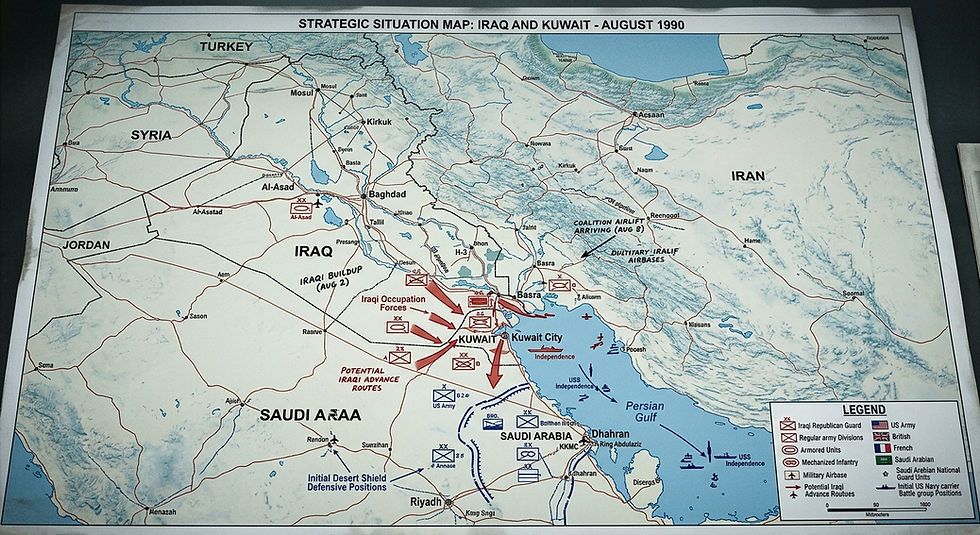
The Gulf War of 1991 was fought to reverse Iraq’s invasion of Kuwait—two states whose borders Britain drew.
The Iraq War of 2003 was fought to transform Iraq—an artificial state that could only be held together by authoritarianism—into a democracy. The result was predictable: the artificial state fell apart along the lines Britain had ignored. The cost: over 4,400 American lives, over 100,000 Iraqi civilian deaths, and trillions of dollars.⁶⁰
The Syrian Civil War involves a country France created, in which an Alawite minority rules a Sunni majority, using borders France imposed.
The ISIS phenomenon explicitly rejected Sykes-Picot, promising to restore the caliphate that the settlement had dismembered. When ISIS fighters bulldozed the Iraq-Syria border, they were making a political statement a century in the making.
The “ancient hatreds” we are told make the region ungovernable are not ancient. They are the modern consequences of modern decisions—decisions made by European diplomats in the second decade of the twentieth century, for European imperial purposes, without regard for the populations affected.
We cannot fix what we do not understand. We do not understand what we refuse to examine. And we refuse to examine the origins of the Middle East’s pathologies because doing so would implicate our allies, our policies, and our pretensions.
Conclusion: The Lines that Bind Us
The Middle East is not incomprehensible. It is the predictable result of imperial design.
States created to serve empires do not serve their peoples. Borders drawn without regard for the populations they enclose produce conflict. Promises made and broken generate grievances that persist for generations. Contradictions built into foundational documents—national home but not prejudice, independence but not really, self-determination but not for you—cannot be resolved because they were never meant to be resolved.
The founders of the American republic warned against exactly this kind of entanglement. Washington’s Farewell Address counseled against “permanent alliances” and “interweaving our destiny with that of any part of Europe.”⁶¹ Jefferson warned against “entangling alliances.”⁶² Madison warned that war would transform republics into engines of executive power.⁶³
We did not listen. We intervened in the European war that produced Sykes-Picot. We inherited the consequences when the European powers collapsed. We have been trying to manage those consequences ever since—always failing, always escalating, always finding new justifications for old entanglements.
The question is whether America can ever disentangle itself from the Sykes-Picot framework. Can we relate to the Middle East as it is, rather than as Europeans designed it?
Can we acknowledge that borders drawn by imperialists will never produce stability, that states created to serve foreign interests will never satisfy their peoples, that conflicts rooted in imperial betrayal cannot be solved by imperial intervention?
Or are we doomed to keep trying to stabilize instability?
The first step toward wisdom is acknowledging what was done and why. The lines were drawn by Sykes and Picot. The promises were made and broken by Balfour and McMahon. The states were created by Churchill and the Colonial Office. The consequences have been paid by millions of people—Arab, Kurdish, Jewish, Christian—who had no voice in the decisions that shaped their lives.
And by American soldiers, sent to fight in countries whose borders were drawn before their grandparents were born, for purposes they were never told, in conflicts they could not resolve.
The lines still bind us. Whether we choose to acknowledge them—or continue to pretend that the Middle East is simply incomprehensible—will determine whether we can ever escape them.
Self-Reflection Prompts
As you consider this history, ask yourself these questions:
ISIS’s propaganda explicitly invoked Sykes-Picot. Why do you think a century-old agreement still resonates in the region? What does this suggest about the durability of imposed borders—and about American assumptions that these borders are legitimate?
The Balfour Declaration promised a “national home” for Jews while protecting the rights of “existing non-Jewish communities.” Was this promise coherent? Could it have been implemented? What does its failure to satisfy either party tell us about the nature of such promises?
American policymakers often speak of “nation-building” in the Middle East. Given the origins of these nations—artificial constructions designed for imperial administration—what would successful nation-building actually require? Is it possible?
The Saudi alliance has provided oil and strategic partnership but also funded the global spread of extremist ideology. How should Americans weigh these costs and benefits? Is the alliance worth maintaining?
The founders warned against entanglement in European affairs. The Sykes-Picot settlement was the product of exactly such entanglement—America entered World War I, which enabled the settlement, which created the Middle East America has been trying to manage ever since. Does this history vindicate the founders’ warnings?
Endnotes
“The End of Sykes-Picot,” video released by Islamic State media arm, June 29, 2014. The video shows ISIS fighter Abu Safiyya bulldozing the Syria-Iraq border.
The phrase “Sick Man of Europe” is traditionally attributed to Tsar Nicholas I in conversation with the British ambassador in 1853, though the exact provenance is disputed. See Harold Temperley, England and the Near East: The Crimea (London: Longmans, 1936), p. 272.
For Ottoman territorial losses, see Eugene Rogan, The Fall of the Ottomans: The Great War in the Middle East (New York: Basic Books, 2015), chapters 1-2.
On the millet system, see Benjamin Braude and Bernard Lewis, eds., Christians and Jews in the Ottoman Empire: The Functioning of a Plural Society (New York: Holmes & Meier, 1982).
On Ottoman entry into WWI, see Mustafa Aksakal, The Ottoman Road to War in 1914 (Cambridge: Cambridge University Press, 2008).
Gallipoli casualty figures from Robert Rhodes James, Gallipoli (London: B.T. Batsford, 1965), p. 348.
The complete Hussein-McMahon Correspondence is available in George Antonius, The Arab Awakening (London: Hamish Hamilton, 1938), Appendix A.
McMahon to Hussein, October 24, 1915, in Antonius, The Arab Awakening, pp. 419-420.
The dispute over whether Palestine was included in the promises has never been resolved. See Isaiah Friedman, Palestine: A Twice-Promised Land? (New Brunswick: Transaction Publishers, 2000).
On the Arab Revolt, see Eugene Rogan, The Arabs: A History (New York: Basic Books, 2009), chapter 5.
T.E. Lawrence, Seven Pillars of Wisdom (1926; London: Penguin, 1962), p. 24.
The Constantinople Agreement of March 1915 promised Russia the city and the straits. See C.J. Smith, The Russian Struggle for Power, 1914-1917 (New York: Philosophical Library, 1956).
The Sykes-Picot Agreement was signed May 16, 1916. Text available in J.C. Hurewitz, ed., The Middle East and North Africa in World Politics (New Haven: Yale University Press, 1979), vol. 2, pp. 60-64.
For detailed analysis of the agreement’s terms, see James Barr, A Line in the Sand: The Anglo-French Struggle for the Middle East, 1914-1948 (New York: W.W. Norton, 2011), chapters 1-4.
David Fromkin, A Peace to End All Peace: The Fall of the Ottoman Empire and the Creation of the Modern Middle East (New York: Henry Holt, 1989), p. 286.
The “Acre to Kirkuk” line is described in multiple sources. See Barr, A Line in the Sand, p. 12.
Kurdish population estimates vary; twenty million is a conservative figure across Turkey, Syria, Iraq, and Iran. See David McDowall, A Modern History of the Kurds (London: I.B. Tauris, 2004).
Balfour Declaration, November 2, 1917. Original held in British Library.
Theodor Herzl, Der Judenstaat (Vienna, 1896), translated as The Jewish State.
First Zionist Congress, Basel Program, August 1897.
On Balfour’s personal views, see Jonathan Schneer, The Balfour Declaration: The Origins of the Arab-Israeli Conflict (New York: Random House, 2010), pp. 151-158.
Lloyd George statement quoted in Schneer, The Balfour Declaration, p. 342.
On mistaken beliefs about Jewish influence, see Fromkin, A Peace to End All Peace, pp. 294-297.
On British desire to exclude France from Palestine, see Barr, A Line in the Sand, chapter 3.
Palestine population figures from A Survey of Palestine, prepared by the British Mandate government for the UN Special Committee on Palestine (1946), vol. 1, p. 141.
On the deliberate ambiguity of “national home,” see Schneer, The Balfour Declaration, pp. 341-344.
Arthur Koestler, Promise and Fulfilment: Palestine 1917-1949 (London: Macmillan, 1949), p. 4.
The Bolsheviks published the secret treaties in Izvestia beginning November 23, 1917.
King-Crane Commission Report (1919), available in Foreign Relations of the United States: The Paris Peace Conference, 1919, vol. 12.
League of Nations Covenant, Article 22.
On the Battle of Maysalun, see Rogan, The Arabs, pp. 152-153.
On British use of airpower in Iraq, see David E. Omissi, Air Power and Colonial Control: The Royal Air Force, 1919-1939 (Manchester: Manchester University Press, 1990).
Churchill memo, May 12, 1919, quoted in Sven Lindqvist, A History of Bombing (New York: New Press, 2001), section 79.
Iraqi revolt casualty estimates from Charles Tripp, A History of Iraq (Cambridge: Cambridge University Press, 2007), p. 44.
On the strategic importance of Mosul oil, see Peter Sluglett, Britain in Iraq: Contriving King and Country (New York: Columbia University Press, 2007), chapter 3.
Treaty of Sèvres (1920), Section III, Articles 62-64, promised Kurdish autonomy; Treaty of Lausanne (1923) contained no such provisions.
On Sunni dominance in Iraq, see Tripp, A History of Iraq, chapter 2.
On Faisal’s installation as king, see Sluglett, Britain in Iraq, chapter 1.
On French creation of Lebanon, see Kamal Salibi, A House of Many Mansions: The History of Lebanon Reconsidered (Berkeley: University of California Press, 1988).
The National Pact of 1943 formalized Lebanon’s confessional system.
On French mandate policies in Syria, see Philip S. Khoury, Syria and the French Mandate: The Politics of Arab Nationalism, 1920-1945 (Princeton: Princeton University Press, 1987).
Alawite population percentage from Fabrice Balanche, “Sectarianism in Syria’s Civil War,” Washington Institute for Near East Policy, 2018.
On Churchill’s meeting with Abdullah, see Fromkin, A Peace to End All Peace, pp. 503-506.
On Jordan’s dependence on external support, see Avi Shlaim, Lion of Jordan: The Life of King Hussein in War and Peace (New York: Knopf, 2008).
Palestine demographic data from Survey of Palestine (1946), vol. 1, p. 141.
Arab Revolt casualty estimates from Matthew Hughes, “The Banality of Brutality: British Armed Forces and the Repression of the Arab Revolt in Palestine, 1936-39,” English Historical Review 124 (2009): 313-354.
King David Hotel bombing, July 22, 1946. Death toll from Thurston Clarke, By Blood and Fire: The Attack on the King David Hotel (New York: G.P. Putnam’s Sons, 1981).
UN General Assembly Resolution 181 (II), November 29, 1947.
Nakba refugee figures are disputed; 700,000 is a commonly cited estimate. See Benny Morris, The Birth of the Palestinian Refugee Problem Revisited (Cambridge: Cambridge University Press, 2004).
On the Saud-Wahhab alliance, see Madawi Al-Rasheed, A History of Saudi Arabia (Cambridge: Cambridge University Press, 2010), chapter 1.
On British support shifting from Hussein to Ibn Saud, see Gary Troeller, The Birth of Saudi Arabia: Britain and the Rise of the House of Sa’ud (London: Frank Cass, 1976).
Dammam No. 7 discovery, March 1938. See Daniel Yergin, The Prize: The Epic Quest for Oil, Money, and Power (New York: Simon & Schuster, 1991), pp. 291-292.
Roosevelt-Ibn Saud meeting, February 14, 1945. See William A. Eddy, F.D.R. Meets Ibn Saud (New York: American Friends of the Middle East, 1954).
Fifteen of nineteen hijackers were Saudi nationals per 9/11 Commission Report (2004), p. 231.
On Saudi funding of Wahhabi expansion, see Dore Gold, Hatred’s Kingdom: How Saudi Arabia Supports the New Global Terrorism (Washington: Regnery, 2003).
Scott Horton, Enough Already: Time to End the War on Terrorism (Libertarian Institute, 2021), chapters on Saudi connections to terrorism.
The “28 pages” on Saudi connections were declassified in July 2016.
On the Suez Crisis, see Keith Kyle, Suez: Britain’s End of Empire in the Middle East (London: I.B. Tauris, 2003).
Eisenhower Doctrine, Special Message to Congress, January 5, 1957.
Iraq War casualties: U.S. military deaths from Department of Defense; Iraqi civilian deaths from Iraq Body Count project (conservative estimate; other estimates significantly higher); cost estimates from Brown University Costs of War Project.
Washington’s Farewell Address, September 19, 1796.
Jefferson’s First Inaugural Address, March 4, 1801: “Peace, commerce, and honest friendship with all nations—entangling alliances with none.”
James Madison, “Political Observations,” April 20, 1795: “Of all the enemies to public liberty war is, perhaps, the most to be dreaded.”
Sources and Further Reading
Primary Sources
Hussein-McMahon Correspondence (1915-1916) — Available in Antonius, The Arab Awakening, Appendix A
Sykes-Picot Agreement (1916) — Text in Hurewitz, The Middle East and North Africa in World Politics
Balfour Declaration (1917) — British Library archives
King-Crane Commission Report (1919) — Foreign Relations of the United States
Treaty of Sèvres (1920) and Treaty of Lausanne (1923)
Secondary Sources
David Fromkin, A Peace to End All Peace: The Fall of the Ottoman Empire and the Creation of the Modern Middle East (1989) — The definitive account of how the modern Middle East was created
James Barr, A Line in the Sand: The Anglo-French Struggle for the Middle East, 1914-1948 (2011) — Focuses on British-French rivalry and its consequences
Eugene Rogan, The Arabs: A History (2009) — Comprehensive history from the Arab perspective
Jonathan Schneer, The Balfour Declaration (2010) — The origins of the Arab-Israeli conflict
From the Non-Interventionist Tradition
Patrick Buchanan, A Republic, Not an Empire (1999) — On the dangers of entangling commitments
Scott Horton, Enough Already: Time to End the War on Terrorism (2021) — On the regional consequences of American intervention
Ron Paul — Numerous speeches and writings on blowback from Middle East policy


Comments