top of page

Contemporary Application Podcasts
A weekly series of contemporary podcasts that connect the week's historical episode and article to current events. History is all around us and happening in real time, you just need to know where to look.

The Draft Was Never Repealed. Here Is What Changes in December
This December, Selective Service registration becomes automatic. The duty to sign up moves from the man to the government, and the agency that has to run it withdrew its implementing rules in July without ever publishing them.
6 days ago3 min read

Massie, Hegseth & the Epstein Petition: Why Congress Stopped Checking
This contemporary-application episode takes the question Episode 14 ended on — what happens to a constitutional design when the parts stop resisting each other — and puts it to the House of Representatives this month. In Federalist 51, Madison connected the interest of the man to the constitutional rights of the place. In his chapter on England, Montesquieu gave the legislature the means of examining how its laws are executed, and warned against a legislature a considerable t
Sep 223 min read

Socialist Calculation Debate Explained: Menger, Mises, Hayek and "I, Pencil" in 2026
Adam Smith wrote in 1776 that no human wisdom or knowledge could ever be sufficient to direct the industry of a nation. A century and a half later, other men turned that sentence into a formal argument. Carl Menger argued in 1871 that value sits in the person valuing, not in the object. Ludwig von Mises argued in 1920 that without private ownership of producer goods there are no exchange ratios for them, and so no way to weigh one use of a ton of steel against another.
Sep 153 min read

NYC Municipal Grocery Stores, the Rent Freeze, and Federal Equity Stakes: Hume's Knowledge Problem in 2026
Three cases, in ascending order of how hard they are to correct. The Rent Guidelines Board voted seven to one on June 25 under Order 58 to set adjustments at zero percent for both one-year and two-year renewal leases beginning October 1, covering roughly a million rent-stabilized apartments. The board is not a mob; it is a technical body that publishes seven separate research documents, one of which produced commensurate adjustment figures running from 3.4 to 8.5 percent. It
Sep 94 min read


A Tax Expired at Midnight. Another Took Its Place in the Same Minute.
Covers the fourth declaratory clause in full, the 1689 revenue settlement and the four-year customs grant, the first Mutiny Act and its seven-month life, Learning Resources v. Trump and the three-justice major questions plurality, Section 122 and Section 307, and the two bills now sitting in the Senate Finance Committee.
Sep 13 min read


In the Age of Trump and Biden, Victor Davis Hanson Is Wrong About Third Parties
I believe strongly in the value of minor parties and ensuring the coalitions built have a representation of your ideas and ideals. This message is missed in the episode I am responding to so I want to fill in the gaps and let users also understand the math of what it really means to “waste your vote” because it is not what you think.
Aug 293 min read

Scribere Est Agere: When a Government Turns Your Writing Into an Act
This hour names a British government, a Chinese government, and an American administration, and applies the same standard to each. It also declines the easy version of its own argument. The British non-crime hate incident regime was found unlawful by Britain’s own Court of Appeal in 2021, abandoned for investigation by the Metropolitan Police in October 2025, and the statutory basis for it was repealed by an Act of Parliament that received Royal Assent this April. The reform
Aug 183 min read

Fauci Contempt Vote Explained: The Fifth Amendment, the Pardon, and the Lois Lerner Precedent
This hour costs something. It defends a man I hold responsible for real harm, it criticizes Senator Rand Paul, who is on most days the best friend the Bill of Rights has in the Senate, and it turns on the movement and on me before it turns anywhere else. That is the point. The test this series always comes back to: did this leave us more free, or more governed?
Aug 113 min read

The Golden Metwand, Some Powers Were Never the Vote's to Give Away
This is Episode 8B of Self-Evident: The Road to 1776 — the Tuesday contemporary-application episode of Week 8, following Saturday’s Episode 8, “The Common Law Will Control,” on Sir Edward Coke and the Stuart struggle. Every episode of this series asks the same question of every consequential action: did this leave Americans more free, or more governed?
Aug 43 min read

Grotius, the Free Sea & the War Powers Debate: Hormuz, Bab al-Mandab & Article I
This is the contemporary-application episode for Week 7 of Self-Evident: The Road to 1776, and it takes Grotius off the page and holds him against our own moment — then follows the free-sea question to a harder one, closer to home. When the sea is contested and America turns to military force over it, who decides that we fight? The Constitution begins with a plain answer: Article I, Section 8 gives the power to declare war to Congress, not the President. This hour measures ou
Jul 283 min read
Who Actually Writes the Laws You Live Under? (It Isn't Congress)
Congress passed a statute, years or decades ago, that said something broad and pleasant, and then handed the real lawmaking to an agency the voter cannot reach. This is not a scandal in the ordinary sense. No one broke into the Capitol and stole the power to legislate. The strange and important truth at the center of this hour is that the power was given away.
Jul 213 min read

Censorship, the Printing Press, and Free Speech: Luther's Inheritance Today
Luther set two things loose at Worms: the sovereignty of the individual conscience, and the printing press that carried it past the gatekeepers by shattering an institution's monopoly on truth. This contemporary-application companion braids three modern threads onto that one spine. First, the two censorships of the pandemic era — the overt pressure of the State on private platforms, and the quieter soft-censorship that brands a reasonable question as a mark of bad character u
Jul 143 min read

Flock, Palantir & the Caribbean Boat Strikes: Due Process in 2026
What happens when the government decides to skip the courtroom and issue a death sentence via missile?
Since late 2025, over 200 people have been killed in secret U.S. military strikes on small boats. The military claims these are narco-terrorists, but admits they lack the evidence to actually hold or prosecute survivors in a court of law. It is a stark deprivation of life without due process, performed openly as state policy.
Jul 72 min read

Ellsberg, Snowden, Assange & the Espionage Act of 1917
Who tells us what we were not supposed to know? On Saturday we met that figure in his oldest form — the Hebrew prophet who walks up to the king with no army and says "thou art the man." This episode meets him in ours: Daniel Ellsberg, Edward Snowden, Julian Assange — and the single 1917 law turned against all three, not for selling secrets to enemies, but for telling Americans what their own government was doing. Underneath runs the deeper argument of the series: the Constitu
Jun 302 min read

What the Classics Teach About Democracy
Saturday’s episode drew from Aristotle, Polybius, and the Founders the idea of the mixed constitution — the one, the few, and the many in balance — and insisted that the democratic element had to be genuinely popular for the whole structure to hold. This contemporary application episode asks whether our own “people’s house” still carries the voice of the people, and argues that it has been narrowed by two mechanisms: the cap of 435 members frozen in 1929, which has stretched
Jun 232 min read

Why This History Matters Now
What is the difference between a right and an entitlement? This contemporary application episode takes the concept of natural rights inherited by the American Founders — introduced on Saturday in “The Golden Thread” — and applies it to the most consequential category confusion in modern politics: the belief that a government benefit funded by other people’s labor is a right. Using the 2026 Social Security solvency debate as its spine, the episode walks the hardest case honest
Jun 162 min read

What Are Sanctions — Do They Work, and Who Pays the Price
The covert action toolkit under fire after revelations of extra-constitutional actions during the Church committee hearings and reports of 1975-76, have been expanded to include economic instruments that are viewed as "soft" power, but cause much more widespread damage. The substitution thesis posits that regime change objectives never faded after the revelations, rather the foreign policy establishment just exchanged paramilitary activity with primary and secondary sanctions
May 122 min read
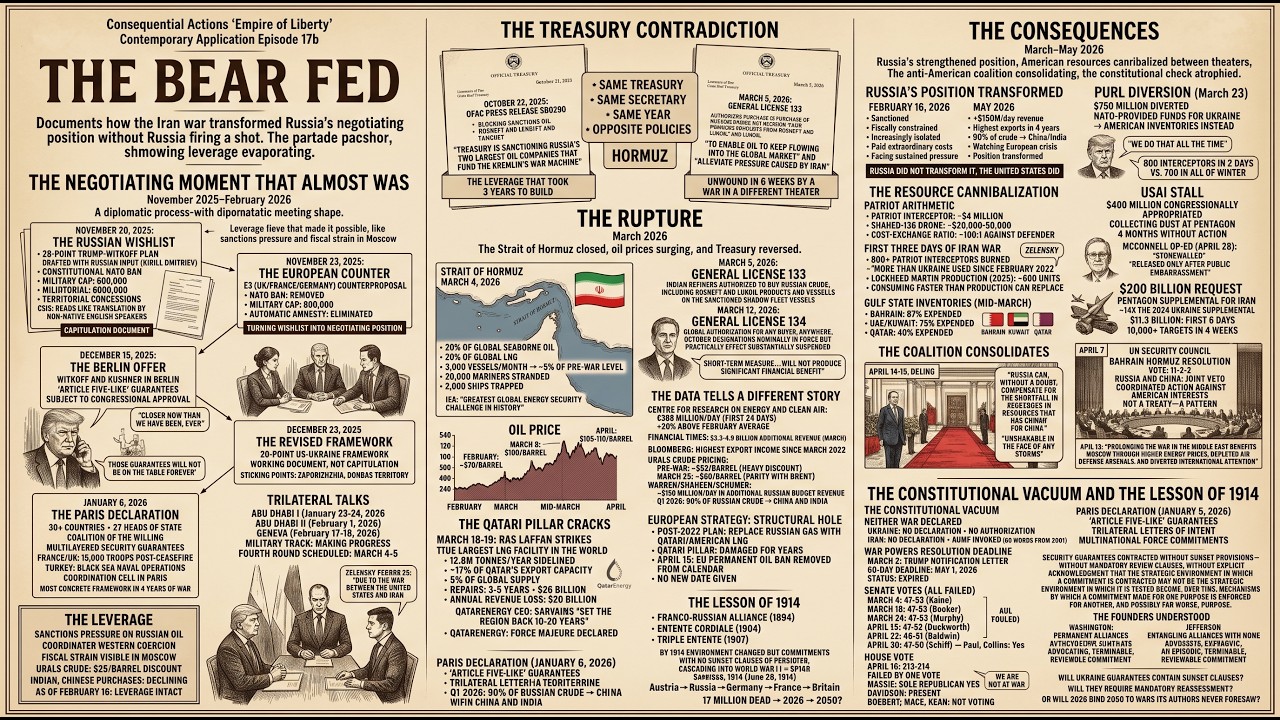
The Bear Fed — How the Iran War Handed Russia the Negotiating Position It Could Not Win on the Battlefield
This contemporary application episode examines the Russo-Ukrainian peace negotiations from the perspective of how the Iran war, launched on February twenty-eighth, 2026, materially altered the negotiating landscape in Russia’s favor.
May 52 min read

Whose Liberation, Whose Loss? — The Pattern of Intervention’s Aftermath, From Baghdad to Tehran
This contemporary application episode tests the central moral claim of American interventionism — that war can liberate populations — against the historical record of the past quarter century. Walking through Iraq, Libya, Afghanistan, and Syria in narrative form, the episode documents the consistent pattern: ancient Christian communities devastated, women’s lives constrained or destroyed, moderates eliminated, countries economically and physically wrecked.
Apr 281 min read

The People’s House? — The Engineered Paradox and How Congress Built a Machine Against Accountability
This contemporary application episode rejects the conventional framing of the congressional accountability “paradox” — the fifteen percent approval rating alongside the ninety-seven percent incumbent reelection rate — and argues instead that the gap is the engineered output of a machine that Congress has deliberately built to insulate itself from accountability.
Apr 211 min read
bottom of page