The Adjective and the Noun — What "Libertarian" Means When It Stands Alone, and What Happened When It Became a Party

“In the United States, where it has become almost impossible to use “liberal” in the sense in which I have used it, the term “libertarian” has been used instead. It may be the answer; but for my part I find it singularly unattractive. For my taste it carries too much the flavor of a manufactured term and of a substitute. What I should want is a word which describes the party of life, the party that favors free growth and spontaneous evolution. But I have racked my brain unsuccessfully to find a descriptive term which commends itself.”— Friedrich A. Hayek, The Constitution of Liberty, postscript “Why I Am Not a Conservative” (1960)¹
Later this month, up to 1,045 delegates, along with alternates, activists, speakers, vendors, and observers, will gather in Grand Rapids, Michigan, for the 2026 Libertarian National Convention. The convention will run May 21 through May 25 at the Amway Grand Plaza and DeVos Place complex. Because 2026 is not a presidential election year, delegates will not nominate a presidential ticket; they will conduct party business, consider platform and bylaws changes, and elect officers for the next two-year cycle.²
This three-part feature exists to ask what should happen there, what is likely to happen there, and what either outcome would mean. The first piece cannot begin at the convention. It has to begin at a distance from the convention, with the most basic question: what is being claimed, and by whom, when someone uses the word libertarian?
The Adjective That Came First
Last year as part of this project, in the series titled Parties, Ideologies, and Systems, the central analytical move was to separate three things American political vocabulary habitually confuses.
Parties are coalitions: shifting electoral combinations of interest groups, factions, and pragmatists, held together by the prospect of winning.
Ideologies are coherent belief systems: structured commitments about human nature, the moral status of force, the source of legitimate authority, and the proper scope of government.
Systems are structural arrangements — capitalism, socialism, mercantilism — institutional forms which can be defended on incompatible grounds.
Most of what passes for political argument in America fails because the parties to the argument are using a single label to mean two or three different things at once.
Libertarian is exactly that kind of word.
Written with a lowercase l, the word names an ideology. That ideology and its traditional-based antecedents are older than the United States, older than the Enlightenment that produced the United States, older than the modern English language in which we now use it. It is a coherent set of commitments — about self-ownership, about the use of force, about the source of governmental authority, about the conditions under which obligation can be morally binding — drawn from a tradition articulated and refined across roughly twenty-five centuries.
Written with a capital L, the word names a coalition. The coalition was organized at a meeting on December 11, 1971, at the home of David Nolan in Westminster, Colorado, in immediate response to a specific economic and political crisis.³ It has continued in unbroken legal existence since, but it has not been the same coalition continuously. It has migrated across the ideological map at least three times in fifty-five years, and it is migrating again as this article goes to press.
The tradition the lowercase l now names predates the capital L by approximately twenty-four hundred years. The capital L predates this article by less than three generations. This is the foundation of what follows. The relationship between the two is the relationship between a tradition and an institution — between a body of thought and one organizational vessel that has, for some portion of its history, attempted to carry that body of thought into electoral politics. The tradition does not depend on the institution. The institution depends on the tradition. When the institution is well-aligned with the tradition, it does honor to the name. When it is not, then the meaning is … less.
Much of the political illiteracy that surrounds the word arises from a failure to keep these two things separate. Critics of the Libertarian Party are routinely treated by their opponents as critical of libertarianism, the ideology, as though the institutional choices of an organization in the 2020s reflect the philosophical claims advanced by John Locke in 1689 or by Frédéric Bastiat in 1850. Defenders of the Libertarian Party, similarly, sometimes lean on the philosophical heritage of the lowercase l as a guarantee of the moral standing of the capital L — as though the lineage from Cicero to Rothbard had vested in this particular incorporated entity in 1971 and could not be compromised.
Both moves are mistakes. The remainder of this article exists to keep the adjective and the noun separate. The first half treats the adjective: the idea, the lineage that produced it, and the live conversations within it. The second half treats the noun: the party, what produced it, what it has been across five decades, and what it is at the moment Grand Rapids approaches.
First Principles
The libertarian idea, reduced to its core commitments, can be stated in a single page. The philosophy is not complicated. Its complications arise only when its simple commitments meet the friction of the real world.
The foundation is self-ownership. Each individual owns himself or herself — not as a matter of policy preference, but as a matter that precedes politics altogether. The body, the labor, the choices, the moral life — these belong to the person who lives them. They do not belong to a clan. They do not belong to a state. They do not belong to a majority that happens to have prevailed in a recent election. To argue otherwise is to revive a position that mankind spent several thousand years escaping — a position the libertarian rejects on principle, and one few moral philosophers in the modern era have been willing to defend in plain language.⁴
From self-ownership comes the non-aggression principle. The initiation of force against another person, or against another person’s legitimately held property, is the basic moral wrong from which most political crimes descend. Murder, assault, theft, fraud, kidnapping, rape — these are wrong not because a statute names them so, but because they violate something prior. Statutes that authorize aggression — and many do, when the aggression is conducted under official letterhead — do not transform the moral status of the act. They license it. They conceal it under a uniform. They give it the dignity of a procedure. They do not change what it is.⁵
If aggression is the basic wrong, then human cooperation, to be morally legitimate, must rest on something else. The libertarian’s answer is consent. Trade, contract, association, marriage, employment, religious community — every form of human cooperation under which civilization has actually flourished — is built on voluntary exchange. Each party judges that the exchange improves their position. If either party did not so judge, the exchange would not occur. The aggregate result of countless voluntary exchanges is the wealth, the cultural achievement, and the social order we inherit and pass on. The aggregate result of countless coerced exchanges is what civilization has spent its better moments trying to escape.⁶
These two commitments together — self-ownership and the non-aggression principle — produce the libertarian view of government. Government is not a parent. It is not a partner. It is not the source of rights. It is, on the libertarian account, a derivative agent — an institution that exists, where it legitimately exists at all, only because individuals possessing prior rights have delegated certain narrowly defined functions to it. And because individuals cannot delegate authority they do not themselves possess, government cannot rightly do what an individual could not rightly do.
This is not a slogan. It is a logical proposition. A delegated agent’s authority cannot exceed the authority of the principal. If a man does not have the authority to take his neighbor’s property by force, he cannot vest that authority in an agent. If ten men do not have it, ten million voters do not have it. Numbers do not create rights. Adding a ballot box to ten thousand individual acts of theft does not change the moral status of the underlying act.
Apply this in three steps and it becomes the Liberty Test.
First, ask whether an individual could morally do this thing to another individual. If the answer is yes, the act is permissible, and the question of who performs it becomes secondary.
If the answer is no, ask whether some group of individuals could delegate this power to government. The libertarian’s answer is that they could not. The delegation is mathematically impossible: a power no individual possesses cannot be transferred to an agent merely by aggregating individuals who do not possess it.
Therefore the act remains aggression regardless of who performs it. A badge does not transform the act. Neither does a robe, a uniform, a majority vote, or an official title.⁷
This recurring framework — sometimes summarized in the phrase fancy hats and larger mobs do not change ethics — runs throughout the second part of this body of work, Self-Evident: The Road to 1776, which traces how thinkers from Cicero through Locke through Jefferson worked out the same insight in their own languages and their own centuries.
If government is a derivative agent, the libertarian’s skepticism of power follows naturally. Lord Acton’s observation that power tends to corrupt was not a warning to bad people. It was a warning to good people. The libertarian assumes that those who acquire power are no better and no worse, on average, than those who do not, and designs institutions on the working assumption that the worst person who could plausibly fill an office will fill it eventually. The institution must be constructed to fail safely under that condition.
From skepticism of central authority comes libertarian respect for spontaneous order. The world is too complicated to be designed by a planner. The knowledge required to govern productively is distributed across millions of minds, none of which could in principle hold it all at once. F. A. Hayek’s argument in “The Use of Knowledge in Society” — that the price system is, among other things, an information system — is the canonical statement of the case.⁸ Languages, common law, scientific norms, customs of trade — these things were built by no one in particular and govern the lives of millions. They cannot be replicated by a committee. They certainly cannot be replaced by a committee without catastrophic loss.
And finally, methodological individualism. Society is not an organism. It is not a tribe. It is not a class. Society is the lives of individual men and women, conducted in cooperation with one another. There is no national interest separate from the interests of the individuals who comprise the nation. There is no general will separate from the wills of the actual individuals who hold them. Aggregations are tools of analysis. They are not moral agents. The morally relevant unit is the individual. The morally relevant question is whether individuals are more free or more governed.
These are the basics. From them, every recognizable libertarian position is derived: free trade and the suspicion of tariffs, sound money and the critique of central banking, free movement as a matter of free contract, free speech as a matter of self-ownership extended to thought and expression, free association as a matter of freedom from compelled cooperation, the suspicion of standing armies and entangling alliances, the rejection of taxation as anything other than a coercive transfer, the commitment to peaceful coexistence with peoples whose lives are not ours to direct.
Within the natural-rights strand of the tradition, reasonable libertarians disagree on the application. They do not disagree on the foundation.
The Intellectual Lineage
The libertarian idea is sometimes treated, by its critics and occasionally by its proponents, as an American novelty. It is not. Its origins are far older than the American founding, and its development has run through many hands and many centuries. The lineage that follows is a sketch — the headlines, no more — and Self-Evident: The Road to 1776 will treat each of these moments in depth across twenty-two articles. For present purposes, what matters is that the lowercase-l is a tradition.
Cicero and the Stoics. The Roman orator and constitutionalist Marcus Tullius Cicero, writing in De Re Publica and De Legibus in the first century before Christ, articulated the doctrine of natural law: that there is a higher standard of justice that exists independently of any positive enactment, by which positive enactments must themselves be measured. The Stoic tradition on which Cicero drew taught the universality of human reason and the cosmopolitan unity of the human race under that reason. Both ideas are foundational to every later natural-rights argument. Cicero died for the Republic he served — killed on the orders of Mark Antony, his head and hands afterward displayed on the rostra from which he had spoken against him — defending, in the most literal sense, the proposition that there is a higher law than the will of the man with the army.⁹
Aquinas and natural law. Thomas Aquinas, writing in the thirteenth century, integrated Aristotelian philosophy with Christian theology and produced the most sophisticated medieval treatment of natural law. The Thomist position — that human reason can discern principles of justice that bind the conscience independently of the commands of any earthly ruler — supplied the moral grammar by which later thinkers would defend the proposition that an unjust command is no law at all. The School of Salamanca in sixteenth-century Spain, particularly through Francisco de Vitoria and Francisco Suárez, would carry this tradition forward, pioneering arguments about subjective rights, the limits of conquest, and the foundations of property which Hugo Grotius and John Locke would inherit a century later.¹⁰

Magna Carta and the Levellers. In 1215, English barons compelled King John to sign a charter limiting royal authority and establishing certain procedural protections — the seed, four centuries before its full flowering, of due process. The seventeenth-century English Civil Wars produced the Levellers — John Lilburne, Richard Overton, William Walwyn — who argued in pamphlets and at the Putney Debates of 1647 for popular sovereignty, religious toleration, an end to legal privilege based on station, and a written constitution. They lost in their immediate political moment. They won across centuries: their language and their arguments were absorbed by the Whig tradition that produced the Glorious Revolution and, a century later, the American Revolution.¹¹
Locke, Sidney, and the Commonwealthmen. John Locke’s Two Treatises of Government, published in 1689/1690 in the aftermath of the Glorious Revolution, became the most influential single statement of the natural-rights argument in English. The state of nature, the law of nature, the rights of life and liberty and property, the social contract, the right of revolution against tyranny — this is the language the American founders would use because it is the language Locke had given them. Algernon Sidney, executed in 1683 for the manuscript of his Discourses Concerning Government, taught that resistance to tyranny was not merely a right but a duty. The eighteenth-century Commonwealthmen — Trenchard and Gordon’s Cato’s Letters, the writings of Bolingbroke, the historical and constitutional works of James Burgh — provided the immediate revolutionary vocabulary the American colonists deployed in the 1760s and 1770s.¹²
Jefferson, Madison, Mason, and the Anti-Federalists. The American founding is itself a chapter in this lineage, not its origin. Thomas Jefferson, drafting the Declaration of Independence, was, as he wrote near the end of his life, expressing the harmonizing sentiments of the day rather than offering a new philosophy.¹³ James Madison drafted much of the Constitution from libraries of ancient and modern confederacies that Jefferson had shipped him from Paris. George Mason, drafting the Virginia Declaration of Rights in June 1776, gave Jefferson much of the language of unalienable rights that would appear in the Declaration of Independence three weeks later. The Anti-Federalists — particularly the writers using the pseudonyms Brutus and Federal Farmer — supplied the most penetrating critique of the proposed Constitution, warning that its powers would consolidate in the central government and produce, eventually, the very tyranny the Revolution had been fought to escape. The Bill of Rights was, in considerable measure, the Federalists’ concession to those warnings.¹⁴
Bastiat, Tocqueville, Spencer. In the nineteenth century the lineage moved largely to Europe. Frédéric Bastiat, writing in France in the years before his death in 1850, produced The Law — the most accessible single statement of the libertarian view of legitimate government ever written — and a series of essays, including “What Is Seen and What Is Not Seen” and “The Petition of the Candlemakers,” that remain the gold standard of free-market polemics. Alexis de Tocqueville’s Democracy in America warned, with particular acuity, about the tendency of democratic states toward soft despotism and administrative centralization. Herbert Spencer, in The Man Versus the State (1884), produced one of the late nineteenth century’s sharpest critiques of the new collectivist tendency rising on both sides of the Atlantic.¹⁵
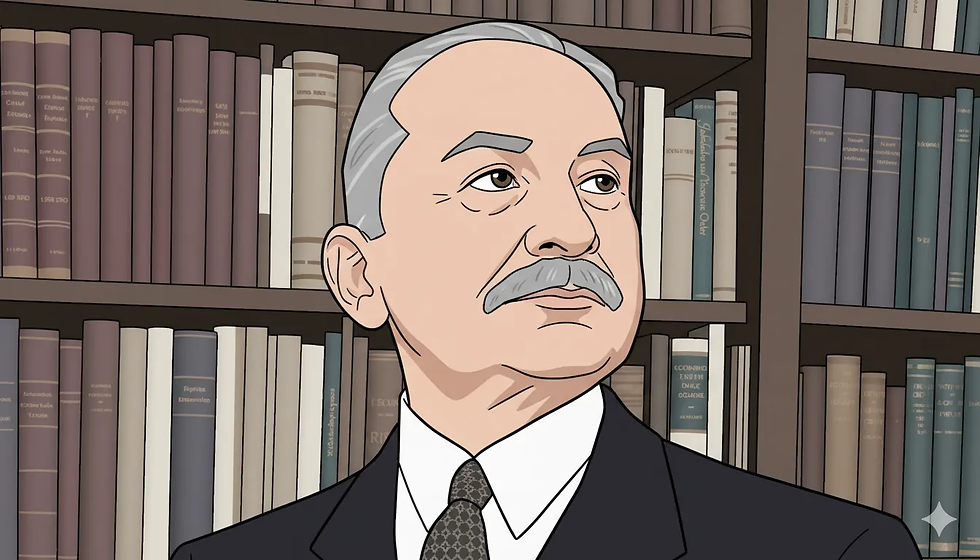
Mises, Hayek, Rothbard. The twentieth-century revival of the libertarian tradition was led, in considerable measure, by economists working in or descended from the Austrian school. Ludwig von Mises, writing in Vienna and later in New York, produced Socialism (1922), Liberalism (1927), and Human Action (1949). Between them, those three books constituted the most rigorous defense of the market economy and the most penetrating critique of central planning the century would produce. Friedrich Hayek’s The Road to Serfdom (1944) brought the Austrian critique of economic planning to a popular audience. Hayek’s later Constitution of Liberty (1960), from whose postscript this article’s epigraph is taken, gave the most sophisticated mid-century philosophical defense of the free society. Murray Rothbard, working in the second half of the century, drew the implications of the Austrian and natural-law traditions to their logical conclusion in For a New Liberty (1973) and The Ethics of Liberty (1982), and built the institutional infrastructure of late twentieth-century American libertarianism through the Mises Institute and his many students.¹⁶
Friedman and Nozick. From outside the strict Austrian tradition, two other twentieth-century figures shaped the public reception of the libertarian idea. Milton Friedman made the case for free markets at Chicago and in books like Capitalism and Freedom (1962) and Free to Choose (1980). His record on policy detail, however — particularly the wartime design of income tax withholding — earned him sharp and well-deserved criticism within the broader tradition.¹⁷ Robert Nozick, the Harvard philosopher whose Anarchy, State, and Utopia (1974) was a direct response to John Rawls, produced the most influential modern academic defense of the minimal state and remains required reading in any serious political philosophy program. Friedman expanded the audience. Nozick legitimized the position within the academy.
Ron Paul, Hoppe, and the present. In the late twentieth and early twenty-first centuries, the public face of American libertarianism has been, more than any other person, Congressman Ron Paul of Texas — physician, twelve-term member of the House of Representatives, twice the Republican primary candidate whose presidential campaigns brought a generation of young Americans to the works of Mises, Rothbard, and Hayek. Hans-Hermann Hoppe, working at the University of Nevada, Las Vegas, has extended the Rothbardian tradition into argumentation ethics and the analysis of democracy as a system of public ownership of the state.¹⁸ Beneath those names is a wider movement: Lew Rockwell, Tom Woods, Scott Horton, Jeff Deist, Judge Andrew Napolitano, Dave Smith, Michael Malice, and dozens of others working through the Mises Institute, the Libertarian Institute, antiwar.com, the Cato Institute, the Reason Foundation, and a thousand independent voices on the platforms that have replaced the legacy media. The lineage is unbroken. It is also alive.
The lowercase-l is not an American invention. It is not a 1971 invention. It is not a faction. It is a tradition. The party that bears its name is one institutional expression of that tradition, founded under specific circumstances which the next sections will examine. It is not the source of the tradition. It is, at most, an heir.
The Internal Conversations
A tradition that has lasted twenty-five centuries does not lack internal disagreement. Five conversations within the libertarian tradition are worth flagging here, because each of them will recur in the second piece of this feature. The point of flagging them now is to establish that they are arguments inside a shared frame, not arguments about whether the frame should be honored at all.
The minarchist–anarchist conversation. Some libertarians believe that the legitimate scope of government, while strictly limited, is nonzero. The state, on this minarchist view, should be confined to defense, courts, and the protection of basic rights against violation. Others — the anarcho-capitalists, of whom Murray Rothbard was the most influential expositor — argue that even these functions can in principle be supplied by competing private institutions, and that the historical record of states monopolizing the use of force is so consistently catastrophic that maintaining any state at all is a concession the libertarian tradition need not make. Within the Libertarian Party itself, the famous Dallas Accord, reached at the 1974 national convention in Dallas, was a working compromise: the platform would not formally take a position on whether the legitimate state was minimal or zero, leaving both positions welcome under the party tent. The accord held, with strain, for decades.¹⁹
Thick versus thin. A more recent argument concerns the cultural and social commitments libertarianism does or does not entail. The “thin” libertarian holds that libertarianism is exhausted by its political claims — the non-aggression principle, property rights, free exchange — and is silent on what kind of culture, family structure, or social attitude follows from those claims. The “thick” libertarian, by various definitions, holds that libertarianism either entails or naturally accompanies further commitments: to anti-racism and secular tolerance on some accounts, to traditional family structure and religious community on others. The argument is not whether the non-aggression principle is binding. The argument is whether anything else is.²⁰
Paleolibertarian versus cosmopolitan. Closely related but not identical: whether libertarianism is best paired with cultural conservatism, traditional family structures, regional and religious particularism — or with cosmopolitanism, secularism, and an explicit rejection of inherited cultural forms. The paleolibertarian tradition — associated with Rothbard’s late writings, Lew Rockwell, the Mises Institute, and Pat Buchanan in his anti-interventionist register — holds that the institutions of liberty cannot survive in a society whose cultural and moral capital has been depleted. The cosmopolitan tradition — associated with much of the academic and Reason-magazine wing of the movement — holds that liberty travels independently of any particular culture, and is in fact threatened, at least sometimes, by efforts to attach it to one.²¹
Pragmatist versus doctrinaire. Within any movement that engages electoral politics, the question arises of how much of the doctrinal position can be deferred or compromised in the pursuit of intermediate gain. The pragmatist holds that politics is the art of the possible, and that incremental movement toward libertarian outcomes is preferable to articulate stagnation. The doctrinaire holds that the doctrine is the point — that compromises which dilute the doctrine cease to advance the cause they purport to serve, and that the value of having a libertarian voice in public life lies precisely in its refusal to soften. This argument has been rehearsed at every Libertarian Party convention since 1972, and it will be rehearsed at Grand Rapids.
The immigration question. No internal conversation has been more contested across the past decade. The libertarian commitment to free movement and free contract has been read by some thinkers — Bryan Caplan most prominently, but also the older Reason-magazine and Cato-Institute consensus — as entailing open borders. The libertarian commitment to private property rights has been read by others — Hans-Hermann Hoppe most prominently, but also the paleolibertarian tradition more broadly — as entailing that mass migration into a country whose borders, public spaces, and welfare-state apparatus are not voluntarily owned constitutes a form of coerced association at the expense of the actual rightful claimants.²² Both positions appeal to recognizably libertarian first principles. They reach different conclusions about how those principles apply when the territorial state is the thing whose policies are at issue.
These are the live conversations. They are not the boundaries of the tradition. They are the arguments inside the tradition. The second piece of this feature will examine how these conversations have crystallized into specific factions within the Libertarian Party itself, and how those factions are likely to be tested at Grand Rapids. For the moment, what matters is the framing. A vigorous internal conversation is a sign of life, not of incoherence. A tradition that does not argue with itself has stopped thinking. The lowercase-l has not stopped thinking.
The Party Born in Rebellion
On August 15, 1971, President Richard Nixon announced from the Oval Office a package of measures historians have come to call the Nixon Shock. He closed the gold window, severing the last link between American currency and any physical store of value. He imposed a ninety-day freeze on wages and prices. He imposed a ten percent surcharge on imports. The combination amounted to the most aggressive peacetime intervention in the American economy since the New Deal. Any prior generation would have recognized it for what it was: a confession that the postwar Bretton Woods monetary order had failed, and that the federal government intended to manage the consequences by direct economic command rather than by reform.²³
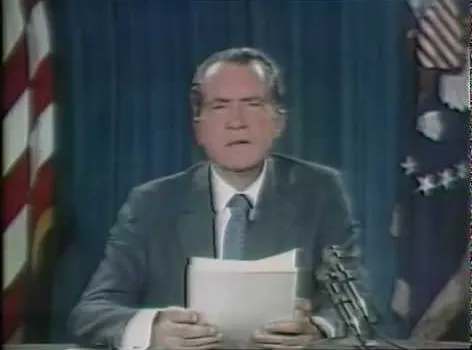
What galvanized libertarians, and others outside the Keynesian and Nixonian establishments, was not only what Nixon did but what he had said earlier that year. In an interview with the broadcaster Howard K. Smith aired in January 1971, Nixon was reported to have remarked: “I am now a Keynesian in economics.” A self-styled fiscal conservative and Republican president had openly disclosed that, in the matter of money and economic management, he had abandoned the position the Republican Party had nominally claimed for half a century, and had embraced the position of the chief intellectual architect of the postwar managed economy.²⁴ For libertarians, the August intervention was not the surprise that political historians sometimes describe. It was the predicted consequence of a confession already made.
In the months that followed, conversations among free-market activists, Goldwater veterans, Objectivists, Misesians, constitutionalists, and refugees from the 1969 Young Americans for Freedom split converged on a single conclusion. The Republican Party was not going to defend liberty. The Democratic Party had abandoned that pretense decades earlier. If liberty was going to have an organized political voice in American electoral life, it would need a vehicle of its own.
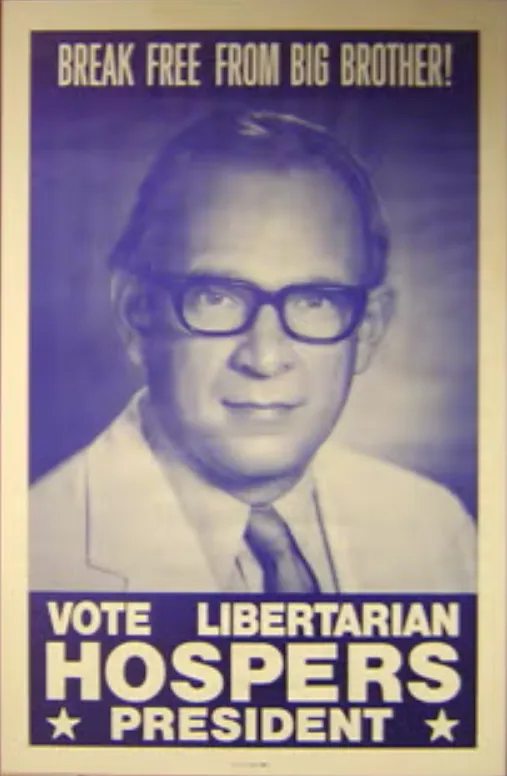
The vehicle was constructed, in its first form, in the living room of David Nolan in Westminster, Colorado, on December 11, 1971. Nolan, a libertarian writer and activist, had assembled approximately a dozen like-minded individuals — among them his then-wife Susan, John Hospers, a philosophy professor at the University of Southern California, and Theodora Nathan, a journalist from Eugene, Oregon, known to her friends as Tonie. The group voted to form a new political party. Within weeks they had drafted a Statement of Principles which, with some modifications, remains the philosophical foundation of the party to this day. The first national convention was held in Denver in June 1972.²⁵
The party’s first presidential ticket consisted of Hospers, whose 1971 book Libertarianism: A Political Philosophy for Tomorrow had supplied much of the new party’s intellectual scaffolding, and Nathan, his running mate. The ticket appeared on the ballot in only two states — Washington and Colorado — and received fewer than four thousand votes nationwide. By any conventional electoral measure, the campaign was negligible.²⁶
It was not negligible, however, in the manner that mattered.
On December 18, 1972, a Republican presidential elector from Virginia named Roger MacBride, who had been pledged to cast his electoral vote for the Nixon-Agnew ticket, declined to do so. He cast his electoral vote instead for Hospers and Nathan. The decision made Tonie Nathan the first woman in American history to receive an electoral vote — twelve years before Geraldine Ferraro became the first woman nominated for vice president on a major-party ticket, and forty-eight years before Kamala Harris was elected vice president. It was also the first electoral vote ever cast for a Libertarian Party ticket.²⁷ MacBride himself would become the Libertarian Party’s presidential nominee in 1976, where he would receive 173,000 votes — a fortyfold increase over the 1972 ticket — and demonstrate that the institutional fact of the party was real, and that it would persist beyond a founding moment.
The pattern of the party’s birth deserves notice. It was not founded in good times. It was not founded by people seeking a comfortable expression of an established consensus. It was founded by people who looked at the dominant political vehicles of 1971 — the Republican Party that had just confessed itself Keynesian, and the Democratic Party that had spent forty years building the architecture Nixon was, in his own way, ratifying — and concluded that the libertarian idea no longer had a home in either. The capital-L, in its first form, was the institutional refusal to be a Keynesian. It was the dissent given organizational shape. That is what should be remembered when its later forms are examined.
What the party has been since that founding moment is a more complicated story.
Five Decades of the Vehicle
What follows is a compressed account of the Libertarian Party’s institutional history. The fuller forensic account — the assessment of which factions delivered which results, of which strategic choices proved sound and which did not — belongs to the second piece of this feature. The purpose here is to establish a basic chronology.
The doctrinal era (1971–1979). The first decade of the party was an extended argument about who the party was. The 1972 Hospers–Nathan ticket established the basic question: was the party to be a vehicle for the broadest possible coalition under a libertarian banner, or for the most rigorous application of libertarian first principles to public policy? The 1974 Dallas Accord answered a related but separate question: whether minarchists and anarchists could coexist within the same party. They could, the convention determined, provided the platform itself remained agnostic on whether the legitimate state was minimal or zero. The 1976 MacBride campaign demonstrated that the institutional party could survive its founding personnel.²⁸
Ed Clark and the high-water mark of the era (1980). Clark’s 1980 campaign, with David Koch as his running mate and substantial Koch family financial support, received 921,128 votes — approximately 1.06 percent of the national total. That figure would stand as the Libertarian Party’s high-water mark for thirty-six years. The Clark campaign demonstrated, more clearly than any prior effort, both the size of the audience the libertarian message could reach and the structural ceiling that ballot access laws, debate exclusion rules, and media indifference would impose on any third party. It also exposed an internal fault line. Clark’s relatively moderate, mainstream-friendly positioning drew sharp criticism from the doctrinaire wing of the party — Murray Rothbard most prominently — who would shortly thereafter leave the LP altogether for several years.²⁹
The lean years and the Paul intervention (1984–1988). The 1984 nomination of David Bergland produced 228,000 votes — a steep retreat from the Clark high. Then, in 1988, an event occurred whose significance has been re-examined repeatedly since. Ron Paul, a former three-term Republican congressman from Texas who had broken with his party over its abandonment of fiscal restraint and constitutional limits, sought the Libertarian Party presidential nomination. He won it on the first ballot, defeating among others the American Indian Movement leader Russell Means. The Paul ticket received 432,000 votes nationally — short of Clark’s total in absolute terms, but arguably more substantive in its ideological coherence. More importantly, the 1988 campaign began the long process by which Ron Paul would become, over the next thirty years, the most consequential public face of the libertarian idea in American life — though most of that influence would be exercised, after 1988, from within the Republican Party rather than the Libertarian Party.³⁰
The Browne years (1996, 2000). Harry Browne, a financial author whose libertarian convictions had been formed in the post-Goldwater intellectual ferment, secured the LP nomination twice. The Browne campaigns are remembered, by libertarians who lived through them, as a period of unusual philosophical clarity. Browne ran on a doctrinaire platform — abolition of the income tax, withdrawal from foreign entanglements, end of the drug war, restoration of sound money. His vote totals were modest in raw numbers (485,000 in 1996, 384,000 in 2000), but his speeches, debates, and books offered the most coherent statement of the libertarian position any major LP candidate would deliver until Ron Paul’s Republican primary campaigns of 2008 and 2012.³¹
The drift toward the establishment (2004–2012). The 2004 nomination of Michael Badnarik, a constitutional scholar without major-party experience, produced 397,000 votes. The 2008 nomination of Bob Barr — a former Republican congressman from Georgia who had voted for the Patriot Act and authored the Defense of Marriage Act before re-evaluating his record — was a deliberate effort to broaden the party’s appeal by recruiting a name with prior elected experience. The result was 524,000 votes: a modest gain in raw terms, though one many doctrinaire libertarians considered ideologically expensive. The 2012 nomination of Gary Johnson, a former two-term Republican governor of New Mexico, continued the trend. Johnson received 1.28 million votes — the LP’s best showing to that date — by nominating a candidate whose libertarianism was, by Browne or Paul standards, decidedly thin. The strategic question — whether the party should optimize for raw vote totals or for ideological coherence — had been answered, at least at the convention level, in favor of vote totals.³²
Johnson-Weld and the peak (2016). In 2016, with both major parties offering historically unpopular candidates, Gary Johnson sought the LP nomination a second time. He chose as his running mate Bill Weld, a former Republican governor of Massachusetts whose libertarianism was thinner still than Johnson’s own. The Johnson-Weld ticket received 4,489,221 votes — 3.28 percent of the national total. That was more than triple the Ed Clark high of 1980. It was the largest Libertarian Party vote in absolute and percentage terms in the party’s history. The campaign was simultaneously the most ideologically diluted presentation the party had ever offered. Johnson struggled visibly with foreign policy questions. Weld, in the campaign’s closing weeks, effectively endorsed Hillary Clinton. The platform-level concessions made to attract major-party defectors drew sustained criticism from the doctrinaire wing.³³ The same year that produced the party’s electoral peak produced its sharpest internal crisis of identity. Both the peak and the crisis were the same event.
The Mises Caucus forms (2017–2018). In the immediate aftermath of the 2016 campaign, a group of activists associated with the Mises Institute, the Tom Woods podcast audience, the Ron Paul movement remnant, and the broader paleolibertarian tradition began organizing within the Libertarian Party to redirect it toward what they regarded as its founding doctrinal commitments. The proximate trigger was a series of public conflicts between the LP’s then-chairman Nicholas Sarwark and his vice-chair Arvin Vohra, on the one hand, and the leadership of the Mises Institute on the other — particularly over Mises Institute president Jeff Deist’s 2017 speech “For a New Libertarian,” which had drawn Sarwark’s and Vohra’s public condemnation. The caucus that formed in response — the Mises Caucus — was organized formally by Michael Heise and others beginning in 2017, with the explicit purpose of recapturing the institutional party for the doctrinaire tradition.³⁴
The Reno takeover (2022). At the Libertarian Party’s national convention in Reno, Nevada, in May 2022, the Mises Caucus succeeded in installing Angela McArdle as chair of the Libertarian National Committee, sweeping most other party officer positions, and substantially rewriting the party platform — most notably by removing language on social issues that the caucus regarded as departures from libertarian first principles, and by rewriting the immigration plank in a more restrictionist direction. The takeover was decisive at the convention level. It was also fiercely contested by the wing of the party — sometimes called the Classical Liberal Caucus, sometimes the Pragmatist Caucus, sometimes simply “the legacy LP” — which regarded the new direction as a hostile capture of the institution by a paleolibertarian faction.³⁵
Washington 2024. The 2024 national convention in Washington, D.C., produced the nomination of Chase Oliver, a candidate the Mises Caucus leadership had not endorsed. The convention floor revealed that the 2022 takeover had not produced unified caucus control of the party’s nominating process, and that the legacy and pragmatist wings retained meaningful institutional strength. Oliver received approximately 650,000 votes in the November general election — well below the Johnson-Weld peak in raw numbers, well below most of Browne’s totals in percentage terms. The 2024 cycle is read by different observers as evidence of different things: by some, as the failure of the Mises Caucus to consolidate its 2022 gains; by others, as the failure of the legacy and pragmatist wings to articulate an alternative. Both readings have merit. The fuller assessment belongs to the second piece of this feature.³⁶
Grand Rapids (2026). The next national convention will run from May 21 through May 25, 2026, at the Amway Grand Plaza and DeVos Place complex in Grand Rapids, Michigan. Officer elections, platform debate, and procedural decisions made at that convention will shape the institutional party for at least the following two-year cycle and probably longer.
The Idea, the Vehicle, and the Distinction That Matters
Return now to the framing with which this article opened.
The libertarian idea — the lowercase-l — is older than the United States. It is older than the Enlightenment. It is older than the modern English language in which we now use the word. It will be older still when the present generation has passed. Its survival does not depend on the survival of the Libertarian Party. Its quality does not depend on the quality of the Libertarian Party. The party can flourish, dissolve, recapture itself, fragment, or persist as a marginal vehicle of expression for a contracting subculture. The idea will remain what it is, independently of that history. Cicero is not less correct because Grand Rapids goes one way rather than another. Bastiat is not less correct. Locke is not less correct. The Liberty Test is the Liberty Test whether anyone in particular passes it.
The Libertarian Party — the capital-L — is one institutional expression of the idea. It is not the only one. The Mises Institute is another. The Libertarian Institute is another. Antiwar.com is another. The Cato Institute, in its sounder moments, is another. The Reason Foundation, in its more libertarian moods, is another. The Ron Paul Institute is another. The dozens of independent voices — podcasters, substack writers, working scholars, working journalists — operating outside any institutional shelter at all are also another. The Libertarian Party, when it functions well, is the electoral expression of an idea that has many other channels of expression. Its value is not given. It is a function of whether it serves the idea, or some other cargo.
This is what the Parties, Ideologies, and Systems framework demanded that we keep separate. The party is a coalition. The ideology is a body of thought. The party can be evaluated by whether it advances the ideology, and that evaluation can change over time as the party’s choices change. The ideology is evaluated by its internal coherence and by its correspondence to the underlying moral reality it claims to describe. These are different evaluations. They use different standards. They are not interchangeable.
A reader who absorbs this distinction can navigate the next two pieces of this feature with the right map. Next week’s article examines the contemporary factions of the Libertarian Party — what they advocate, who leads them, what they have accomplished, and what specific tests Grand Rapids will pose to each. It measures them against the standard the present article has just laid out. The piece after that, scheduled for the day the convention adjourns, reports from the floor of the convention itself, comparing what occurred against what was expected or predicted.
A reader who fails to absorb this distinction will read the next two pieces as a conventional partisan accounting — Mises Caucus versus Classical Liberal Caucus, paleo versus pragmatist, the score of the Reno takeover and the Washington counter — and will miss what is actually being measured. The measurement is not which faction won. The measurement is whether what won, in any given convention, was identifiably libertarian by the standards laid out in First Principles above.
Those standards are old. They will be older still next week.
Defense and Counterargument
This article’s framing — that the libertarian idea is older than, larger than, and analytically prior to the Libertarian Party — is not the only framing on offer. Two serious objections deserve to be heard in their strongest form before being engaged. They are made in good faith by serious people, including people whose libertarian credentials are unimpeachable.
The realist case. The first objection comes in two related but distinct forms.
In its first form, the case runs as follows. The duopoly of the Republican and Democratic Parties is the central political fact of American electoral life. Breaking that duopoly is the precondition for any meaningful libertarian political achievement. Only the Libertarian Party — the most established, ballot-accessed, and institutionally durable third party in American history — has the standing to attempt that break. To preserve the institutional asset, the LP must broaden its tent, recruit candidates with crossover appeal, soften its more doctrinaire positions, and pursue the largest possible vote share, since electoral viability is the only currency the political system actually recognizes. To insist on doctrinal purity at the cost of electoral viability is to render the institutional asset useless — which is, in itself, a betrayal of the cause the asset was built to serve. This is the working theory of the Cato Institute and much of the Reason magazine network, and it has been for forty years.
In its second form, the case turns the conclusion in the opposite direction. Third-party politics in a first-past-the-post electoral system is structurally hopeless. Ballot access laws, debate exclusion rules, campaign finance asymmetries, and the Duvergerian dynamics of single-member-district plurality elections produce reliable two-party outcomes regardless of intervening third-party effort. Libertarian-aligned voters who care about advancing the libertarian agenda in actual policy must therefore work within the Republican Party — the only one of the two major coalitions that has, at least intermittently, hosted serious libertarian voices. The evidence is Ron Paul’s two presidential primary campaigns. Paul reached more Americans with libertarian arguments through Republican primary debates in 2008 and 2012 than the Libertarian Party has reached, in aggregate, across the entirety of its electoral history. The political achievement of the libertarian idea in the twenty-first century, on this account, has come overwhelmingly from inside the GOP. This is the working theory of the broader Ron Paul movement, and of the Liberty Movement faction within the Republican Party itself.
Both versions of the realist case are serious. They reach opposite tactical conclusions about the same political environment.
The philosophical-purity-as-luxury case. The second objection is related but separable. It runs as follows. The doctrinaire libertarian position — the full anarcho-capitalist or strict-minarchist application of first principles to every issue, the refusal to compromise on incremental gains, the public refusal to support major-party candidates whose records are even partially libertarian — is, whatever its philosophical merits, electorally unwinnable in any plausible American future. The perfect, on this view, is the enemy of the actual. By refusing to support a Republican candidate who would cut the income tax by twenty percent on the ground that the candidate also supports the war on drugs, the doctrinaire libertarian forfeits the achievable cut for the sake of a doctrinal completeness no candidate will ever offer. The cumulative cost of that posture, across decades, is a political outcome substantially less libertarian than what could have been secured by a more flexible alliance strategy. The philosophical position is held at the cost of the policy achievements the philosophy itself purports to value.
These are real arguments. They are not silly. They are arguments to be answered, not dismissed.
The answer is not refutation. It is relocation.
These arguments are not arguments about whether libertarianism is true. They are arguments about strategy — about how libertarians, given that the underlying philosophy is true, ought to behave in the political world they actually inhabit. Strategy is contestable. Strategic disagreement is internal to the tradition. What is not contestable, and what every one of these arguments implicitly concedes, is the underlying standard against which any strategic choice would be judged. That standard is whether the choice serves the libertarian idea: whether it advances liberty, reduces aggression, restrains the state, and respects the moral primacy of the individual. The realist who urges crossover candidates and the doctrinaire who refuses them are agreeing on the question. They disagree on the answer. The disagreement is honorable. It is the disagreement of allies who have read the same books and reached different conclusions about what the books require under present conditions.
That is precisely what this article has been about. The standard does not change. The standard is the lowercase-l. Whatever institutional vehicle, whatever strategic posture, whatever tactical alliance is being weighed in the moment, the question to be asked is the same. Does this leave Americans more free or more governed? Does this advance the libertarian idea, or some adjacent thing wearing its label? Does this honor the tradition that runs from Cicero through Locke through Bastiat through Rothbard, or does it use that tradition as cover for something the tradition would not recognize?
The next piece will measure the contemporary factions of the Libertarian Party against that standard. The piece after that will measure the convention’s actual performance against the predictions. Both pieces depend on the work this article has done. The work this article has done is to put the standard on the table.
Self-Reflection Prompts
Where do you believe government may legitimately use force, and on what authority does that delegation rest?
When you encounter a disagreement among libertarians, can you tell whether it is a family dispute inside the idea or a departure from the idea?
What would have to be true for you to abandon a vehicle, a coalition, or a party? Have those conditions ever occurred in your lifetime?
When the people you most respect disagree with the people you most agree with, what test do you use to decide?
If the Libertarian Party did not exist, what would you do to advance the libertarian idea?
Sources and Further Reading
Primary works in the libertarian tradition:
Frédéric Bastiat. The Law. 1850. Foundation for Economic Education edition; also Mises Institute edition.
F. A. Hayek. The Constitution of Liberty. University of Chicago Press, 1960. Particularly the postscript “Why I Am Not a Conservative.”
F. A. Hayek. The Road to Serfdom. University of Chicago Press, 1944.
John Hospers. Libertarianism: A Political Philosophy for Tomorrow. Nash Publishing, 1971.
Ludwig von Mises. Liberalism: The Classical Tradition. 1927; English edition Liberty Fund.
Ludwig von Mises. Human Action: A Treatise on Economics. Yale University Press, 1949.
Robert Nozick. Anarchy, State, and Utopia. Basic Books, 1974.
Ron Paul. The Revolution: A Manifesto. Grand Central Publishing, 2008.
Ron Paul. Liberty Defined. Grand Central Publishing, 2011.
Murray N. Rothbard. For a New Liberty: The Libertarian Manifesto. Macmillan, 1973.
Murray N. Rothbard. The Ethics of Liberty. Humanities Press, 1982.
Murray N. Rothbard. The Betrayal of the American Right. Mises Institute, 2007.
Institutional history of the Libertarian Party and the broader movement:
Brian Doherty. Radicals for Capitalism: A Freewheeling History of the Modern American Libertarian Movement. PublicAffairs, 2007. The indispensable institutional history of the broader movement and the party within it.
Jonathan Bean, ed. Race and Liberty in America: The Essential Reader. University Press of Kentucky, 2009.
Periodicals and ongoing institutions:
Reason magazine (reason.com) — the pragmatic and Classical Liberal perspective.
The Mises Institute (mises.org) — the paleolibertarian and Austrian perspective.
The Libertarian Institute (libertarianinstitute.org) — the antiwar and Rothbardian perspective.
LewRockwell.com — the paleolibertarian commentary tradition.
The Cato Institute (cato.org) — the Hayekian and broadly classical-liberal perspective.
antiwar.com — in continuous operation since 1995.
Endnotes
Friedrich A. Hayek, The Constitution of Liberty (University of Chicago Press, 1960), postscript: “Why I Am Not a Conservative.” The same passage closes a few lines later with Hayek’s own self-identification: “The more I learn about the evolution of ideas, the more I have become aware that I am simply an unrepentant Old Whig — with the stress on the ‘old.’” Hayek’s discomfort with the term libertarian in the very essay in which he positions himself within the broader liberty tradition is the most concise statement of his ambivalent relationship to the vocabulary in which the present article works.
Libertarian Party national convention announcement, lp.org, accessed April 2026; Amway Grand Plaza and DeVos Place complex, Grand Rapids, Michigan, May 21–25, 2026.
Brian Doherty, Radicals for Capitalism: A Freewheeling History of the Modern American Libertarian Movement (PublicAffairs, 2007), pp. 384–390. The party was incorporated in Colorado the same month.
The classical libertarian statement of self-ownership runs through John Locke, Two Treatises of Government (1689/1690), Book II, Chapter V; through Murray N. Rothbard, The Ethics of Liberty (Humanities Press, 1982), Chapters 6–8; and through the broader natural-law tradition treated in Edward S. Corwin, The “Higher Law” Background of American Constitutional Law (Cornell, 1955).
The non-aggression principle in its modern form is most rigorously developed in Murray N. Rothbard, For a New Liberty: The Libertarian Manifesto (Macmillan, 1973), Chapters 1–2, and in The Ethics of Liberty. The phrase has antecedents in Auberon Herbert and Herbert Spencer.
The economic case for voluntary exchange is developed in Ludwig von Mises, Human Action: A Treatise on Economics (Yale University Press, 1949); the moral case in Frédéric Bastiat, Economic Harmonies (1850, posthumous), and Mises, Liberalism: The Classical Tradition (1927).
The Liberty Test as formulated here is the working framework of Self-Evident: The Road to 1776 (Consequential Actions, forthcoming Summer 2026), particularly Episode 1, “The Golden Thread.” The underlying logical proposition — that delegated authority cannot exceed the authority of the principal — is treated in Lysander Spooner, No Treason: The Constitution of No Authority (1870), and Rothbard, The Ethics of Liberty, Chapter 22.
F. A. Hayek, “The Use of Knowledge in Society,” American Economic Review 35, no. 4 (September 1945): 519–530.
Anthony Everitt, Cicero: The Life and Times of Rome’s Greatest Politician (Random House, 2002); on the Philippics and Cicero’s death, see Tom Holland, Rubicon: The Last Years of the Roman Republic (Doubleday, 2003).
Brian Tierney, The Idea of Natural Rights: Studies on Natural Rights, Natural Law, and Church Law, 1150–1625 (Eerdmans, 1997); Alejandro Chafuen, Faith and Liberty: The Economic Thought of the Late Scholastics (Lexington, 2003).
A. S. P. Woodhouse, ed., Puritanism and Liberty (J. M. Dent, 1938); Christopher Hill, The World Turned Upside Down (Viking, 1972); Rachel Foxley, The Levellers: Radical Political Thought in the English Revolution (Manchester University Press, 2013).
Bernard Bailyn, The Ideological Origins of the American Revolution (Harvard University Press, 1967, expanded 1992); Jonathan Scott, Algernon Sidney and the Restoration Crisis, 1677–1683 (Cambridge University Press, 1991).
Thomas Jefferson to Henry Lee, May 8, 1825, in The Writings of Thomas Jefferson, ed. Andrew A. Lipscomb (Memorial Edition, 1903), vol. 16.
Herbert J. Storing, What the Anti-Federalists Were For (University of Chicago Press, 1981); the seven-volume Complete Anti-Federalist, ed. Storing (Chicago, 1981).
Frédéric Bastiat, The Law (1850); Alexis de Tocqueville, Democracy in America (1835, 1840); Herbert Spencer, The Man Versus the State (1884), Liberty Fund edition.
Jörg Guido Hülsmann, Mises: The Last Knight of Liberalism (Mises Institute, 2007); Bruce Caldwell, Hayek’s Challenge: An Intellectual Biography of F. A. Hayek (University of Chicago, 2004); Justin Raimondo, An Enemy of the State: The Life of Murray N. Rothbard (Prometheus, 2000).
Charlotte Twight, “Evolution of Federal Income Tax Withholding,” Cato Journal 14, no. 3 (Winter 1995); Friedman’s later acknowledgment of regret about the policy is documented in Two Lucky People: Memoirs (University of Chicago, 1998).
Hans-Hermann Hoppe, Democracy: The God That Failed (Transaction, 2001); The Economics and Ethics of Private Property (Kluwer, 1993).
Doherty, Radicals for Capitalism, pp. 411–416; Roy A. Childs, “Objectivism and the State: An Open Letter to Ayn Rand,” The Rational Individualist, August 1969.
Charles Johnson, “Libertarianism Through Thick and Thin,” The Freeman, July 2008; Chris Matthew Sciabarra, Total Freedom: Toward a Dialectical Libertarianism (Pennsylvania State University Press, 2000).
Murray N. Rothbard, “Right-Wing Populism: A Strategy for the Paleo Movement,” Rothbard-Rockwell Report, January 1992; Justin Raimondo, Reclaiming the American Right (ISI, 2008); Llewellyn H. Rockwell, Jr., The Left, the Right, and the State (Mises Institute, 2008).
Bryan Caplan with Zach Weinersmith, Open Borders: The Science and Ethics of Immigration (First Second, 2019); Hans-Hermann Hoppe, “The Case for Free Trade and Restricted Immigration,” Journal of Libertarian Studies 13, no. 2 (Summer 1998), and Democracy: The God That Failed.
Jeffrey E. Garten, Three Days at Camp David: How a Secret Meeting in 1971 Transformed the Global Economy (HarperBusiness, 2021); Allen J. Matusow, Nixon’s Economy: Booms, Busts, Dollars, and Votes (University Press of Kansas, 1998).
Howard K. Smith interview, broadcast January 4, 1971; Time magazine, “Nixon Reverses Field,” January 18, 1971. The remark “I am now a Keynesian in economics” is the most commonly cited form, reported after the broadcast rather than as a verified on-air transcript.
Doherty, Radicals for Capitalism, pp. 384–390; Libertarian Party institutional records archived at lp.org.
John Hospers, Libertarianism: A Political Philosophy for Tomorrow (Nash Publishing, 1971); Hospers, “Conversations with Ayn Rand,” Liberty magazine, July and September 1990.
Official records of the Electoral College, 1972 election; Doherty, Radicals for Capitalism, pp. 395–397. On the Geraldine Ferraro 1984 major-party nomination, see U.S. House of Representatives, History, Art & Archives, “Ferraro, Geraldine Anne.”
Doherty, Radicals for Capitalism, pp. 411–423.
Doherty, Radicals for Capitalism, pp. 423–443; Raimondo, An Enemy of the State, Chapters 9–10. Vote totals: Federal Election Commission, 1980 General Election Results.
Brian Doherty, Ron Paul’s rEVOLution: The Man and the Movement He Inspired (Broadside, 2012), Chapters 4–5. Vote totals: Federal Election Commission, 1988 General Election Results.
Harry Browne, Why Government Doesn’t Work (St. Martin’s, 1995) and The Great Libertarian Offer (LiamWorks, 2000); Doherty, Radicals for Capitalism, pp. 538–545.
Doherty, Radicals for Capitalism, expanded edition postscript; Reason magazine 2008 and 2012 cycle coverage.
Federal Election Commission, 2016 General Election Results; Ballotpedia, Libertarian Party candidates 2016. Reason magazine post-election coverage, December 2016 and following; Matt Welch, “What Happened to the Libertarian Moment?” Reason, January 2017.
Jeff Deist, “For a New Libertarian,” speech at the Mises Institute Corporate Welfare and Big Business event, July 2017, available at mises.org. The subsequent public conflict between Deist and the Sarwark/Vohra LP leadership was widely reported in libertarian commentary publications across 2017–2018.
Reason magazine coverage of May 2022; Mises Caucus communications archived at takehumanaction.com; The Atlantic coverage of the convention, May 30, 2022. The convention was held at the Nugget Casino Resort in Sparks, Nevada (the Reno area).
Reason magazine coverage of May 2024; Federal Election Commission, 2024 General Election Results, showing Chase Oliver with 650,126 votes (0.42%).


Comments