top of page

Why Did the US Enter World War I? Top 5 Reasons
Twenty-three months separate those two dates. A country supposedly enraged past all endurance somehow contained itself for almost two years — and then went to war anyway.
So what actually changed in between? These are the top five reasons the United States entered World War One, ranked not by drama but by depth: from the reason everybody names first, up to the condition underneath all of them. At every single item, the case for war is given at full strength before one word
Jul 292 min read


“America First”: The Old Right and the Fight Against Intervention
The “Old Right”—a term applied retrospectively to the coalition that opposed American intervention in World War II—represented the last significant American political movement to defend the founders’ foreign policy of non-intervention. Their arguments were not answered; they were rendered moot by Pearl Harbor and then retroactively discredited by court historians who wrote the interventionists’ perspective into scholarly consensus. The phrase “isolationist,” applied as a pejo
Feb 1526 min read

Lines in the Sand—Sykes-Picot, Balfour, and the Creation of the Modern Middle East
This episode traces the destruction of the Ottoman Empire and the creation of the modern Middle East through three documents: the Hussein-McMahon Correspondence, the Sykes-Picot Agreement, and the Balfour Declaration. We examine the key figures who shaped these events—Enver Pasha and the Young Turks, Winston Churchill and the Gallipoli disaster, T.E. Lawrence and the Arab Revolt, the Hussein and Saud families—and explore how promises made and broken a century ago created conf
Feb 141 min read


"Lines in the Sand" — Sykes-Picot, Balfour, and the Creation of the Modern Middle East
Understanding Sykes-Picot is essential to understanding why the Middle East looks the way it does—and why American intervention there repeatedly fails.
Feb 826 min read
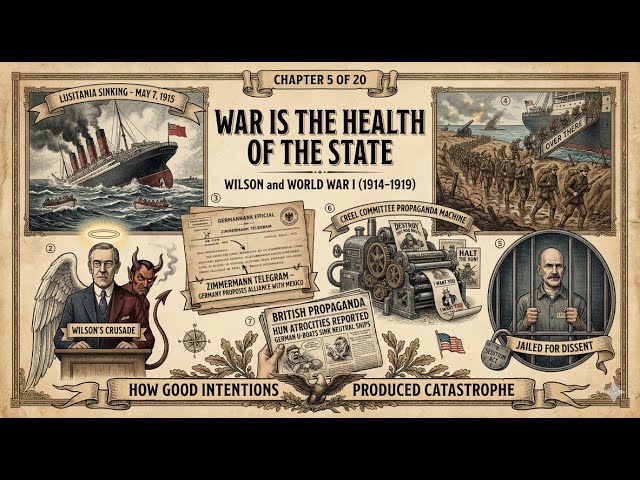
War Is the Health of the State—Wilson and World War I
America’s entry into World War I was not a response to German aggression against the United States but a choice—influenced by British propaganda, financial entanglement, Wilsonian ideology, and the interests of those who would profit from war. This episode traces how neutrality eroded through $2.3 billion in Wall Street loans, how the Lusitania and Zimmermann Telegram provided pretexts for intervention, and how the dissenters who opposed war were silenced and destroyed. We ex
Feb 71 min read

The Tripwires of Empire—NATO, Ukraine, Iran, and the Alliance Logic of 1914
This contemporary application episode connects the alliance dynamics traced in Episode 4 to current events in Ukraine and Iran. As peace talks continue in the UAE and the USS Abraham Lincoln positions off Iran’s coast, we examine how alliance commitments—NATO’s Article 5, the Russia-Iran strategic partnership, the Russia-North Korea mutual defense pact—create the same escalation dynamics that produced World War I. With 200,000 Ukrainian soldiers AWOL and President Trump threa
Feb 31 min read


War Is the Health of the State: Wilson and World War I
Understanding how America entered World War I is essential to understanding how America enters every war since. The patterns established in 1917—the manufacture of consent, the financial entanglements that precede intervention, the ideological framing that forecloses compromise, the suppression of dissent once war begins—have repeated with remarkable consistency for over a century.
Feb 121 min read

Great Game and the Road to Armageddon—European Imperialism and the System That Produced World War
Before Americans can evaluate whether intervention in World War I was wise, they must understand the system they were being asked to join. This episode examines the European imperial order that produced the Great War: the British Empire at its zenith, the Crimean War and the birth of anti-Russian propaganda, the romantic brutality of the Great Game in Afghanistan, the horrors of the Scramble for Africa, and the alliance system that transformed a Balkan assassination into cont
Jan 311 min read


The Great Game and the Road to Armageddon: European Imperialism and the System That Produced World War
To understand America’s entry into World War I—and to evaluate whether it was wise—we must first understand the world Americans were being asked to enter. This article examines the European imperial system: its origins, its logic, and its catastrophic failure. Before Americans can judge whether intervention was necessary, they must grasp what intervention meant: joining a continent-spanning network of automatic commitments that could transform any local dispute into general w
Jan 2517 min read


Reconstruction, Industrialization, and the Rise of the New Constitution
When the Civil War ended, the United States was not the same nation that had gone to war four years earlier. The bloodletting had settled the question of state sovereignty by force, but the peace that followed redefined individual sovereignty by law.
The Reconstruction Amendments—the 13th, 14th, and 15th—marked a second founding. They transformed the Constitution from a pact among states into a national charter of rights that bound the states themselves.
Oct 6, 20257 min read
bottom of page