“The Indispensable Nation” — Post-Cold War Interventionism and the Squandered Peace

“If we have to use force, it is because we are America. We are the indispensable nation. We stand tall. We see further into the future.”—Madeleine Albright, Secretary of State, 1998¹
Introduction: The Road Not Taken
On Christmas Day 1991, the Soviet flag was lowered over the Kremlin for the last time. The Cold War was over. America had won.
For forty-five years, every sacrifice had been justified by the Soviet threat—the military spending, the covert operations, the compromised principles, the lives lost in Korea and Vietnam and countless smaller conflicts. The ideological struggle that had defined the postwar world was finished. The rival superpower had dissolved.
What would America do with its victory?
The founders’ answer was clear: return to normalcy. This was what America had done after the earlier wars. After the Revolution, the Continental Army was disbanded. After the Civil War, the massive Union forces were demobilized. After World War I, American troops came home from Europe. The pattern was consistent: fight the war, win the war, come home.
But the Cold War had lasted so long—forty-five years—that a permanent national security state had emerged. Institutions had been built. Careers depended on continued conflict. Industries had grown around military production. Think tanks existed to justify intervention. A foreign policy establishment had formed that saw American hegemony not as temporary expedient but as permanent necessity.²
These interests had no intention of demobilizing.
The 1990s are remembered as a decade of peace and prosperity—the Clinton years, the dot-com boom, the “end of history.” But they were not a decade of peace. They were a decade of intervention: the Gulf War, Somalia, Haiti, Bosnia, Kosovo, ongoing strikes against Iraq. More importantly, they were the decade when the architecture of permanent intervention was constructed.
NATO expanded to Russia’s borders despite promises to the contrary. The doctrine of humanitarian intervention was established—America could bomb countries without UN authorization if we deemed the cause just. The ideology of American “indispensability” became the governing assumption of both parties. The neoconservative movement captured key positions and published blueprints for regime change that would be implemented after September 11.
The “peace dividend” was spent on new wars and new commitments. Understanding the 1990s is essential to understanding why the peace that should have followed the Cold War became instead the forever wars.
The Unipolar Moment
The New World Order
President George H.W. Bush announced a “new world order” during the buildup to the
Gulf War in a special joint session of Congress on September 11, 1990. The phrase suggested international cooperation, collective security, and the rule of law. The United Nations would function as its founders intended. America would lead but would act through international institutions.

The reality proved different. The new world order was American hegemony with UN cover when convenient, and American unilateralism when the UN would not cooperate. The question of the era was not whether America would lead but whether any limits would constrain American power.³
The Defense Planning Guidance
In 1992, a document leaked from the Pentagon that revealed the thinking of those who would dominate American foreign policy for the next three decades.
The Defense Planning Guidance was drafted by Paul Wolfowitz and Lewis “Scooter” Libby under Secretary of Defense Dick Cheney. Its core thesis was stark: the United States must prevent the emergence of any rival power in any region. America would maintain military superiority so overwhelming that potential competitors would not even aspire to challenge it.⁴
The document stated: “Our first objective is to prevent the re-emergence of a new rival... we must maintain the mechanism for deterring potential competitors from even aspiring to a larger regional or global role.”
When leaked, the document caused controversy. It was officially disavowed and softened. But it was not abandoned. The people who wrote it—Cheney, Wolfowitz, Libby—would return to power under George W. Bush and implement its vision.
This was the neoconservative blueprint, articulated years before “neoconservative” became a common term.
The Alternatives Rejected
The hegemonic vision was not the only option.
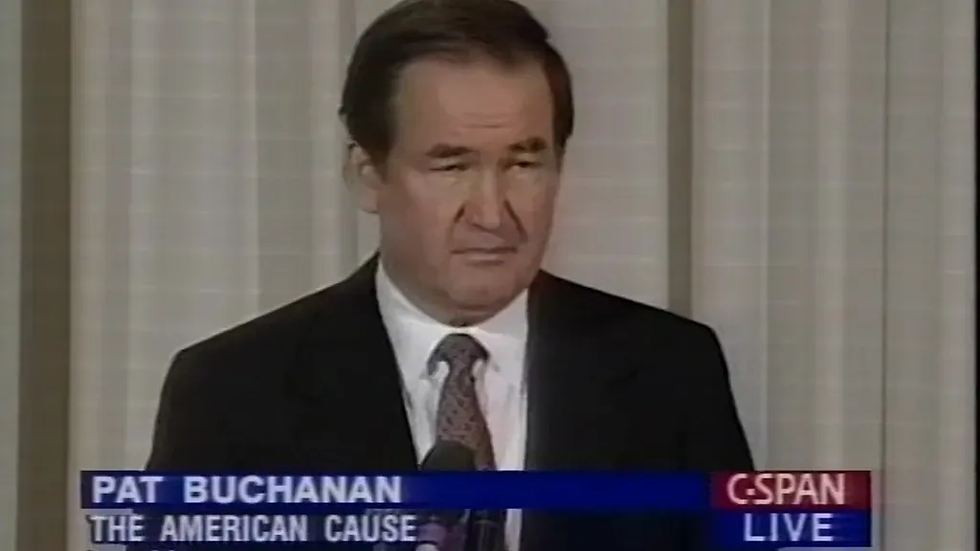
Pat Buchanan articulated an “America First” conservatism: come home, rebuild the nation, avoid foreign entanglements. The Cold War had required global commitment; with the Cold War over, those commitments should end.
The libertarian tradition, represented by Ron Paul, argued for free trade without military commitments—commerce with all nations, alliances with none, precisely what the founders had recommended.
Realist scholars like John Mearsheimer advocated restraint: maintain the balance of power without seeking global hegemony. Manage great power relations; do not seek to dominate the globe.⁵
These positions existed. They were articulated by serious people with serious arguments. They were marginalized rather than refuted. The foreign policy establishment simply proceeded as if no alternatives existed.
The Gulf War: The New Model
The Ambiguous Prelude
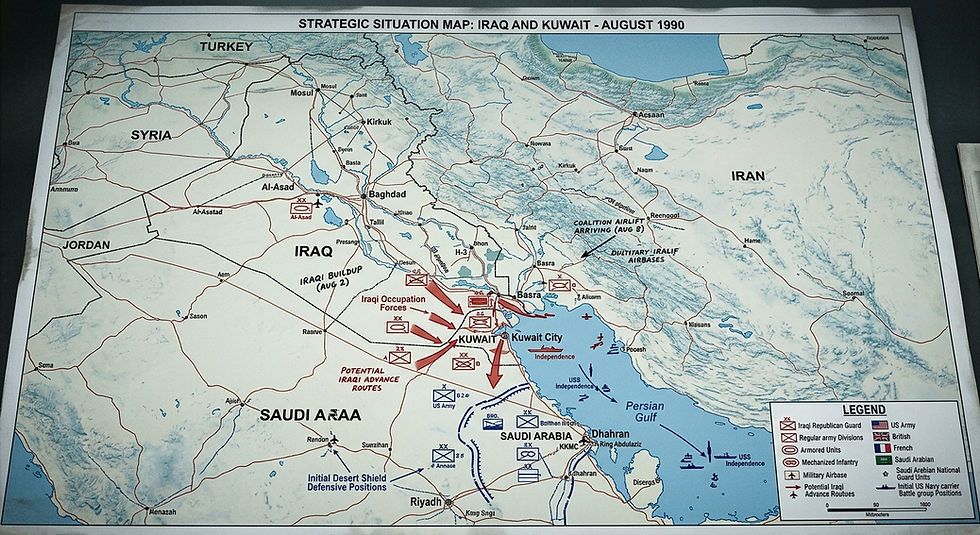
On August 2, 1990, Iraq invaded Kuwait. Saddam Hussein’s forces overran the small, oil-rich emirate within hours.
The invasion was condemned worldwide. But the context was more complicated than the simple narrative of aggression suggested.
Iraq had been an American ally throughout the 1980s. The Reagan and Bush administrations had supported Saddam against Iran, providing intelligence, agricultural credits, and tacit approval for weapons programs. Donald Rumsfeld had visited Baghdad as special envoy; the famous photograph shows him shaking hands with Saddam.

In July 1990, just days before the invasion, U.S. Ambassador April Glaspie met with Saddam. According to Iraqi transcripts, she told him: “We have no opinion on Arab-Arab conflicts, like your border disagreement with Kuwait.”⁶
Did Saddam believe he had American permission—or at least acquiescence—for his invasion? The evidence is ambiguous. What is clear is that American signals were not unambiguous.
The Coalition and the War
Once Iraq invaded, Bush assembled an international coalition with remarkable diplomatic skill. The UN Security Council passed resolution after resolution condemning Iraq and demanding withdrawal. When Saddam refused, the Council authorized “all necessary means” to enforce compliance. Operation Desert Shield deployed over 500,000 American troops to Saudi Arabia.
The deployment itself would have lasting consequences. American forces in Saudi Arabia—home to Islam’s holiest sites in Mecca and Medina—enraged religious conservatives throughout the Muslim world. Osama bin Laden, who had offered to defend Saudi Arabia with his mujahideen veterans, was horrified when the kingdom chose American infidel troops instead. The grievance would fuel al-Qaeda’s war against America for decades.⁷
Operation Desert Storm began on January 17, 1991. The air campaign was devastating—the most intensive bombing since World War II. Iraqi infrastructure was systematically destroyed: power plants, water treatment facilities, bridges, communications centers. The bombing targeted not just military assets but the industrial foundation of Iraqi society.
When the ground war began, it lasted one hundred hours. American and coalition forces swept through Iraqi defenses. The vaunted Republican Guard disintegrated. Iraqi forces were expelled from Kuwait. The “Highway of Death”—where retreating Iraqi columns were annihilated from the air—produced images of destruction that shocked even some American commanders.
Coalition casualties were minimal by the standards of major wars: 383 Americans killed, fewer than 500 coalition deaths total. Iraqi casualties were massive: estimates range from 20,000 to 35,000 military deaths, with thousands more civilian deaths from direct combat.⁸
Bush declared victory. He announced that the “Vietnam Syndrome” had been kicked—Americans need no longer fear military engagement. The lesson learned was that American technological superiority could achieve quick, decisive victories with minimal American casualties.
But the coalition stopped at the Iraqi border. Saddam remained in power. The war’s objectives had been limited to liberating Kuwait, not overthrowing the regime.
This restraint was deliberate. General Colin Powell and others understood that occupation would be costly and complicated. Marching to Baghdad would fracture the coalition—Arab states had not signed up for regime change. The aftermath would require American management of a country with deep ethnic and sectarian divisions.
The restraint of 1991 would be abandoned in 2003, and every problem the elder Bush’s advisors foresaw would materialize.
The Sanctions Regime
The war ended, but the suffering intensified.
The United Nations imposed comprehensive sanctions on Iraq—the most punishing sanctions regime in modern history. The sanctions prohibited most imports and exports, crippling an economy that depended on oil revenues. Iraq could not sell oil; it could not import the goods its population needed to survive.
The humanitarian consequences were catastrophic. Sanctions prevented Iraq from importing sufficient food, medicine, and the parts needed to repair water treatment and electrical systems that bombing had destroyed. Infant mortality soared. Preventable diseases spread. Malnutrition became endemic.
A 1995 UN Food and Agriculture Organization study estimated that 567,000 Iraqi children under five had died as a consequence of sanctions—excess mortality above pre-war baselines. Other studies produced varying estimates, but all agreed that hundreds of thousands of Iraqi civilians, predominantly children, had died.⁹
When asked about the 500,000 figure in a 1996 interview, Secretary of State Madeleine Albright replied: “We think the price is worth it.”

The price—half a million dead children, by this estimate—was worth it. This was American policy, stated plainly on national television.
The sanctions continued for twelve years, until the 2003 invasion. They did not remove Saddam from power. They did not prevent him from maintaining control. They devastated the civilian population while the regime survived.
The moral mathematics were perverse: to punish a dictator, America helped kill his country’s children. The policy produced suffering, resentment, and no strategic benefit.
The Questions
The Gulf War raised questions that would recur throughout the interventions that followed:
Was this about Kuwait’s sovereignty or about oil? Kuwait was not a democracy. It was an authoritarian emirate where ruling family members held all significant power. The principle of sovereignty is important, but America had not defended sovereignty in countless other cases—when Indonesia invaded East Timor, when Morocco occupied Western Sahara. The difference was oil.
What about the consequences that followed? The sanctions killed more people than the war itself. American troops stationed in Saudi Arabia—deployed for the Gulf War and remaining afterward—became the grievance that Osama bin Laden cited most frequently. The “success” planted seeds for future disasters.
Did the Gulf War’s “success” create overconfidence for later interventions? The clean victory suggested that American power could solve problems quickly and efficiently. This confidence would prove catastrophic when applied to Iraq again in 2003.
Somalia: The War That Never Ended
Humanitarian Intervention
Somali civil war and famine produced harrowing images on American television—starving children, armed militias, collapsed government. The state had disintegrated after the fall of dictator Siad Barre in 1991. Warlords competed for power. Aid shipments were looted. Hundreds of thousands faced starvation.
President Bush, in his final weeks in office, sent troops for a humanitarian mission in December 1992. Operation Restore Hope aimed to secure food distribution and end the famine. American troops would facilitate humanitarian relief, then withdraw.
President Clinton inherited the mission and expanded it. What began as feeding the hungry became nation-building—attempting to establish functioning government in a country without one. Then it became hunting warlords. Mission creep transformed a humanitarian operation into something far more ambitious and dangerous.
On October 3, 1993, a raid to capture lieutenants of warlord Mohamed Farah Aidid went catastrophically wrong. Task Force Ranger soldiers roped into Mogadishu from helicopters to seize targets at the Olympic Hotel. Two Black Hawk helicopters were shot down. The extraction became a rescue mission. The rescue became a desperate fight for survival.
Eighteen American soldiers were killed. Seventy-three were wounded. The bodies of dead Americans were dragged through the streets of Mogadishu by jubilant crowds, footage broadcast worldwide.⁹
The images shocked America. Clinton withdrew ground forces. Somalia was declared a failure. The lesson drawn by policymakers was to avoid casualties at all costs—use airpower, use drones, use special operations, but never commit ground forces where they might be killed.
This lesson would shape every subsequent intervention. Kosovo was fought with airpower alone. Libya was fought without ground troops. The fear of another Mogadishu constrained American operations for decades.
The War That Never Ended
But the withdrawal was not what it appeared.
Ground troops left in 1994. But American involvement continued. Throughout the late 1990s and early 2000s, the CIA conducted operations in Somalia, supporting warlords against Islamist factions.
When the “War on Terror” began after September 11, Somalia provided new justification for intervention. Al-Shabaab, an Islamist militia that emerged in 2006, affiliated with al-Qaeda. The group that had not existed when Congress authorized force against 9/11 perpetrators became a target under that very authorization.
The bombing continued through every subsequent administration. Barack Obama dramatically increased drone strikes and special operations in Somalia. His administration conducted hundreds of airstrikes against al-Shabaab targets.
Donald Trump loosened rules of engagement, giving field commanders more authority to conduct strikes. The pace of bombing increased further.
Joe Biden continued the campaign. American forces remain in Somalia and neighboring countries, conducting strikes against al-Shabaab positions.
As of late 2025, the United States has conducted over one hundred airstrikes in Somalia this year alone. Most Americans are unaware their country is at war there.¹⁰

The Constitutional Question
The legal basis for this ongoing war is the 2001 Authorization for Use of Military Force—the AUMF passed three days after September 11 to authorize action against those who “planned, authorized, committed, or aided” the attacks.
Al-Shabaab did not exist on September 11, 2001. It formed in 2006—five years after the attacks. It did not plan, authorize, commit, or aid the September 11 attacks. It could not have—it did not exist.
The legal theory is that al-Shabaab is an “associated force” of al-Qaeda and therefore covered by the 2001 authorization. This theory has never been tested in court. It has never been voted on by Congress. It has simply been asserted by successive administrations.
This interpretation transforms a specific authorization against specific attackers into authorization for permanent, global war against anyone designated an “associated force.” The executive branch decides who the enemy is. The war continues without end.
The war in Somalia has continued for over thirty years. No new authorization has been sought. No declaration of war has been made. The founders established that Congress declares war precisely to prevent endless executive war-making. That constitutional structure has been evaded.
The Thirty-Year War
First intervention: 1992.
Ground troops withdrawn: 1994.
Bombing continues: 2025.
Duration: thirty-three years and counting.
Somalia remains a failed state. Al-Shabaab remains active. American bombing has not defeated the group, has not stabilized the country, has not achieved any stated objective.
Each strike may kill militants but also kills civilians, generates grievances, and recruits new militants. The bombing perpetuates the conditions that justify more bombing. The war sustains itself.
This is not learning from failure—it is failure becoming permanent. The intervention has achieved nothing except its own continuation. And most Americans do not even know it is happening.
Yugoslavia: Humanitarian War Without UN
The Breakup
Yugoslavia dissolved along ethnic and religious lines between 1991 and 1992. The federation that Josip Broz Tito had held together through charisma and repression fragmented into its constituent parts: Slovenia, Croatia, Bosnia, Serbia, Montenegro, Macedonia, and Kosovo.
The dissolution was violent. Slovenia’s independence war lasted ten days. Croatia’s war lasted years. Bosnia was worst—a three-way conflict among Serbs, Croats, and Bosniaks that killed over 100,000 people and displaced millions.
The Srebrenica massacre of July 1995 crystallized the horror. Serbian forces under General Ratko Mladić overran a UN “safe area” protected by Dutch peacekeepers. Over the following days, they systematically murdered approximately 8,000 Bosniak men and boys—the worst mass killing in Europe since World War II. The bodies were buried in mass graves. The Dutch peacekeepers, inadequately armed and unsupported, could not prevent the slaughter.¹¹
The massacre demonstrated that UN peacekeeping without the will to fight was theater. “Safe areas” were not safe. Blue helmets without robust rules of engagement could not protect civilians from determined killers.
The Bosnia Intervention
The United States had initially resisted involvement in the Yugoslav wars. Secretary of State James Baker had reportedly said, “We don’t have a dog in that fight.” The Bush administration, focused on managing the Soviet collapse, treated the Balkans as a European problem.
But the Clinton administration concluded that European inaction was producing catastrophe. NATO launched airstrikes against Serb positions in August and September 1995. American diplomacy, backed by military force, produced the Dayton Accords—a peace agreement that ended the Bosnian war by dividing the country into ethnic components.
The intervention was conducted without UN Security Council authorization for the airstrikes. NATO acted independently, claiming that humanitarian necessity justified action without the approval that Russia would have blocked.¹²
A NATO peacekeeping force deployed to enforce the Dayton Accords. American troops would remain in Bosnia for years. The country was stabilized—frozen in its ethnic divisions, dependent on international administration, but no longer at war.
The Kosovo War
Kosovo was an Albanian-majority province within Serbia. Under Tito, it had enjoyed significant autonomy. Under Milošević, that autonomy was revoked, and Kosovar Albanians faced systematic discrimination.
An independence movement emerged. Initially nonviolent, it radicalized as Serbian repression intensified. The Kosovo Liberation Army began guerrilla attacks. Serbian security forces responded with disproportionate violence. Villages were burned. Civilians were massacred. Ethnic cleansing accelerated.
In March 1999, after diplomatic efforts failed, NATO launched a seventy-eight-day bombing campaign against Serbia. No UN authorization was sought—Russia and China would have vetoed. NATO acted alone.¹³
The campaign targeted Serbian military positions, but also infrastructure: bridges, power plants, television stations. The bombing of a Serbian television facility killed sixteen civilians—journalists and technicians. The Chinese embassy in Belgrade was struck, killing three Chinese journalists, in what the United States claimed was an accident caused by outdated maps.
Milošević eventually capitulated. Serbian forces withdrew from Kosovo. A NATO and UN administration took control. Kosovo achieved formal independence in 2008, though Serbia and Russia have never recognized it.
The Significance
The Yugoslav interventions established precedents with far-reaching consequences.
The doctrine of humanitarian intervention held that sovereignty yields to human rights. When a government commits atrocities against its own people, outside powers may intervene. The doctrine sounds noble in principle. In practice, it raised troubling questions.
Who decides when intervention is justified? The United States and its allies decided for themselves, without UN authorization. The doctrine would be invoked for Libya in 2011—producing a failed state and regional destabilization—but not for Saudi Arabia’s war in Yemen, Israel’s operations in Gaza, or other situations where allied governments committed violence.
The selective application suggested that humanitarian intervention was not a neutral principle but a tool of American power—invoked when convenient, ignored when inconvenient.
NATO transformed from a defensive alliance against the Soviet threat into an offensive alliance capable of conducting war without UN mandate. The implications were enormous. An alliance created to defend Western Europe from Soviet attack was now bombing a country that had not attacked any NATO member.¹⁴
Russia was humiliated. Its traditional ally Serbia was bombed despite Russian objections. Russia’s veto in the Security Council—the mechanism that was supposed to protect great power interests—was simply bypassed.
The Russian perspective matters for understanding what followed. Russia saw NATO bombing Serbia as demonstration of what could happen to Russia itself. NATO was not a defensive alliance; it was an offensive tool of American power. And NATO was expanding—moving closer to Russian borders.
This perception would shape Russian policy for decades. The confrontation over Ukraine had roots in Kosovo.

NATO Expansion: The Fateful Decision
The Promise
When the Cold War ended, Western leaders assured Soviet President Mikhail Gorbachev that NATO would not expand eastward.
The assurance was verbal, not codified in treaty. But it was made. Secretary of State James Baker told Gorbachev that NATO’s jurisdiction would not move “one inch eastward.” Similar assurances came from other Western leaders. Gorbachev allowed German reunification on this understanding.¹⁴
Declassified documents from the National Security Archive confirm these assurances were made. Western officials now deny any promise existed. The documents say otherwise.
The Expansion
Despite the assurances, NATO expanded relentlessly.
1999: Poland, Hungary, and Czech Republic joined
2004: Estonia, Latvia, Lithuania, Bulgaria, Romania, Slovakia, and Slovenia
2009: Albania and Croatia
2017: Montenegro
2020: North Macedonia
2023: Finland
2024: Sweden
The alliance doubled—from sixteen members in 1991 to thirty-two members. NATO’s eastern border moved from Germany to Russia’s doorstep. The Baltic states—NATO members since 2004—share borders with Russia. Article 5, the mutual defense provision, means that an attack on Estonia requires American military response.¹⁵
The Warnings Ignored
The Cold War generation of diplomats and strategists warned against expansion with remarkable consistency.
George Kennan, the architect of containment policy, called NATO expansion “the most fateful error of American policy in the entire post-cold-war era.” In a 1997 New York Times op-ed, he predicted it would “inflame the nationalistic, anti-Western and militaristic tendencies in Russian opinion” and “restore the atmosphere of the cold war to East-West relations.”¹⁶
Kennan was not a dove or an isolationist. He had designed the strategy that won the Cold War. His warning was not ideological but analytical: expansion would produce Russian hostility without enhancing American security.
William Perry, Clinton’s own Secretary of Defense, opposed expansion and considered resigning over the issue. He later called his failure to prevent it one of his greatest regrets.
Jack Matlock, the last American ambassador to the Soviet Union—the man who had managed the relationship as it transformed—warned that expansion would poison relations.
Henry Kissinger, no friend of restraint generally, cautioned specifically against moving toward Ukraine. “The West must understand that, to Russia, Ukraine can never be just a foreign country,” he wrote.
Thomas Friedman, the New York Times columnist generally sympathetic to American power projection, asked Kennan about expansion. Kennan predicted: “I think it is the beginning of a new cold war. I think the Russians will gradually react quite adversely and it will affect their policies.”¹⁷
The entire generation that had managed the Cold War—hawks and doves alike, Republicans and Democrats—warned that expansion would produce exactly the consequences that occurred. They were ignored by a younger generation that believed history had ended and Russia would simply accept American hegemony.
The Logic of Expansion
Why did expansion proceed despite the warnings?
The Clinton administration cited democracy promotion—stabilizing Eastern Europe, making “Europe whole and free.” The aspiration was genuine. Eastern European nations had suffered under Soviet domination and genuinely wanted American protection. Their fear of Russia was real and historically grounded.
But the policy served other interests as well.
The defense industry benefited enormously. New NATO members were required to upgrade their militaries to alliance standards. This meant purchasing American weapons—billions of dollars in arms sales to Poland, Hungary, the Czech Republic, and eventually a dozen more countries.
NATO itself needed a new mission. Without the Soviet threat, the alliance required justification for its continued existence. Expansion provided that justification. Bureaucracies seek to survive; NATO found reasons to grow.
Eastern European lobbies—particularly Polish-American organizations—pressured the Clinton administration. Electoral calculations played a role: Polish-American voters in swing states like Michigan and Illinois mattered.¹⁸
The logic was compelling to those who believed in American hegemony. Russia was weak; now was the time to lock in gains. NATO expansion would make European stability permanent. Russia would eventually accept the new reality.
The logic was blind to Russian perspectives. It assumed that Russian acquiescence was permanent rather than temporary. It discounted the possibility that Russia might recover, might resent the humiliation, might eventually push back.
The Consequences
Everything the critics predicted came to pass.
Russia’s cooperative period ended. The hopes of the early 1990s—that Russia might join the Western system, might become a normal European country—evaporated. The relationship deteriorated steadily.
Vladimir Putin, who came to power in 2000, explicitly cited NATO expansion as grievance. His 2007 Munich Security Conference speech marked the definitive end of Russian accommodation. He accused the United States of creating a “unipolar world” with “one master, one sovereign.”
Georgia in 2008 was the first test. When Georgia moved toward NATO membership, Russia invaded, establishing breakaway territories that remain under Russian control. The message was clear: NATO expansion into the former Soviet space would be resisted with force.
Ukraine in 2014 was the second test. When a pro-Western government came to power in Kyiv, Russia annexed Crimea and fomented conflict in eastern Ukraine. The confrontation that Cold War veterans had predicted for two decades had arrived.
Ukraine in 2022 was the full-scale war. Whatever one thinks of Russian actions—and the invasion violated international law—the context includes decades of NATO expansion despite Russian objections and explicit American warnings.¹⁹
The costs continue to mount: thousands dead, millions displaced, European energy crisis, nuclear risks, a new cold war that may last decades. Kennan’s prediction was exactly correct.
The Project for a New American Century
The Organization
In 1997, William Kristol—son of neoconservative founding father Irving Kristol—and Robert Kagan founded the Project for a New American Century. PNAC was a neoconservative think tank advocating American global leadership without apology.
The organization’s founding statement of principles declared that America should “shape a new century favorable to American principles and interests.” It called for increased defense spending, modernized armed forces, and willingness to “accept responsibility for America’s unique role in preserving and extending an international order friendly to our security, our prosperity, and our principles.”
The organization’s membership read like a roster of future Bush administration officials: Dick Cheney signed the founding statement. So did Donald Rumsfeld, Paul Wolfowitz, Lewis “Scooter” Libby, and John Bolton. Jeb Bush and Dan Quayle added their names. The plans these men developed in the late 1990s would become American policy after 2001.²⁰

The Ideology
PNAC’s vision was comprehensive and unapologetic:
American military dominance should be preserved and extended indefinitely. The post-Cold War “unipolar moment” should become permanent. No rival power—whether China, Russia, or a united Europe—should be permitted to emerge.
Democracy should be promoted through force if necessary. Hostile regimes—Iraq, Iran, North Korea—should be changed. The promotion of democracy was not merely an ideal but a strategic imperative.
Multilateral constraints—the United Nations, international law, allied objections—should not limit American action. When American interests required action, America should act. If the UN Security Council would not authorize war, the war should proceed anyway.
The approach rejected both realist restraint and liberal multilateralism. It rejected the realist view that America should manage the balance of power without seeking dominance. It rejected the liberal view that American power should be exercised through international institutions with allied consent.
America was exceptional. America was good. American power should reshape the world according to American values. Those who resisted would be overcome.
The Letters and Reports
PNAC published letters urging regime change in Iraq throughout the late 1990s.
A January 1998 letter to President Clinton, signed by Rumsfeld, Wolfowitz, Bolton, Richard Armitage, and others, argued that “the policy of ‘containment’ of Saddam Hussein has been steadily eroding.” It called for military action “to remove Saddam Hussein and his regime from power.”²¹
The letter was explicit: “We believe the U.S. has the authority under existing UN resolutions to take the necessary steps, including military steps, to protect our vital interests in the Gulf.”
This was more than three years before September 11. The Iraq War was planned long in advance. The attacks of 2001 provided the opportunity, not the cause. The people who signed the 1998 letter were positioned to implement their vision when the moment arrived.
In September 2000, PNAC published “Rebuilding America’s Defenses,” a comprehensive strategy document that read as a blueprint for the Bush administration’s policies.
The document called for maintaining American military preeminence “as far into the future as possible.” It advocated forces capable of “multiple, simultaneous major theater wars.” It called for a new military service focused on space and for the development of missile defense systems.
The document was candid about the obstacles to transformation. It acknowledged that “the process of transformation, even if it brings revolutionary change, is likely to be a long one, absent some catastrophic and catalyzing event—like a new Pearl Harbor.”²²
One year later, the catastrophic and catalyzing event arrived. The new Pearl Harbor happened. And the transformation that PNAC had outlined proceeded rapidly.
The Continuity
The continuity between PNAC’s 1990s planning and Bush administration policy was not coincidental. The people who developed the plans implemented them.
Rumsfeld became Secretary of Defense. Wolfowitz became his deputy. Libby became Cheney’s chief of staff. Bolton served at the State Department and later as UN Ambassador. Cheney himself was Vice President.
The Iraq War—justified by claims about weapons of mass destruction that proved false, sold as response to September 11 though Iraq had no connection to the attacks—was the implementation of plans developed years before the ostensible cause.
Understanding PNAC is essential to understanding what followed. September 11 was not the cause of the Iraq War; it was the opportunity. The war had been planned. It waited only for the catalyzing event.
The Peace Dividend That Wasn’t
What Should Have Happened
The Cold War’s end should have produced transformation.
Military spending, which had reached extraordinary levels during the Reagan buildup, could have been reduced dramatically. The Soviet threat was gone. Who was the military preparing to fight?
Troops could have come home from Europe and Asia. The bases established to contain the Soviet Union no longer served that purpose.
The national debt could have been paid down. Domestic needs—infrastructure, education, healthcare—could have been addressed.
What Actually Happened
Military spending declined modestly in the early 1990s, then resumed growth. The “peace dividend” proved modest and temporary.
Bases remained. The foreign deployment that had been justified by Soviet containment continued without the Soviets.
New commitments accumulated. NATO expanded. Interventions multiplied. By 2001, America was more committed globally than it had been in 1991.²⁰
The 1990s prosperity masked the ongoing military-industrial complex. When September 11 came, the apparatus was ready for massive expansion. The “peace” decade had been preparation for permanent war.
The Interventionist Defense
The Case for the 1990s Interventions
The interventionist position deserves fair statement.
The Gulf War restored Kuwaiti sovereignty and demonstrated that aggression would not stand. The UN authorized the action. The war was quick and limited.
The Yugoslav interventions stopped ethnic cleansing and genocide. Srebrenica demanded response. The Milošević regime was brutal and destabilizing.
NATO expansion fulfilled the aspirations of Eastern European nations that had suffered under Soviet domination. They wanted American protection; America provided it. Democracy spread.
The alternative—American withdrawal—might have produced worse outcomes. Without American presence, regional powers might have filled the vacuum. Russia might have reconstituted its empire. Humanitarian catastrophes might have gone unanswered.²¹
The Response
These arguments contain partial truths but miss essential points.
The Gulf War’s success created overconfidence that led to the Iraq disaster. The sanctions regime that followed killed more people than the war. American troops in Saudi Arabia became al-Qaeda’s primary recruitment grievance.
The Yugoslav interventions set precedents that would be abused. Humanitarian intervention without UN authorization was invoked for Libya in 2011—producing a failed state and regional destabilization. The doctrine sounds noble; its application has been selective and often disastrous.
NATO expansion created the confrontation that now risks nuclear war. Every Cold War expert warned against it. The warnings were exactly right. Russia did not simply accept the loss of its sphere of influence; it pushed back—in Georgia, in Ukraine, and potentially elsewhere.
The opportunity for restraint was rejected not because restraint was impossible but because powerful interests preferred hegemony. The peace dividend was consumed by those who profited from its absence.
Conclusion: Setting the Stage
What the 1990s Established
The decade established precedents that would produce the disasters of the 2000s:
Humanitarian intervention without UN authorization—the Kosovo precedent that would justify Libya.
NATO as an offensive alliance expanding toward Russia—the confrontation that now dominates European security.
American “indispensability” as governing ideology—the assumption that would justify endless intervention.
Regime change as policy tool—attempted against Saddam throughout the 1990s, achieved in 2003.
Neoconservative capture of the foreign policy establishment—the people and ideas that would dominate the Bush administration.
The Stage Set for Disaster
Every seed of the twenty-first century’s disasters was planted in the 1990s.
The Gulf War’s “success” produced overconfidence for Iraq. The sanctions killed hundreds of thousands and generated grievance. American troops in Saudi Arabia enraged bin Laden.
NATO expansion created Russian grievance that would produce the Ukraine conflict.
The humanitarian intervention doctrine would justify the Libya catastrophe.
Regime change ideology, developed by PNAC throughout the decade, would produce the Iraq disaster.
Somalia established the template for permanent, low-level war without congressional authorization or public attention.
The Question
The Cold War ended; the warfare state did not.
The Soviet threat disappeared; new threats were found or created.
The opportunity for restraint was rejected.
Was this inevitable—or was it a choice made by identifiable people for identifiable reasons?
The founders warned against foreign entanglements because they understood that such entanglements corrupt republics. The 1990s demonstrated the truth of their warning. The chance to return to republican normalcy was rejected in favor of permanent hegemony.
The price of that choice would be paid in the century that followed—in blood, treasure, and freedom. The “indispensable nation” would find that dispensing with limits produced limitless war.
Self-Reflection Prompts
George Kennan warned that NATO expansion would “inflame nationalistic, anti-Western and militaristic tendencies in Russian opinion.” His prediction proved accurate. What does this suggest about expertise being ignored when it conflicts with policy preferences? Are there mechanisms that could force policymakers to engage seriously with dissenting expert opinion?
The humanitarian interventions of the 1990s had mixed results. Does the intention to help—preventing genocide, ending famine—justify interventions that produce unintended consequences? How should policymakers weigh immediate humanitarian benefits against long-term strategic costs?
The Project for a New American Century called for regime change in Iraq years before September 11. Does this suggest that the attacks were a pretext rather than a cause for the Iraq War? What does it mean that the same people who planned the war in the 1990s were in position to execute it in 2003?
The “peace dividend” after the Cold War was largely spent on maintaining global military presence and new interventions. What interests benefited from this choice? Why did the alternative—restraint, demobilization, domestic investment—lack powerful advocates?
The United States has been conducting military operations in Somalia for over thirty years with no end in sight. Most Americans are unaware of this ongoing war. What does this suggest about democratic accountability for military action? Is permanent, low-level war compatible with republican government?
Endnotes
Madeleine Albright, interview with Matt Lauer, NBC Today Show, February 19, 1998.
Andrew Bacevich, The New American Militarism: How Americans Are Seduced by War (New York: Oxford University Press, 2005), pp. 1-32.
George H.W. Bush, Address Before a Joint Session of Congress, September 11, 1990.
Patrick Tyler, “U.S. Strategy Plan Calls for Insuring No Rivals Develop,” New York Times, March 8, 1992.
Patrick Buchanan, A Republic, Not an Empire (Washington: Regnery, 1999); John Mearsheimer and Stephen Walt, “The Case for Offshore Balancing,” Foreign Affairs (July/August 2016).
Rick Atkinson, Crusade: The Untold Story of the Persian Gulf War (Boston: Houghton Mifflin, 1993), pp. 45-52.
On American troops in Saudi Arabia and bin Laden’s reaction, see Lawrence Wright, The Looming Tower (New York: Knopf, 2006), pp. 160-175.
Atkinson, Crusade, pp. 302-340; Iraqi casualty estimates vary widely.
Madeleine Albright, interview on 60 Minutes, CBS, May 12, 1996; the sanctions’ humanitarian impact documented in UN FAO reports.
Mark Bowden, Black Hawk Down: A Story of Modern War (New York: Atlantic Monthly Press, 1999).
Airwars and Antiwar.com maintain ongoing documentation of U.S. strikes in Somalia; Nick Turse, “U.S. Military Says It Has Conducted More Than 100 Strikes in Somalia This Year,” The Intercept (various reports).
The International Criminal Tribunal for the Former Yugoslavia documented the Srebrenica massacre; see ICTY Judgment, Prosecutor v. Radislav Krstić.
Ivo Daalder and Michael O’Hanlon, Winning Ugly: NATO’s War to Save Kosovo (Washington: Brookings Institution Press, 2000).
On NATO’s transformation and Russian perceptions, see Mary Elise Sarotte, Not One Inch: America, Russia, and the Making of Post-Cold War Stalemate (New Haven: Yale University Press, 2021), pp. 145-180.
National Security Archive, “NATO Expansion: What Gorbachev Heard,” Electronic Briefing Book No. 613 (December 12, 2017).
NATO official membership statistics from NATO archives.
George Kennan, “A Fateful Error,” New York Times, February 5, 1997.
Thomas Friedman, “Now a Word From X,” New York Times, May 2, 1998, quoting Kennan on expansion consequences.
On the domestic politics of NATO expansion, see James Goldgeier, Not Whether But When: The U.S. Decision to Enlarge NATO (Washington: Brookings, 1999).
Vladimir Putin, Munich Security Conference speech, February 10, 2007.
James Mann, Rise of the Vulcans: The History of Bush’s War Cabinet (New York: Viking, 2004).
Project for the New American Century, Letter to President Clinton on Iraq, January 26, 1998.
Project for the New American Century, Rebuilding America’s Defenses (September 2000), p. 51.
Bacevich, The New American Militarism, pp. 98-126.
The interventionist case is made in Robert Kagan, The World America Made (New York: Knopf, 2012).
Sources and Further Reading
Primary Sources
Defense Planning Guidance (1992) — Leaked draft revealing hegemonic strategy
PNAC letters and reports (1997-2000) — The neoconservative blueprint
George Kennan, “A Fateful Error,” New York Times (1997) — Warning against NATO expansion
National Security Archive documents — NATO expansion assurances to Gorbachev
Secondary Sources
Andrew Bacevich, American Empire (2002) — Critical analysis of post-Cold War interventionism
Mary Elise Sarotte, Not One Inch (2021) — Definitive on NATO expansion promises
James Mann, Rise of the Vulcans (2004) — The Bush administration’s foreign policy team
Mark Bowden, Black Hawk Down (1999) — The Somalia disaster
From the Non-Interventionist Tradition
Patrick Buchanan, A Republic, Not an Empire (1999) — Written during this period
Ron Paul, congressional speeches — Consistent warnings against intervention
John Mearsheimer, writings on NATO expansion — Great power realism
Scott Horton, Antiwar.com — Ongoing documentation of Somalia operations


Comments