“The Bear Baited” — Ukraine and the Vindication of the Realists

Updated: Oct 5
“Expanding NATO would be the most fateful error of American policy in the entire post-cold-war era. Such a decision may be expected to inflame the nationalistic, anti-Western and militaristic tendencies in Russian opinion; to have an adverse effect on the development of Russian democracy; to restore the atmosphere of the cold war to East-West relations, and to impel Russian foreign policy in directions decidedly not to our liking.”—George F. Kennan, The New York Times, February 5, 1997¹
Editorial Note: Explaining causation is not justifying aggression. A physician who explains that smoking causes cancer is not defending cancer. This article explains how American policy choices contributed to creating the conditions for war, while fully acknowledging that Russia bears responsibility for its own decisions. We cannot learn from catastrophe unless we are willing to understand the underlying motivations of those who produced it. The question before us is whether American policy served American interests, and whether different choices could have prevented a war that has killed hundreds of thousands and still threatens escalation to nuclear catastrophe.
Introduction: The War They Said Would Never Happen
In September 2014, the political scientist John Mearsheimer published an essay in Foreign Affairs titled “Why the Ukraine Crisis Is the West’s Fault.” The piece argued that NATO expansion, European Union outreach, and Western support for regime change in Kyiv had provoked a predictable Russian response, and that continued pressure along these lines would lead to catastrophe. Mearsheimer was denounced as a Putin apologist, a useful idiot, a relic of outdated realist thinking whose views belonged in a Cold War museum. Foreign policy elites in Washington and Brussels assured the public that nothing could be further from the truth. Russia was a declining power. It would not dare invade a sovereign European state. The architects of NATO expansion had been proven right by history.²
On February 24, 2022, Russian armored columns crossed the Ukrainian border. The largest land war in Europe since 1945 had begun. The war that Mearsheimer had predicted, that George Kennan had warned against twenty-five years earlier, that Ambassador Jack Matlock and Professor Stephen Cohen and Secretary of Defense William Perry had all tried to prevent, had arrived. The question is no longer whether the realists were right. Events have answered that question beyond dispute. The question now is why the warnings were ignored, who ignored them, whether the war could have been prevented, and whether it can still be ended before the unthinkable occurs.
This article does not excuse Russian aggression. Vladimir Putin chose to invade. He bears moral and legal responsibility for that choice and for the atrocities his forces have committed. But American policymakers are responsible for American choices, and those choices — made over three decades by Presidents Clinton, Bush, Obama, Trump, and Biden — created the conditions in which Russian aggression became first likely, then probable, then nearly inevitable. The architects of expansion were repeatedly warned. They dismissed the warnings. They continue to occupy positions of influence while the realists they mocked remain marginalized. Until that accountability gap closes, the lessons of Ukraine will not be learned, and similar catastrophes will follow.
As of April 2026, the war grinds on. Combined military casualties exceed one million. The Center for Strategic and International Studies estimates Ukrainian military casualties at between 500,000 and 600,000 through December 2025, with 100,000 to 140,000 killed.³ Russian casualties are even higher: estimates from Bloomberg, the Wall Street Journal, and The Economist converge on roughly 1.2 million killed and wounded.⁴ The United Nations Office of the High Commissioner for Human Rights has verified 15,172 Ukrainian civilian deaths, a figure it acknowledges substantially understates the true toll.⁵ Russia controls approximately twenty percent of Ukrainian territory, an area roughly the size of Pennsylvania.⁶ A brief Orthodox Easter ceasefire in April 2026 collapsed within thirty-two hours, each side accusing the other of violations.⁷ The Trump administration has proposed a twenty-point settlement that would recognize Russian control of Crimea and bar Ukrainian NATO membership — essentially the terms George Kennan warned could have prevented the war thirty years ago, now being negotiated at the cost of a million lives and a shattered country.⁸
How did we arrive here? That is the question this article answers.
Russia, Ukraine, and the Lands Between
To understand Ukraine, one must first understand what Ukraine is to Russia — not as a matter of sentiment, but as a matter of strategic reality. Russia and Ukraine share deep historical, religious, cultural, and linguistic ties that stretch back more than a thousand years. Kyiv is the birthplace of Russian Orthodox Christianity; Vladimir the Great was baptized there in 988. Ukraine was part of the Russian Empire for centuries, and part of the Soviet Union for the entirety of the Soviet period. Eastern and southern Ukraine are overwhelmingly Russian-speaking. Crimea was transferred from Russian to Ukrainian administrative jurisdiction by Nikita Khrushchev in 1954, an internal Soviet reorganization that no one at the time considered a matter of international borders.⁹
None of this gives Russia a moral right to invade Ukraine. Ukrainians are a distinct people with a legitimate right to self-determination, and after 1991 Ukraine was a sovereign state whose borders were recognized by international law. What it does establish is that for Russia — for any Russian government, regardless of who leads it — Ukraine is not simply another neighbor. It is existentially significant in ways that a Western mind steeped in the assumption that history ended in 1989 has difficulty grasping.
More important than sentiment is geography. Ukraine is flat, open, indefensible terrain — the invasion highway that Napoleon took in 1812 and Hitler followed in 1941. There are no natural barriers between Kyiv and Moscow. A hostile military alliance entrenched in Ukraine places missiles and aircraft within minutes of the Russian capital. Viewed from Moscow, the prospect of NATO in Ukraine is not an abstraction about European security architecture. It is the equivalent of what the United States would regard as Chinese or Russian missiles in Mexico or Canada. Americans know, because the United States itself drew this line. In October 1962, President Kennedy imposed a naval blockade and credibly threatened nuclear war over the placement of Soviet missiles ninety miles from Florida. He was not defending the principle of international law. He was enforcing a great-power security prerogative — the same prerogative Russia would later assert regarding Ukraine.¹⁰
The Crimean Peninsula in particular carries strategic weight that cannot be overstated, and here we return to ground we covered in Article 4. When this series examined the nineteenth-century Great Game between Russia and Britain, the Crimean War of 1853 to 1856 was not an antiquarian detour. It was a direct explanation of why events a century and a half ago still shape our present. Sevastopol has served as the headquarters of Russia’s Black Sea Fleet since the time of Catherine the Great. It is Russia’s only warm-water port with reliable access to the Mediterranean. Britain and France went to war in the 1850s to prevent Russian control of the Black Sea straits; hundreds of thousands died in that war; Lord Tennyson immortalized it in “The Charge of the Light Brigade.” That same strategic prize — Sevastopol, the Black Sea Fleet, access to the Mediterranean — remains as vital to Russia in 2026 as it was in 1854. The idea that NATO could take possession of Sevastopol, or even threaten it, without provoking a Russian response that would have been entirely predictable to Lord Palmerston or Nicholas I represents not sophistication but the forgetting of everything the nineteenth century had to teach.
This is why the Great Game mattered. This is why studying dusty imperial rivalries from a hundred seventy years ago turned out to be the most practical preparation one could have undertaken for understanding the evening news. History did not stop because the Berlin Wall fell. Geography did not rearrange itself because American policy elites declared a new era. The men who ignored these continuities did so not because they were unknown but because acknowledging them was inconvenient.
The Broken Promises
In February 1990, as the Cold War wound down and the question of German reunification dominated diplomacy, Secretary of State James Baker sat across from Soviet General Secretary Mikhail Gorbachev in Moscow. The discussion concerned whether a unified Germany would remain in NATO. Baker made what has become one of the most consequential assurances in diplomatic history. He told Gorbachev that if a unified Germany stayed in NATO, the alliance would extend “not one inch eastward” of its then-current boundaries.¹¹ Similar assurances were offered by West German Foreign Minister Hans-Dietrich Genscher, Chancellor Helmut Kohl, British Prime Minister John Major, and French President François Mitterrand. The assurances were oral rather than written into a treaty, a distinction that Western officials would later use to deny that any promise had been made at all.

But the documentary record, painstakingly assembled by the National Security Archive at George Washington University and the historian Mary Elise Sarotte in her book Not One Inch, establishes beyond reasonable dispute what the Soviets were told.¹² Gorbachev acceded to German reunification on the understanding that NATO would not exploit the collapse of the Warsaw Pact to advance into the geographic space Soviet forces were vacating. That understanding was violated, not once but repeatedly, in every administration that followed.
The first wave of expansion came in 1999, when Poland, Hungary, and the Czech Republic were admitted. The second wave followed in 2004: the three Baltic states — Estonia, Latvia, and Lithuania, which share a border with Russia itself — plus Bulgaria, Romania, Slovakia, and Slovenia. Albania and Croatia joined in 2009, Montenegro in 2017, North Macedonia in 2020, Finland in 2023, and Sweden in 2024. Each wave moved NATO closer to Russia. Each wave validated Russian fears that Western assurances were worthless. Each wave was justified by American officials with the argument that Russia had no legitimate reason to object — which, given what had been promised, was either ignorance or bad faith.¹³

The critical inflection point came at the NATO summit in Bucharest in April 2008. Chancellor Angela Merkel of Germany and President Nicolas Sarkozy of France both opposed putting Ukraine and Georgia on the path to membership, correctly identifying this as a red line that Russia would not accept. The Bush administration pushed for their inclusion anyway. The compromise communiqué declared that Ukraine and Georgia “will become members of NATO” — a binding political commitment without a timeline or Membership Action Plan.¹⁴ It was the worst of both worlds: a declared intention sufficient to provoke Russia, without the actual alliance commitment that might have deterred Russian action. Vladimir Putin, in attendance at Bucharest, told President Bush directly that Ukraine was not even a real country, and that if it joined NATO, Russia would take Crimea and eastern Ukraine.¹⁵ The warning was explicit. It was ignored.
Four months later, Russia went to war with Georgia over South Ossetia. The pattern was established. It was only a matter of time before Ukraine became the next arena.
Maidan and the Coup Question
Ukraine after independence was a country divided. Western Ukraine, historically tied to Poland and Austria-Hungary, looked toward Europe. Eastern and southern Ukraine, Russian-speaking and heavily industrial, looked toward Moscow. Elections in the post-Soviet period reflected this divide with remarkable consistency: pro-European candidates won in the west, pro-Russian candidates in the east. Viktor Yanukovych, a politician from the heavily Russian-speaking Donbas region, was elected president in 2010 in elections that international observers described as meeting democratic standards. He was corrupt. He was oligarchic. He was legitimate.¹⁶
In 2013, Yanukovych faced a choice between two competing offers of economic integration. The European Union proposed an Association Agreement that would require Ukraine to orient its economy toward Europe and implement austerity measures in exchange for relatively modest financial support. Russia countered with fifteen billion dollars in loans, cheaper natural gas, and a proposal to join the Eurasian Economic Union. Yanukovych chose the Russian offer. Protests erupted immediately in Kyiv’s Independence Square, known as the Maidan.¹⁷
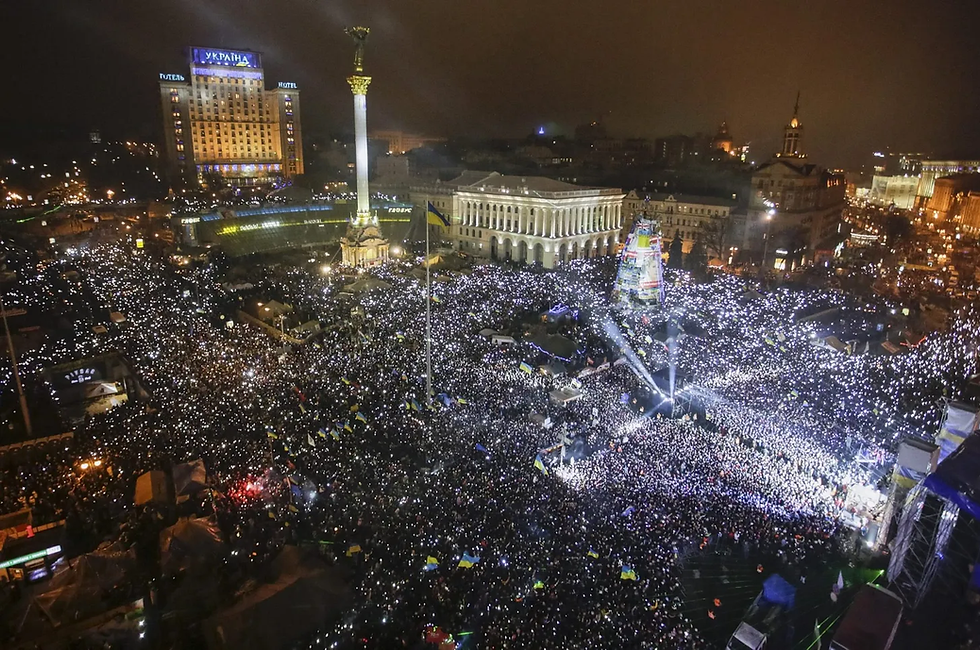
The Maidan protests were, at their core, a genuine popular movement. Millions of Ukrainians legitimately preferred European integration to Russian alignment. They were frustrated with corruption, with stagnation, with the sense that their government served oligarchs rather than citizens. Nothing in this article should be read as dismissing the authenticity of their grievances. But the protests were also something else. Violent elements were present from the early stages, including far-right nationalist groups like Right Sector and the Svoboda party, some of whose members drew ideological inspiration from the Ukrainian Insurgent Army that had collaborated with Nazi Germany during World War II. Snipers killed both protesters and police in February 2014; the identity of those snipers remains disputed, with evidence pointing in multiple directions.¹⁸
What is not disputed is that the United States government was an active participant, not a neutral observer. Assistant Secretary of State Victoria Nuland traveled to Kyiv in December 2013 and distributed sandwiches to protesters. She met repeatedly with opposition leaders. And in early February 2014, a phone call between Nuland and United States Ambassador to Ukraine Geoffrey Pyatt was intercepted and leaked, revealing the two of them discussing in explicit detail who should lead a post-Yanukovych Ukrainian government. Nuland identified Arseniy Yatsenyuk as her preferred prime minister, stating bluntly: “Yats is the guy.”¹⁹ When Pyatt raised concerns about European Union involvement, Nuland famously dismissed them with: “Fuck the EU.”²⁰
These are not the words of a diplomat observing events. These are the words of a proconsul selecting a government. When Yatsenyuk indeed became prime minister weeks later, the sequence appeared to vindicate precisely the Russian complaint: the United States was engineering regime change in a country on Russia’s border.
On February 21, 2014, European foreign ministers brokered an agreement between Yanukovych and the opposition. It called for early elections, a unity government, and constitutional reforms. Yanukovych signed it. The next day, amid continuing violence and armed occupation of government buildings, Yanukovych fled the capital. The Ukrainian parliament then voted to remove him from office. The vote did not follow the constitutional procedure for impeachment, which requires a two-thirds majority and judicial review. Western media overwhelmingly described this as a democratic revolution. The Russian government described it as a coup. On this occasion, as on many others, the language matters less than the facts. A European-brokered agreement for elections was signed one day and repudiated the next. An elected president was removed by extraconstitutional means. A government preferred by the United States was installed. Whatever one calls that, it is not the orderly functioning of democratic institutions.²¹
The Response: Crimea, Donbas, and the Minsk Betrayal
Russia’s response came within weeks. In late February and early March 2014, Russian forces already stationed in Crimea under the Black Sea Fleet basing agreement moved to secure the peninsula. A hastily organized referendum on March 16 reported that ninety-seven percent of Crimean voters had chosen to join Russia — a figure whose exact legitimacy is contested, but which certainly reflected the preferences of a substantial majority of the Russian-speaking Crimean population, who had voted pro-Russian in every previous election. Russia formally annexed Crimea, marking the first European border change by force since World War II. Western sanctions followed; Russia’s diplomatic isolation deepened; Sevastopol remained in Russian hands.²²
In the eastern Donbas region, Russian-speaking separatists in Donetsk and Luhansk proclaimed breakaway republics and took up arms against the new Kyiv government. Russia supported them with weapons, volunteers, and eventually — despite official denials — regular troops. Ukrainian forces attempted to reassert control. By the time of the 2022 full-scale invasion, approximately fourteen thousand people had been killed in eight years of Donbas fighting.²³
In September 2014 and February 2015, the leaders of France, Germany, Ukraine, and Russia negotiated the Minsk Agreements. The Minsk II accord of February 2015 called for ceasefire, withdrawal of heavy weapons, constitutional reform granting special status and autonomy to the Donbas regions within Ukraine, and eventual restoration of Ukrainian control over the international border. Russia considered Minsk II the framework for a political settlement. Ukraine, with strong encouragement from its Western backers, treated it as an imposition to be resisted and, ideally, reversed by force.²⁴
Then, in December 2022, former German Chancellor Angela Merkel gave an interview to Die Zeit that reframed the entire diplomatic history of the period. Asked about Minsk II, Merkel stated plainly: “The 2014 Minsk agreement was an attempt to give Ukraine time. It used this time to become stronger, as can be seen today. The Ukraine of 2014–2015 is not the Ukraine of today. It was clear to all of us that this was a frozen conflict, that the problem had not been solved, but that is precisely what gave Ukraine valuable time.”²⁵
Former French President François Hollande subsequently confirmed Merkel’s account in an interview with The Kyiv Independent, stating that the agreements “stopped the Russian offensive for a while” and allowed Ukraine to strengthen its military capabilities.²⁶ Former Ukrainian President Petro Poroshenko, who had signed Minsk II on behalf of Ukraine, admitted in a June 2022 interview that “our goal was to, first, stop the threat, or at least to delay the war — to secure eight years to restore economic growth and create powerful armed forces.”²⁷
This was not an accusation by Russian propagandists. It was an admission by the Western signatories themselves. The agreements they had signed, sworn to implement, and invoked whenever Russia was accused of violating them had been signed in bad faith from the beginning. The Russian conclusion — that the West could not be trusted to negotiate honestly, that Western diplomacy was a delaying tactic to enable military buildup — was precisely what the Minsk signatories eventually confirmed. One may argue that Ukraine had legitimate reasons for seeking to rearm. What one cannot argue is that the West was dealing in good faith. And if one is Russian, looking ahead to December 2021 and trying to assess whether negotiations with the West might resolve the crisis peacefully, one concludes on the basis of the most recent precedent that negotiation is not a serious alternative. That conclusion would prove consequential.
The Road to War
Between 2014 and 2022, Ukraine moved steadily westward. Post-Maidan governments pursued NATO integration through every means short of formal membership: joint exercises, training missions, weapons transfers, doctrinal alignment, interoperability measures. In 2019, the Ukrainian constitution was amended to make NATO and European Union membership explicit state goals.²⁸ American and British special forces trained Ukrainian units; Western weapons flowed in; Ukrainian officers studied at Western staff colleges. By 2021, Ukraine was, in all but name, a NATO partner in a state of undeclared military confrontation with Russia. From Moscow’s perspective, the red line drawn at Bucharest in 2008 was being crossed incrementally, through the accomplished fact rather than the formal declaration.
Throughout this period, Russian officials from Putin downward stated repeatedly and publicly that Ukrainian NATO membership or de facto military integration was unacceptable. These statements were dismissed in Western capitals as bluster, or as pretexts for internal repression, or as artifacts of Putin’s peculiar psychology. The possibility that they represented a serious assessment of Russian interests — the kind of assessment any great power would make regarding hostile alliances on its borders — was not entertained in any policy forum that mattered.
In December 2021, with approximately one hundred thousand Russian troops massed near the Ukrainian border, the Russian Foreign Ministry published two draft treaties — one with the United States, one with NATO — laying out Russia’s security demands. The core requests: a halt to NATO expansion, particularly regarding Ukraine and Georgia; a withdrawal of NATO forces and infrastructure from states that had joined the alliance after 1997; and a mutual agreement not to deploy certain categories of missile systems in Europe.²⁹ The drafts were maximalist. They contained provisions no American president could have accepted. But they also contained provisions — particularly regarding Ukrainian non-membership — that any serious negotiator would have recognized as the starting point of a diplomacy that might have averted war.
The Biden administration’s response was dismissive. On January 26, 2022, the United States formally replied that NATO’s open-door policy was non-negotiable. The administration subsequently leaked its position to the media, signaling that it had no intention of engaging seriously. Whether Russia would have accepted a deal preserving Ukrainian independence in exchange for formal neutrality is a question that will never be answered, because the offer was never made. What is known is that serious negotiation was not attempted.³⁰
On February 24, 2022, Russia invaded. The initial operation appeared designed either for rapid regime change in Kyiv or for the forced imposition of a settlement favoring Russian demands. Ukrainian resistance exceeded every Western estimate. The initial Russian offensive failed. The war became a grinding attrition conflict that has now consumed hundreds of thousands of lives on both sides. The war that Mearsheimer had predicted, that Kennan had warned of, that every informed realist had seen coming, had arrived exactly as described.
The Proxy War
The American response was the largest sustained arms transfer to a non-aligned state in modern history. Through December 2025, approximately $188 billion in United States spending had been made available for Ukraine, including military aid, economic support, and humanitarian assistance, according to the Council on Foreign Relations.³¹ An additional $20 billion loan was arranged through the World Bank, backed by frozen Russian assets held in Western financial institutions.³² European countries collectively exceeded the American total; the Kiel Institute estimates that approximately $127 billion directly supported Ukraine, with additional sums committed through multi-year frameworks.³³
The weapons packages grew in sophistication over time, following a predictable pattern. Early transfers were defensive: Javelin anti-tank missiles, Stinger anti-aircraft systems, small arms ammunition. Then came artillery, HIMARS rocket systems, air defense missiles. Then Bradley fighting vehicles, Leopard and Abrams tanks, F-16 fighter aircraft. Then long-range ATACMS missiles with eventual permission to strike inside internationally recognized Russian territory. At each step, a supposed Western red line was crossed. At each step, Russian threats of escalation were dismissed as bluff. At each step, the bluff was called and the next weapons system was delivered. Whether through careful calibration or through luck that may not hold, the escalation did not trigger the response it implicitly dared.³⁴
The decisive question is whether this vast expenditure of American resources purchased anything like a strategic benefit for the American people. The answer, evaluated honestly, is no. Ukrainian sovereignty over territory has not been restored; as of April 2026, Russia holds roughly the same twenty percent of Ukraine it held at the end of 2022. Russian military power has been degraded but not broken; Russia now produces more artillery ammunition than all of NATO combined. Russian sanctions have not destroyed the Russian economy; Russia’s GDP contracted in 2022 but has grown since, with the budget dominated by wartime production. European deindustrialization has accelerated as cheap Russian natural gas was replaced by expensive American liquefied natural gas — a windfall for American energy companies, a disaster for European manufacturing. Ukraine itself has lost a generation of young men, a quarter of its population to emigration, and a substantial portion of its infrastructure. The American defense industry has posted record earnings.³⁵
The cui bono analysis points to conclusions readers will find familiar. Lockheed Martin, Raytheon, General Dynamics, Northrop Grumman, and a constellation of smaller contractors have benefited enormously. European dependence on American energy and American security leadership has deepened, advantaging Washington in intra-alliance politics. The military-industrial complex that President Eisenhower warned against has been fed on a scale unprecedented in peacetime. The American people — whose taxes financed the transfers, whose government deficits grew to accommodate them, and whose sons and daughters stand closer to nuclear war than at any time since 1962 — have received nothing tangible in exchange.
One moment deserves particular attention. In March and April 2022, peace negotiations between Russia and Ukraine reportedly came within reach of a settlement. The terms under discussion in Istanbul included Ukrainian neutrality, limitations on the size of the Ukrainian armed forces, and security guarantees from a group of states including the United States, the United Kingdom, France, China, and Russia itself. According to subsequent reporting — including in Foreign Affairs and by journalists speaking with Ukrainian and Turkish officials — an agreement was nearly finalized. Then, in early April 2022, British Prime Minister Boris Johnson traveled to Kyiv. What exactly was communicated is disputed, but the negotiations collapsed shortly afterward. Participants including former Israeli Prime Minister Naftali Bennett, who had served as an intermediary, later stated publicly that the West had discouraged a settlement and preferred to continue the war.³⁶
This is the single most damning fact in the entire Ukrainian catastrophe. A settlement that would have preserved Ukrainian independence at the cost of formal neutrality — essentially the Finnish model that Henry Kissinger had proposed years earlier, essentially the outcome that the Trump administration is now trying to negotiate after three additional years of slaughter — was within reach in April 2022. It was rejected. Everything that followed, every death, every devastated city, every dollar spent, every step up the escalation ladder, traces to that decision.
The Nuclear Dimension
The nuclear dimension of the Ukraine war requires careful treatment. Alarmism serves no one; neither does dismissal. What is called for is a measured review of what is known.
Russia possesses the largest nuclear arsenal in the world, with roughly 5,580 warheads including approximately 1,710 strategic warheads deployed on intercontinental ballistic missiles, submarine-launched ballistic missiles, and strategic bombers.³⁷ Russian military doctrine, as revised in 2020 and reaffirmed in amended form in 2024, specifies conditions under which nuclear weapons might be employed: in response to nuclear attack, in response to attack with other weapons of mass destruction, in response to aggression against Russia using conventional weapons “when the very existence of the state is threatened,” and — under the 2024 revisions — in response to conventional attack against Russia or its ally Belarus that creates a critical threat to their sovereignty and territorial integrity.³⁸
Russia has made explicit nuclear threats at multiple points during the war. Putin and senior officials including former President Dmitry Medvedev have warned that Russia would use nuclear weapons if its existence were threatened. American officials have largely dismissed these threats as bluff. This dismissal may prove correct. It may also prove catastrophically wrong.
The question is not whether Russia will use nuclear weapons — no one knows, including the Russian leadership — but whether the policy of incremental escalation being pursued has accounted for the possibility that it might. Western strategy has proceeded on an implicit assumption that Russia will accept battlefield defeat rather than escalate to nuclear use. This assumption is untested. The conventional defeat of a nuclear superpower on its own declared strategic periphery has no precedent in the nuclear age. The confidence with which Washington has assumed that Moscow will behave as Western officials expect it to — that Russian nuclear doctrine is theater rather than doctrine, that Russian red lines are advertising rather than commitments — rests on the private judgments of a generation of policymakers who have misread Russian intentions at every previous step.
The question that was not asked, through three years of escalation, is: what is the American interest sufficient to justify this risk? Not Russia’s interest — Russia started the war. Not Ukraine’s interest — Ukraine is fighting for its national survival. The American interest. What benefit to the American people — in security, in liberty, in prosperity — is great enough that a one percent risk of nuclear exchange is acceptable? A five percent risk? A ten percent risk? The question was never publicly posed, never debated in Congress, never put to voters. The architects of the escalation have simply assumed the answer is “whatever it takes.”
The founders would have recognized this immediately as the essence of what they feared. Large standing military establishments, executive discretion in matters of war and peace, policies made in secret that risk the lives of citizens who never consented — these were the dangers against which the Constitution was designed to protect. In Ukraine, those protections were bypassed entirely. No declaration of war was sought. No congressional vote was taken on the substance of the escalation ladder. The American people were presented with the results.
The Interventionist Defense Answered
The strongest case for continued American support of Ukraine against Russia deserves to be made fairly before it is assessed. That case, shorn of the rhetoric, runs approximately as follows. Russia committed unprovoked aggression against a sovereign European state. Aggression that is rewarded invites further aggression; appeasement failed in 1938 and will fail now. If Russia is allowed to succeed in Ukraine, it will test Article 5 next, perhaps in the Baltics, drawing the United States into direct conflict under conditions of far greater disadvantage. Ukraine is a democracy, imperfect but real, fighting for its survival. The liberal international order that the United States has underwritten since 1945 depends on the principle that borders cannot be changed by force; allowing that principle to fall in Ukraine unravels the entire architecture. America must stand with its allies, support the people resisting tyranny, and ensure that Vladimir Putin’s aggression ends in failure rather than reward.
This case should be answered on its own terms, not dismissed.
The principle that aggression must be opposed is sound. Understanding what caused aggression is not the same as appeasing it. A doctor who explains that untreated hypertension causes strokes is not endorsing strokes. The explanation of how American policy contributed to creating conditions for war is not a defense of Russian action; it is a prerequisite for learning what American policy should be in the future. If every Russian grievance is dismissed as pretext, no Russian grievance can be addressed through diplomacy, and war becomes the only remaining instrument.
The 1938 analogy is misapplied. Munich involved a revisionist totalitarian power demanding territory based on ethnic claims as a prelude to continental conquest. Russia in 2022 invaded a country after thirty years of declaring that a specific step — NATO absorption of Ukraine — would be unacceptable, after that step was repeatedly advanced, and after serious diplomatic proposals to resolve the matter were rejected. One may conclude that Russia’s response was still wrong; one cannot conclude that the circumstances parallel those of Nazi Germany. Putin is not Hitler. Russia is not the Wehrmacht of 1939. The comparison has become a thought-terminating cliché deployed to evade rather than advance analysis.
The argument that Russia will attack NATO next requires assuming that Russia seeks to attack NATO — for which there is no evidence, and for which Russia’s conventional military performance in Ukraine provides considerable evidence to the contrary. Russia has not attacked a NATO member in the seventy-seven years of the alliance’s existence. Article 5 is a functioning deterrent. The Baltic states are protected by the NATO guarantee in a way that Ukraine was not. The premise that Russia will next invade Estonia — a country whose invasion would trigger full NATO involvement — assumes a Russian leadership so reckless that even the lessons of Ukraine would not deter it. That premise is asserted rather than argued.
The description of Ukraine as a democracy worth risking nuclear war for strains the available evidence. Ukraine ranks persistently among the most corrupt states in Europe; it has banned opposition parties, imprisoned political opponents, and nationalized media during the war; it has canceled elections and continues to operate under martial law. These facts do not justify Russian invasion. They do suggest that American readers who imagine they are defending a functioning Jeffersonian republic have been sold a picture that does not match reality. Ukraine is a state fighting for survival, not a model of governance whose preservation justifies the price being paid.
The “liberal international order” argument, finally, trades on an ambiguity. Insofar as it means the principle that borders should not be changed by force, no sincere advocate of peace disputes it. Insofar as it means American global hegemony, the right to expand military alliances to any border Washington chooses, and the authority to discipline deviations from approved behavior anywhere on earth, it describes not an order but an empire — and the founders who designed the American system would have recognized empire as the thing they most sought to prevent.
The question the interventionist defense never answers is the simple one: would this war have occurred without NATO expansion? Would it have occurred without the 2014 Maidan intervention? Could it have been settled in December 2021 through serious negotiation? Could it have been ended in April 2022 with the Istanbul framework? If the honest answer to any of these questions is yes, then those who chose otherwise bear responsibility for the consequences they chose.
The Vindication of the Realists
The historical record on Ukraine establishes, with a clarity rare in foreign policy disputes, who was right and who was wrong.
George Kennan, the architect of Cold War containment, published his warning in The New York Times in February 1997. He predicted that NATO expansion would inflame Russian nationalism, damage Russian democracy, restore the atmosphere of Cold War hostility, and push Russian foreign policy in directions Americans would not like. Every specific prediction was confirmed by events.³⁹
John Mearsheimer warned in 2014 that continued Western pressure on Ukraine would provoke Russian military action. Russia invaded Ukraine in 2022. Mearsheimer had predicted the mechanism — great powers do not tolerate hostile military alliances on their borders — and specified the probable outcome. The outcome matched the prediction.⁴⁰
Ambassador Jack Matlock, the last American ambassador to the Soviet Union, argued throughout the 1990s and 2000s that NATO expansion was strategically incoherent and that Russia would eventually respond. William Perry, Secretary of Defense under President Clinton, publicly regretted the decision to expand NATO and stated that it was one of the great mistakes of the post-Cold War period. Stephen Cohen, the leading American Russian historian of his generation, spent the last decade of his life warning that American policy was producing a confrontation that could end in disaster. Henry Kissinger, whatever else one thinks of his career, wrote in 2014 that Ukraine should be a bridge rather than a battleground, and that forcing a choice between East and West would produce catastrophe.⁴¹
These men were not Putin apologists. They were serious analysts applying serious principles to concrete questions. They were ignored.
The architects of NATO expansion — Strobe Talbott, Madeleine Albright, Richard Holbrooke, and their successors through the Bush, Obama, Trump, and Biden administrations — have not acknowledged error. Victoria Nuland, whose role in 2014 Ukraine is documented on tape in her own voice, was promoted to Under Secretary of State in the Biden administration and served until 2024. The think tanks that promoted expansion — the Atlantic Council, the Brookings Institution’s foreign policy program, the Center for a New American Security — continue to produce analyses as though their prior analyses had not been falsified by events. The media outlets that ridiculed Mearsheimer and Cohen continue to treat the architects of catastrophe as respectable commentators on foreign policy, while the realists who were right remain marginalized to outlets like Antiwar.com, the Quincy Institute for Responsible Statecraft, and specialized academic journals.⁴²
This is the accountability gap that has defined American foreign policy since Vietnam. Those who are wrong retain their positions and their prestige. Those who are right are permitted, at best, to publish in forums that do not reach the audiences whose understanding would actually alter policy. Until that gap closes, no lessons will be learned, because there is no mechanism by which error becomes costly to those who commit it. The Iraq War produced no serious consequences for its architects. The Libyan catastrophe produced no consequences. The Syrian debacle produced no consequences. The Ukrainian war will produce no consequences either — unless citizens who understand the record insist on consequences.
Conclusion: The Unnecessary War
Ukraine demonstrates, with a clarity that subsequent history will find difficult to obscure, several principles the founders understood and their successors forgot.
Great powers have security interests on their borders that cannot be dismissed by moral assertion. This is not a matter of ethics; it is a matter of physics and geography. The United States enforced this principle in 1823 with the Monroe Doctrine and in 1962 over Cuba. Russia asserts it over Ukraine. One may argue that Russia’s claim is less legitimate than America’s; one cannot argue that the structural logic differs. Policies that ignore this logic produce war.
NATO expansion was a choice. Promises were made to the Soviet leadership in 1990 that the alliance would not expand. Those promises were broken, repeatedly, across four administrations. Each breaking was justified as a minor adjustment to a stable system; cumulatively, they produced a strategic confrontation that has now killed more than a million people. The architects were warned. The warnings were dismissed.
Regime change, even when it wears the clothing of democratic revolution, produces instability and reaction. The 2014 Maidan replaced a corrupt but legitimate government with a government chosen partly by foreign sponsors. Whatever its merits, it could not have been anything other than provocative to Russia. Treating Ukrainian sovereignty as something to be exercised by external powers when those powers found the results congenial was not respect for sovereignty; it was its opposite.
Proxy wars escalate. Weapons systems that are unthinkable at the beginning become routine by the middle and obsolete by the end. The pattern in Ukraine — declared red line, Russian warning, crossing, repeat — is the standard pattern of escalation, and it produces unstable equilibria that can collapse in either direction. That this particular escalation has not yet produced nuclear use is a fact to be grateful for, not a fact to be trusted.
The people who are wrong retain power. The people who were right are marginalized. Until this changes, the pattern continues.
The path not taken was not surrender. It was diplomacy. Ukraine as a neutral state, along the Finnish or Austrian model, with security guarantees from multiple great powers, with its territorial integrity respected in exchange for a commitment not to join hostile military alliances — this was an available option. It was available in December 2021. It was available in March 2022. It is now being negotiated in 2026, at the cost of a million lives, a devastated country, and a confrontation between nuclear powers that has not yet reached its resolution.
How does this war end? As of the spring of 2026, the Trump administration is attempting to broker a settlement that accepts Russian control of the territories it has seized, rules out Ukrainian NATO membership, and commits Ukraine to a form of neutrality. This is, essentially, the deal that was available at Istanbul in April 2022. The intervening three years have not improved the terms available to any party. Ukraine has lost more territory, more people, and more economic capacity. Russia has paid enormous costs for gains it could have secured through negotiation. The United States has spent nearly two hundred billion dollars to arrive at a settlement worse than the one available before the spending began. The European economy has suffered lasting damage. The risk of nuclear catastrophe has been elevated and sustained over a period whose safe conclusion was never guaranteed.
The architects of this war have no answer to the question of how it could have been prevented, because preventing it would have required abandoning the policy — NATO expansion — to which they remained committed. They have no answer to the question of how it ends, because acceptable terms to Russia are unacceptable to those whose careers were built on the premise that Russia had no legitimate interests at stake. The gap between what they said and what the world became has not been closed by any acknowledgment of error. It is closed by events, silently, as the war grinds to whatever settlement exhaustion permits.
The founders understood this temperament. George Washington warned against permanent alliances and the passionate attachments that bind American interests to the quarrels of foreign nations. John Quincy Adams warned that America would become the dictatress of the world once she went abroad in search of monsters to destroy, no longer the ruler of her own spirit. The men who built this republic knew that prudence was a republican virtue, that humility was a republican virtue, that restraint was a republican virtue. They did not believe that America’s moral claims entitled her to remake the map of Eurasia. They would not have recognized the foreign policy pursued in Ukraine as an expression of the principles on which they had founded their country.
And yet we persist. The next article in this series will examine the financial architecture that makes this persistence possible — the dollar system, the Federal Reserve, and the exorbitant privilege that allows the United States to spend without apparent constraint on wars its citizens did not choose and do not benefit from. One cannot understand the empire without understanding the money that funds it.
Self-Reflection Prompts
George Kennan predicted in 1997 that NATO expansion would produce precisely the outcome we are witnessing. Why do you think his warning was ignored, and what does this suggest about how foreign policy decisions are actually made in the United States?
In 1962, the United States credibly threatened nuclear war over Soviet missiles ninety miles from Florida. In 2022, Russia invaded Ukraine over a Western military alliance on its border. Is the underlying principle different? If not, what does that tell us about the policies that led to the current war?
Former Chancellor Merkel and former Presidents Hollande and Poroshenko all acknowledged that the Minsk Agreements were signed in bad faith to buy Ukraine time to rearm. If true, how does this affect your assessment of Western diplomatic credibility? How should Russia have been expected to interpret subsequent Western proposals?
The war in Ukraine could still escalate to nuclear confrontation. What level of risk to American cities is acceptable to prevent Russian territorial gains in Ukraine? Who made this decision, and through what constitutional process?
Peace negotiations in March and April 2022 reportedly came within reach of a settlement that would have preserved Ukrainian independence at the cost of formal neutrality. If those negotiations had succeeded, how would the subsequent three years have differed? Who bears responsibility for their failure?
Endnotes
¹ George F. Kennan, “A Fateful Error,” The New York Times, February 5, 1997.
² John J. Mearsheimer, “Why the Ukraine Crisis Is the West’s Fault: The Liberal Delusions That Provoked Putin,” Foreign Affairs 93, no. 5 (September/October 2014): 77–89.
³ Center for Strategic and International Studies, “Ukraine Military Casualties Estimates,” January 2026 assessment, as reported by Russia Matters, March 25, 2026.
⁴ Estimates from Bloomberg, The Wall Street Journal, and The Economist, February 2026, as compiled by Russia Matters, March 25, 2026. See also Mediazona and BBC Russian Service casualty tracking project.
⁵ United Nations Office of the High Commissioner for Human Rights, “Ukraine: Civilian Casualty Update,” January 31, 2026, recording 15,172 killed and 41,378 injured since February 24, 2022.
⁶ Institute for the Study of War, territorial control data as of March 31, 2026, including Crimea and pre-2022 Donbas territories.
⁷ Al Jazeera, “Russia-Ukraine Orthodox Easter Ceasefire Begins,” April 11, 2026; Al Jazeera, “Ukraine and Russia Accuse Each Other of Breaching Easter Ceasefire,” April 12, 2026.
⁸ Reporting on Trump administration proposals including the twenty-point peace framework presented in the 2026 Geneva and Paris talks, as compiled by the UK House of Commons Library research briefing “Ukraine Peace Talks,” February 2026.
⁹ On the 1954 transfer of Crimea: Mark Kramer, “Why Did Russia Give Away Crimea Sixty Years Ago?” Cold War International History Project, Wilson Center, March 19, 2014.
¹⁰ On the Cuban Missile Crisis as an application of great-power security logic: Graham Allison, Essence of Decision: Explaining the Cuban Missile Crisis, 2nd ed. (New York: Longman, 1999).
¹¹ Memorandum of Conversation between James Baker and Mikhail Gorbachev, February 9, 1990, declassified and available through the National Security Archive, George Washington University.
¹² Mary Elise Sarotte, Not One Inch: America, Russia, and the Making of Post-Cold War Stalemate (New Haven: Yale University Press, 2021).
¹³ On the NATO expansion waves and their strategic implications: Richard Sakwa, Frontline Ukraine: Crisis in the Borderlands (London: I.B. Tauris, 2015).
¹⁴ North Atlantic Treaty Organization, Bucharest Summit Declaration, April 3, 2008, paragraph 23.
¹⁵ On Putin’s warning to Bush at Bucharest: multiple contemporaneous accounts, including William Burns, The Back Channel: A Memoir of American Diplomacy and the Case for Its Renewal (New York: Random House, 2019), 213–214.
¹⁶ On the 2010 Ukrainian presidential election: Organization for Security and Cooperation in Europe, “Ukraine Presidential Election 17 January and 7 February 2010: OSCE/ODIHR Election Observation Mission Final Report.”
¹⁷ On the 2013 EU–Russia competition: Samuel Charap and Timothy J. Colton, Everyone Loses: The Ukraine Crisis and the Ruinous Contest for Post-Soviet Eurasia (London: International Institute for Strategic Studies, 2017).
¹⁸ On the disputed sniper attacks of February 2014: Ivan Katchanovski, “The ‘Snipers’ Massacre’ on the Maidan in Ukraine,” paper presented at the American Political Science Association, September 2015; see also multiple investigative reports in BBC, The Guardian, and Die Welt.
¹⁹ Intercepted telephone conversation between Assistant Secretary of State Victoria Nuland and United States Ambassador Geoffrey Pyatt, released publicly on YouTube on February 4, 2014; widely reported, including by BBC News, “Ukraine Crisis: Transcript of Leaked Nuland-Pyatt Call,” February 7, 2014.
²⁰ Ibid.
²¹ On the constitutional questions surrounding Yanukovych’s removal: Nicolai N. Petro, “Understanding the Other Ukraine: Identity and Allegiance in Russophone Ukraine,” in Ukraine and Russia: People, Politics, Propaganda and Perspectives, ed. Agnieszka Pikulicka-Wilczewska and Richard Sakwa (Bristol: E-International Relations, 2015).
²² On the Crimean annexation and referendum: Serhii Plokhy, The Gates of Europe: A History of Ukraine (New York: Basic Books, 2015).
²³ United Nations Human Rights Monitoring Mission in Ukraine, casualty data for the Donbas conflict, 2014–2022.
²⁴ Minsk II Agreement, “Package of Measures for the Implementation of the Minsk Agreements,” signed February 12, 2015.
²⁵ Angela Merkel, interview with Die Zeit, December 7, 2022.
²⁶ François Hollande, interview with The Kyiv Independent, December 28, 2022.
²⁷ Petro Poroshenko, interview with Deutsche Welle and related press, June 17, 2022.
²⁸ On Ukraine’s 2019 constitutional amendment: Law of Ukraine No. 2680-VIII, “On Amendments to the Constitution of Ukraine Regarding the Strategic Course of the State for Acquiring Full Membership in the European Union and in the North Atlantic Treaty Organization,” February 7, 2019.
²⁹ Russian Ministry of Foreign Affairs, “Draft Treaty Between the United States of America and the Russian Federation on Security Guarantees” and “Agreement on Measures to Ensure the Security of the Russian Federation and Member States of the North Atlantic Treaty Organization,” published December 17, 2021.
³⁰ On the American rejection: Anton Troianovski and David E. Sanger, “U.S. Formally Rejects Russia’s Demand to Bar Ukraine from NATO,” The New York Times, January 26, 2022.
³¹ Council on Foreign Relations, “How Much Aid Has the U.S. Sent Ukraine? Here Are Six Charts,” updated December 2025.
³² World Bank, “Financial Intermediary Fund for Ukraine,” structured as a loan against frozen Russian sovereign assets, 2024.
³³ Kiel Institute for the World Economy, “Ukraine Support Tracker,” updated 2025.
³⁴ On the Western escalation pattern: Anatol Lieven, “The West’s Nuclear Brinkmanship with Russia,” Responsible Statecraft, multiple articles, 2022–2025.
³⁵ On the economic effects of sanctions and the European energy transition: Alexander Gabuev, “What’s Really Going on in the Russian Economy?,” Foreign Affairs, multiple analyses, 2023–2025; on American defense industry earnings, Stockholm International Peace Research Institute, annual reports on arms producers, 2023–2025.
³⁶ On the failed April 2022 negotiations: Naftali Bennett, video interview released February 4, 2023; Fiona Hill and Angela Stent, “The World Putin Wants: How Distortions About the Past Feed Delusions About the Future,” Foreign Affairs, September/October 2022; Gerhard Schröder, multiple interviews; and reporting in Ukrainska Pravda based on Ukrainian negotiating-team sources.
³⁷ Federation of American Scientists, “Status of World Nuclear Forces,” Hans M. Kristensen and Matt Korda, updated 2025.
³⁸ Russian Federation, “Fundamentals of State Policy in the Field of Nuclear Deterrence,” Presidential Decree No. 355, June 2, 2020; amended November 2024.
³⁹ Kennan, “A Fateful Error,” as cited above.
⁴⁰ Mearsheimer, “Why the Ukraine Crisis Is the West’s Fault,” as cited above; see also John J. Mearsheimer, The Great Delusion: Liberal Dreams and International Realities (New Haven: Yale University Press, 2018).
⁴¹ Henry Kissinger, “How the Ukraine Crisis Ends,” The Washington Post, March 5, 2014.
⁴² On the accountability gap in foreign policy: Stephen M. Walt, The Hell of Good Intentions: America’s Foreign Policy Elite and the Decline of U.S. Primacy (New York: Farrar, Straus and Giroux, 2018).
Sources and Further Reading
Primary Documents:
Memorandum of Conversation, James Baker and Mikhail Gorbachev, February 9, 1990 (National Security Archive)
NATO Bucharest Summit Declaration, April 3, 2008
Russian draft security treaties, December 17, 2021
Minsk II Agreement, February 12, 2015
Nuland–Pyatt phone call transcript, February 2014
Essential Secondary Sources:
John J. Mearsheimer, The Tragedy of Great Power Politics (2001)
Mary Elise Sarotte, Not One Inch: America, Russia, and the Making of Post-Cold War Stalemate (2021)
Richard Sakwa, Frontline Ukraine: Crisis in the Borderlands (2015)
Stephen F. Cohen, War with Russia? From Putin & Ukraine to Trump & Russiagate (2019)
Samuel Charap and Timothy J. Colton, Everyone Loses: The Ukraine Crisis and the Ruinous Contest for Post-Soviet Eurasia (2017)
Serhii Plokhy, The Gates of Europe: A History of Ukraine (2015)
From Specified Authors:
Scott Horton, Provoked: How Washington Started the New Cold War with Russia and the Catastrophe in Ukraine (2024)
Scott Horton, ongoing coverage at Antiwar.com and The Libertarian Institute
Patrick J. Buchanan, columns on NATO expansion and Ukraine, 1990s through 2020s
Ron Paul, speeches and articles on Ukraine policy, including The Ron Paul Liberty Report
Realist Analysis:
Stephen M. Walt, The Hell of Good Intentions (2018)
Anatol Lieven, Ukraine and Russia: A Fraternal Rivalry (1999)
The Quincy Institute for Responsible Statecraft, ongoing analysis at Responsible Statecraft


Comments