Serving Commerce: 1898 and the Birth of American Empire

“We have about 10% more products than we can consume. We have got to find a market for the excess... It is the greatest commercial prize of the world.”—Senator Albert Beveridge on the Philippines, 1898¹
The Year Everything Changed
In January 1898, the United States was a continental republic with no overseas colonies, a small professional military, and a foreign policy that would have been recognizable to Thomas Jefferson. By December 1898, America possessed an empire spanning the Caribbean and the Pacific, was engaged in colonial warfare against Filipino independence fighters, and had announced itself as a great power with global interests. The transformation took ten months.
This was not evolution but revolution—a deliberate choice for empire made in war fever, justified by humanitarian rhetoric, and opposed by some of the finest minds in America. The Spanish-American War and its consequences marked the decisive break from the founders’ foreign policy. Everything that followed—the interventions in Latin America, the entry into World War I, the permanent military establishment, the national security state—traces its lineage to the choices made in that pivotal year.
The war was manufactured. The empire was chosen. The arguments of those who opposed it—the Anti-Imperialist League, which included former presidents, industrialists, labor leaders, and literary giants—were not refuted but shouted down. Their warnings proved prophetic: the Philippines became exactly the strategic liability they predicted, the methods of colonial war corrupted American principles, and the republic began its transformation into something the founders would not have recognized.
Understanding 1898 is essential because the patterns established then have repeated throughout the subsequent century: the triggering incident of disputed origin, the media hysteria, the humanitarian justification for commercial and strategic interests, the executive manipulation of Congress, the marginalization of critics as unpatriotic, and the unforeseen consequences that produce the next intervention. From the Maine to the Gulf of Tonkin to weapons of mass destruction, the playbook has remained remarkably consistent.
The Spanish Context
Cuba and the Decline of Empire
Spain’s New World empire, once the envy of Europe, had shrunk to a few Caribbean islands and the Philippines by the 1890s. Cuba was the jewel that remained—sugar-rich, strategically positioned, and restless under colonial rule.
Cuban grievances were genuine. Spanish colonial administration was extractive and repressive. A ten-year independence war from 1868 to 1878 had ended in exhaustion rather than resolution. By 1895, a new insurgency had erupted, led by José Martí and other independence figures. The Spanish response, under General Valeriano Weyler, was brutal: a policy of “reconcentration” that herded rural populations into fortified camps to deny support to insurgents.²
The reconcentration policy produced genuine atrocity. Estimates suggest that 100,000 to 400,000 Cubans died in the camps from disease, malnutrition, and neglect.³ Spanish conduct was indefensible by any humanitarian standard. This matters because critics of American intervention are sometimes accused of denying Spanish atrocities. They were real. The question is not whether Spain behaved badly—it did—but whether American intervention was the appropriate response, whether the methods used were justified, and whether the actual consequences served Cuban interests or American imperial ambitions.
American Interests
American concern for Cuba was not purely humanitarian. Approximately $50 million in American capital was invested in Cuban sugar—a substantial sum in 1898 dollars.⁴ The island’s proximity to the planned Panama canal route gave it strategic significance. American businesses wanted stability, and some wanted annexation.
More immediately, the Cuban insurgency provided spectacular copy for the American press. William Randolph Hearst’s New York Journal and Joseph Pulitzer’s New York World were engaged in a circulation war, and Cuban atrocities—real and embellished—sold newspapers. “Yellow journalism” is the term historians use for the sensationalized coverage: lurid illustrations, inflammatory headlines, stories that blurred the line between reporting and advocacy. The apocryphal exchange attributed to Hearst—artist Frederic Remington cabling that there was no war in Cuba, Hearst responding “You furnish the pictures and I’ll furnish the war”—captures the dynamic even if the quotation itself is likely invented.⁵
The press did not create American interest in Cuba, but it amplified and inflamed it. By early 1898, public opinion was primed for intervention. What was needed was an incident.
The Explosion of the Maine
The Event
On January 25, 1898, the battleship USS Maine arrived in Havana Harbor. The official explanation was protection of American citizens and interests during the Cuban turmoil. The implicit message to Spain was unmistakable: the United States was watching.

On the evening of February 15, 1898, an explosion tore through the Maine, sinking the ship and killing 266 American sailors.⁶ The cause was unknown, but the American press did not wait for investigation. “DESTRUCTION OF THE WAR SHIP MAINE WAS THE WORK OF AN ENEMY,” screamed the New York Journal. “Remember the Maine!” became the rallying cry.
The Rush to Judgment
A naval court of inquiry, conducted under wartime pressure, concluded that the explosion was caused by an external mine—implying Spanish responsibility.⁷ This finding drove public outrage to fever pitch.
The inquiry was completed in less than a month. Its members were not explosives experts. They examined the wreckage in Havana Harbor under difficult conditions and with limited time. Their conclusion—external mine—fit the prevailing narrative and satisfied public demand for a culprit. Whether it fit the evidence was another matter.
What the court could not determine was who had planted the mine. Spain vigorously denied responsibility—and had every reason to tell the truth. Spanish authorities knew that war with the United States would be catastrophic for their already crumbling empire. They had no conceivable motive to attack an American warship in their own harbor. If anyone had reason to sink the Maine, it was Cuban insurgents seeking to draw America into their fight, or perhaps American interests seeking the same outcome. The court did not seriously investigate these possibilities.
Spain offered to submit the matter to international arbitration. The offer was refused.
Modern investigations, most notably a 1976 study by Admiral Hyman Rickover and a 1998 National Geographic analysis, have concluded that the explosion was likely internal—probably a coal bunker fire that ignited the ship’s ammunition magazines.⁸ Such accidents were not uncommon in ships of that era. The Maine‘s coal bunkers were positioned adjacent to ammunition storage—a design flaw that made catastrophic accident entirely plausible. Spontaneous coal fires were a known hazard; the Navy had documented similar incidents on other vessels.
The “Spanish mine” theory that drove America to war rested on incomplete evidence, unwarranted assumptions, and the pressure of public opinion demanding a villain. Whether Spain was responsible has never been established. What is established is that the United States did not wait to find out. The machinery of war was already in motion, and the Maine explosion provided the catalyst that made resistance politically impossible.
The pattern would recur. The Gulf of Tonkin incident in 1964 would follow similar contours: an alleged attack, disputed evidence, immediate escalation, investigation after the fact revealing a more complicated picture. By then the wars had been launched, the soldiers deployed, the commitments made. Truth arrives too late to prevent what falsehood has already accomplished.
Spain’s Concessions
In the weeks following the explosion, Spain made significant concessions. It offered an armistice in Cuba. It agreed to close the reconcentration camps. It indicated willingness to grant Cuban autonomy. By early April, Spain had effectively capitulated to American demands short of Cuban independence—which, given the Teller Amendment (discussed below), the United States had pledged not to obstruct.⁹
These concessions were insufficient for the war party. President William McKinley, personally inclined toward peace, faced enormous pressure from Congress, the press, and his own party. On April 11, he sent a war message to Congress that barely mentioned Spain’s concessions. On April 25, Congress declared war.
“A Splendid Little War”
The phrase was Secretary of State John Hay’s, and it captured American sentiment precisely. The Spanish-American War was brief, victorious, and—for Americans—relatively bloodless. It made heroes and launched political careers. It seemed to vindicate those who had clamored for intervention.

The Military Campaigns
Naval victory came swiftly. On May 1, Commodore George Dewey’s Asiatic Squadron destroyed the Spanish Pacific fleet at Manila Bay in the Philippines. The battle lasted hours; American casualties were minimal.¹⁰ Dewey became an instant national hero.
In Cuba, the campaign was messier but equally decisive. Theodore Roosevelt resigned as Assistant Secretary of the Navy to lead the “Rough Riders” volunteer cavalry regiment. The assault on San Juan Hill—actually Kettle Hill—became legend, whatever the tactical realities. By mid-July, Spanish forces in Cuba had surrendered. The Caribbean fleet was destroyed at Santiago.
American combat deaths totaled approximately 400. Disease killed ten times as many—a reminder of the logistical realities of tropical warfare.¹¹ But for the American public, the war was a triumph: swift, glorious, and cheap.
The Treaty of Paris
Spain sued for peace in August. The Treaty of Paris, signed in December 1898, transferred to the United States: Puerto Rico, Guam, and—crucially—the Philippines. Cuba was granted nominal independence but would operate under American oversight through the Platt Amendment, which gave the United States the right to intervene in Cuban affairs and established the Guantánamo Bay naval base that remains American territory today.¹²
The Platt Amendment deserves attention. Cuba, in whose name the war had supposedly been fought, was granted independence—but an independence circumscribed by American prerogatives. The amendment, attached as a condition of American withdrawal, required Cuba to lease naval bases to the United States, limited Cuba’s ability to incur debt or make treaties with foreign powers, and—most significantly—gave the United States the right to intervene “for the preservation of Cuban independence” or “the maintenance of a government adequate for the protection of life, property, and individual liberty.”¹² In other words, Cuba was nominally independent but subject to American intervention whenever American officials judged intervention necessary. This was not the liberation the Teller Amendment had promised.
For the Philippines, the United States paid Spain $20 million—not for Philippine consent, which was neither sought nor given, but for Spanish renunciation of sovereignty over a people who had been fighting for their independence.
The question that mattered—what to do with these possessions—had only begun. The Constitution provided no template for permanent colonies. The founders had not contemplated an American empire. Now the nation had one, and no one was quite sure what the rules were.
The Philippine Question
The Acquisition Debate

The Philippines presented a problem the Teller Amendment had tried to avoid. That amendment, attached to the war declaration, pledged that the United States would not annex Cuba—a concession to anti-imperialist sentiment.¹³ No such restriction applied to other Spanish possessions. The Philippines, an archipelago of seven thousand islands and seven million people halfway around the world, now belonged to the United States.
Filipinos had their own views on the matter. They had been fighting for independence from Spain before American intervention. Emilio Aguinaldo’s independence forces had cooperated with Dewey’s fleet, understanding themselves as American allies against a common enemy. They expected, not unreasonably, that victory would bring the independence they had been fighting for.
President McKinley’s explanation of how he decided to annex the Philippines has become infamous:
“I walked the floor of the White House night after night until midnight, and I am not ashamed to tell you, gentlemen, that I went down on my knees and prayed Almighty God for light and guidance more than one night. And one night late it came to me this way... that there was nothing left for us to do but to take them all, and to educate the Filipinos, and uplift and civilize and Christianize them.”¹⁴
The irony was lost on McKinley: the Philippines had been Christian—Catholic—for three hundred years under Spanish rule. What they lacked was not Christianity but independence.
The Ratification Fight
The Treaty of Paris required a two-thirds Senate vote for ratification. This was not assured. The Anti-Imperialist League mobilized opposition, and the treaty’s fate remained uncertain through January 1899.
William Jennings Bryan, the Democratic standard-bearer and opponent of empire, made a fateful choice. He urged Democratic senators to ratify the treaty, arguing that this would end the war and allow the question of Philippine independence to be decided democratically in the 1900 election.¹⁵ The strategy backfired catastrophically. The treaty was ratified on February 6, 1899, by a margin of two votes. Bryan’s hopes of fighting imperialism at the ballot box came to nothing—he lost the 1900 election to McKinley. The acquisition was legitimized, and the window for reversal closed.
The Philippine-American War
Two days before the Senate ratified the treaty, war erupted between American forces and Filipino independence fighters. It would last officially until 1902 and effectively until 1913. It would claim far more lives than the Spanish-American War itself. And it would employ methods that Americans had condemned when Spain used them.
The War
Conventional military operations ended relatively quickly. The American military advantage in organization, firepower, and resources was overwhelming. By late 1899, Aguinaldo’s organized forces had been defeated, and the independence leader had retreated to guerrilla warfare.
The guerrilla phase was another matter entirely. Filipino resistance proved tenacious, aided by terrain, popular support, and the same factors that would bedevil American counterinsurgency efforts for the next century. American forces controlled the towns; the countryside belonged to the guerrillas after dark.
The Methods
Unable to defeat the insurgency through conventional means, American commanders turned to methods they had condemned when Spain employed them. The reconcentration policy—the very practice that had outraged American opinion and provided moral justification for intervention in Cuba—was adopted under different terminology.¹⁶ Rural populations were concentrated into controlled zones. Food supplies in insurgent areas were destroyed. The countryside was made uninhabitable.
The “water cure,” a form of torture that would later be called waterboarding, was used in interrogations. A Senate investigation documented the practice: water forced into the stomach until the victim’s abdomen was grotesquely distended, followed by pressure on the abdomen to expel the water, the process repeated until information was extracted or the victim died.¹⁷ American soldiers testified to employing this method. Officers acknowledged it occurred. The practice was neither secret nor particularly controversial at the time—the victims were, after all, “savages” resisting American benevolence.
The logic of counterinsurgency drove escalation. When guerrillas operated with popular support, the population itself became the target. Villages suspected of harboring insurgents were burned. Livestock was slaughtered. Crops were destroyed. The strategy had a name: “chastisement.” Its purpose was to make the cost of resistance so high that the population would abandon the insurgents.
General Jacob Smith, commanding operations on the island of Samar after a guerrilla attack killed American soldiers at Balangiga, issued orders that became notorious: “I want no prisoners. I wish you to kill and burn. The more you kill and burn, the better it will please me... The interior of Samar must be made a howling wilderness.” Asked to clarify the age limit for killing, Smith allegedly replied: “Ten years.”¹⁸
Smith was court-martialed, convicted of “conduct to the prejudice of good order and military discipline,” and forced to retire. He was not charged with war crimes. The punishment for ordering the killing of children was loss of employment. The message was clear: the methods might be regrettable, but the mission would continue.
Reports of atrocities reached American newspapers. They produced some outcry but no fundamental reconsideration. The Anti-Imperialist League publicized the testimony. Mark Twain’s satires grew more bitter. But the war continued, and the atrocities continued, and the public eventually tired of hearing about them.
The Death Toll
Estimates of Filipino deaths vary enormously—from 200,000 to over 1,000,000—depending on methodology and what is counted.¹⁹ Most deaths were not from combat but from war-related famine and disease, as they are in most wars. The population of the Philippines declined measurably during the American occupation.
For comparison: approximately 4,200 American soldiers died in the Philippine-American War, most from disease.²⁰ The ratio of Filipino to American deaths tells its own story about who bore the costs of “benevolent assimilation.”
The Anti-Imperialist League
The Coalition
The Anti-Imperialist League was founded in June 1898, before the war with Spain had even concluded, to oppose the annexation of the Philippines. It was not a fringe movement but a substantial coalition of American elites.
Members included former President Grover Cleveland, who had refused to annex Hawaii on principle. Andrew Carnegie, the steel magnate, funded League activities and argued that empire was economically irrational. Mark Twain lent his literary genius to the cause, producing savage satires of imperial pretension. Samuel Gompers of the American Federation of Labor opposed annexation on behalf of American workers who feared competition from colonial labor. Academics, clergy, and reformers joined industrialists and labor leaders in opposition.²¹
At its peak, the League claimed perhaps half a million to a million members or supporters. Its arguments deserve attention, because they were not answered but merely overwhelmed.
The Constitutional Argument
The Constitution, anti-imperialists argued, did not contemplate permanent colonies with subject populations. The founding documents spoke of self-government, consent of the governed, and the rights of man. The Declaration of Independence proclaimed principles it called “self-evident” and universal. How could a republic founded on these principles hold colonies of people denied representation, denied citizenship, denied the rights Americans claimed for themselves?
Senator George Hoar of Massachusetts put the question directly:
“You have no right at the cannon’s mouth to impose on an unwilling people your Declaration of Independence and your Constitution and your notions of freedom and notions of what is good.”²²
The Constitution provided for territories to become states. It did not provide for permanent subject territories, because the founders had not envisioned an American empire. The precedent of holding such territories, anti-imperialists warned, would corrupt American institutions.
The Economic Argument
Free trade did not require political control. If American businesses wanted access to Philippine markets, they could trade with an independent Philippines as they traded with other nations. Colonial administration was expensive—the military occupation, the civil government, the infrastructure of empire all required appropriations that American taxpayers would fund. The Philippines would be a drain, not a source of wealth.
William Graham Sumner, the Yale sociologist, delivered the most famous economic critique in an essay titled “The Conquest of the United States by Spain”:
“We have beaten Spain in a military conflict, but we are submitting to be conquered by her on the field of ideas and policies. Expansionism and imperialism are nothing but the old philosophies of national prosperity which have brought Spain to where she now is.”²³
The Spanish Empire had made Spain poor, not rich. Its colonies had required endless military expenditure to acquire and maintain, had diverted resources from productive investment, and had corrupted Spanish institutions with the habits of colonial administration. Now America proposed to follow the same path.
The Moral Argument
The moral argument was simplest and most fundamental. People have rights. Those rights do not depend on race, religion, or civilization. Filipinos had the same natural rights as Americans—including the right not to be ruled by foreigners against their will.
“We do not intend to free, but to subjugate the people of the Philippines,” Mark Twain wrote. “We have gone there to conquer, not to redeem.”²⁴
The Christian missionaries who supported annexation claimed they were bringing salvation. Twain replied with “The War Prayer,” a devastating satire in which a congregation prays for victory, and a stranger reveals the unspoken content of their prayer: “help us to tear their soldiers to bloody shreds with our shells... help us to wring the hearts of their unoffending widows with unavailing grief.” The piece was too bitter for publication in Twain’s lifetime.
The Strategic Argument
The Philippines, anti-imperialists warned, would be strategically indefensible. The archipelago lay thousands of miles from American shores, adjacent to rising Asian powers with interests of their own. Defending the Philippines would require permanent military presence, naval bases, and entanglement in Asian rivalries that were no concern of the United States.
This argument proved prophetic. The Philippines became the vulnerability that Japanese strategists targeted in December 1941. The islands fell after desperate resistance. American prisoners endured the Bataan Death March. The strategic liability the anti-imperialists predicted materialized exactly as they had warned.
Why They Lost
The anti-imperialists lost despite the quality of their arguments. Several factors explain their defeat.
War fever made opposition appear disloyal. Once American soldiers were fighting and dying in the Philippines, criticism of the war seemed like criticism of the soldiers. To question the acquisition was to question the valor of those who had won it. Patriotic emotion overwhelmed constitutional scruple. The anti-imperialists were labeled traitors, cowards, pro-Spanish—the usual vocabulary deployed against those who question wars in progress.
Racism provided convenient rationalization. Many Americans simply did not believe Filipinos capable of self-government. They were “little brown brothers” who needed American tutelage—perhaps indefinitely. The alternative to American rule was not Philippine independence but chaos, or conquest by some other imperial power. Better American benevolence than Japanese or German domination. This assumption was rarely examined and never proven, but it satisfied Americans who wanted to believe their empire was different.
Commercial interests mobilized effectively. The “China market”—access to Asian trade—was the prize that business interests sought, and the Philippines offered a stepping stone. Senator Albert Beveridge spoke for this constituency: “The Philippines are ours forever... And just beyond the Philippines are China’s illimitable markets.”¹ The romance of commerce in the Orient proved irresistible. That the China market would never generate the profits its advocates promised mattered less than the dream.
Both political parties’ leadership supported expansion. McKinley was a Republican imperialist; Bryan’s attempt to fight imperialism electorally after ratifying the treaty left Democrats without clear anti-imperial positioning. The anti-imperialists had eloquent voices but no political vehicle. They could make arguments but could not make policy. The political system offered no effective mechanism for translating their sentiment into action.
Bryan’s blunder—urging ratification to fight the issue electorally—legitimized the acquisition at the crucial moment. Once the treaty was ratified and war had begun, reversal became nearly impossible. Filipinos were dying, American soldiers were dying, prestige was engaged, and to withdraw would be to admit error. No politician wishes to admit error. The fait accompli prevailed, as faits accomplis generally do.
The Ideology of Empire
The Roosevelt Vision
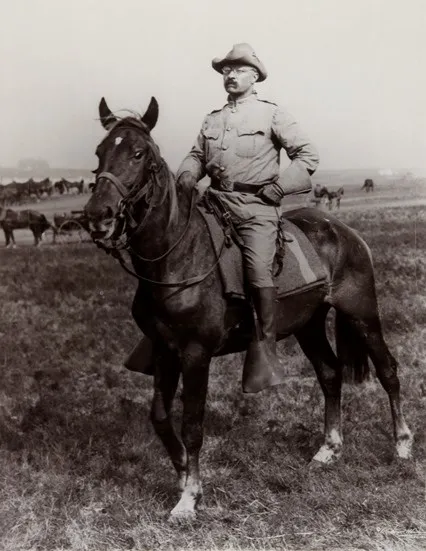
No one embodied the new imperial ideology more completely than Theodore Roosevelt. His political career was launched by the Spanish-American War—the Rough Riders, San Juan Hill, the image of vigorous American manhood triumphant. He became governor of New York, then vice president, then—upon McKinley’s assassination in 1901—the youngest president in American history. His presidency would articulate the vision that would guide American foreign policy for generations.
Roosevelt’s philosophy was one of strenuous nationalism. Nations, like individuals, proved their worth through struggle. Softness invited contempt; vigor commanded respect. The “strenuous life” he celebrated required challenges worthy of the American character. Having conquered the continent, America needed new frontiers—and the world provided them.
“I should welcome almost any war,” Roosevelt had written in 1897, “for I think this country needs one.”²⁵ The sentiment was not ironic. War built character. It unified nations. It separated the virile from the decadent. These were common ideas in the late nineteenth century, drawn from Social Darwinism, from theories of racial vigor, from the widespread sense that civilization needed periodic testing in blood.
The Roosevelt Corollary to the Monroe Doctrine (1904) transformed “Europe stay out” into “America intervenes at will.” Where Monroe had warned European powers against colonizing the Western Hemisphere, Roosevelt announced that the United States would exercise “international police power” in Latin America whenever instability threatened or nations failed to meet their obligations.²⁵ The hemisphere was an American sphere of influence, and the United States would enforce order—by intervention if necessary.
This was not the founders’ foreign policy. It was its opposite. Washington had warned against foreign entanglement; Roosevelt entangled vigorously. Jefferson had counseled commerce with all, alliances with none; Roosevelt proclaimed American primacy and the duty to enforce it. Madison had warned that war concentrates power; Roosevelt celebrated that concentration.
The transformation was not subtle, and contemporaries recognized it. What had changed was not the principles—the founders’ warnings remained on the books, quoted occasionally by dissenters—but the willingness to follow them.
The Intellectual Framework
Roosevelt’s policies drew on intellectual currents that had been building for decades. Alfred Thayer Mahan’s The Influence of Sea Power Upon History (1890) argued that national greatness required naval supremacy, and naval supremacy required bases and coaling stations around the world.²⁶ Social Darwinism applied “survival of the fittest” to nations: empires that did not expand would be surpassed by those that did. Anglo-Saxonism held that the English-speaking peoples had special gifts for governance and a civilizing mission to discharge.
Rudyard Kipling addressed “The White Man’s Burden” specifically to Americans contemplating the Philippines:
“Take up the White Man’s burden— Send forth the best ye breed— Go bind your sons to exile To serve your captives’ need.”²⁷
The poem urged imperial responsibility as duty, not merely interest. The civilized races were obligated to uplift the savage—however ungrateful the recipients might be.
Protestant missionary enthusiasm merged with strategic and commercial calculation. The foreign mission movement saw overseas empire as opportunity for evangelization. Commerce, Christianity, and civilization would advance together under American protection.
The Commercial Reality
Behind the ideology lay commercial interest. American industrial production had grown enormously since the Civil War. By the 1890s, some business leaders worried about overproduction—more goods than domestic markets could absorb. Foreign markets offered the solution, and the “open door” to Asian trade became a strategic objective.
The Open Door Notes of 1899-1900 announced American policy toward China: equal commercial access for all powers, preservation of Chinese territorial integrity (against further partition), and American participation in the China trade.²⁸ The Philippines were the platform from which American influence in Asia would be projected.
The merger of commercial interest and imperial ideology was complete. America would pursue markets, but would justify the pursuit in terms of civilization, Christianity, and uplift. The pattern would persist.
What 1898 Meant
What Changed
The transformation was comprehensive.
America acquired permanent overseas colonies with subject populations—people who were neither citizens nor aliens, governed without consent, ruled by American power without American rights.
America committed to great-power competition in regions far from its shores—the Caribbean and the Pacific—creating interests that would require defense and entanglements that would demand attention.
The executive gained power to deploy forces globally, to acquire territory, and to govern colonial possessions with minimal congressional oversight. The imperial presidency had its origins here.
The military establishment expanded permanently. The small professional army of the continental republic gave way to an institution capable of projecting power across oceans.
The ideology shifted from republican restraint to national greatness, from the founders’ suspicion of power to Roosevelt’s celebration of it.
What Was Lost
The founders’ foreign policy principles were abandoned, not refuted. Washington’s warnings against foreign entanglement, Jefferson’s counsel of “peace, commerce, and honest friendship with all nations,” Madison’s analysis of how war corrupts republics—these were not answered. They were dismissed as obsolete, outgrown, inapplicable to a rising power with global interests.
The anti-imperialists’ arguments were not answered but overwhelmed. The constitutional objections, the economic analysis, the moral critique, the strategic warnings—none received adequate response. They were shouted down by war fever and then forgotten.
The precedent of colonial war and counterinsurgency brutality was established. The methods used in the Philippines—torture, reconcentration, collective punishment, the killing of civilians—would be employed again in subsequent American interventions. The pattern of colonial impunity was set.
The connection between expansion and constitutional decay that Madison warned of became visible. War concentrated power. Empire required standing military forces. The executive gained at the expense of Congress. The trajectory the founders feared had begun.
The Counter-Tradition
The anti-imperialist tradition did not disappear. It survived, diminished but persistent, through the twentieth century.
It would resurface in opposition to World War I, when the “Old Right” warned against European entanglement. It animated the America First movement before World War II. It found expression in the libertarian critique of Cold War interventionism—in the writings of Murray Rothbard, in the campaigns of Ron Paul, in the persistent dissent from bipartisan foreign policy consensus.
The tradition from William Graham Sumner through Robert Taft through the modern libertarian movement is continuous. Its arguments are the founders’ arguments, adapted to changed circumstances but unchanged in essence: that republics cannot sustain empire, that foreign entanglement corrupts domestic liberty, that war is the health of the state and the enemy of freedom.
Self-Reflection Prompts
The Anti-Imperialist League included figures across the political spectrum—conservative industrialists, progressive reformers, labor leaders. Does this suggest that anti-imperialism is not inherently “left” or “right”? Where would you locate it on today’s political spectrum?
William Graham Sumner argued that by conquering Spain’s colonies, “Spain conquered the United States.” What do you think he meant? Do you see evidence of this dynamic in subsequent American history?
The Philippine-American War produced atrocities that were documented at the time but are largely forgotten today. Why do you think this history is not more widely known? Does forgetting such episodes serve any function?
The anti-imperialists warned that the Philippines would become a strategic liability. They were vindicated in 1941-1942, when Japan conquered the islands. Does the accuracy of their strategic prediction affect your assessment of their arguments?
McKinley said divine guidance led him to annex the Philippines. Roosevelt said national greatness required expansion. The Anti-Imperialist League said the Constitution and Declaration of Independence forbade it. Whose argument do you find most compelling? Why?
Endnotes
¹ Beveridge, Albert J. “The March of the Flag.” Speech, September 16, 1898. Available at: https://sourcebooks.fordham.edu/mod/1898beveridge.asp
² Tone, John Lawrence. War and Genocide in Cuba, 1895-1898. University of North Carolina Press, 2006. Chapter 7.
³ Estimates vary widely. See Pérez, Louis A. Cuba: Between Reform and Revolution. Oxford University Press, 1988. pp. 178-179.
⁴ Offner, John L. An Unwanted War: The Diplomacy of the United States and Spain over Cuba, 1895-1898. University of North Carolina Press, 1992. p. 12.
⁵ The Hearst-Remington exchange is almost certainly apocryphal. See Campbell, W. Joseph. Yellow Journalism: Puncturing the Myths, Defining the Legacies. Praeger, 2001.
⁶ Naval History and Heritage Command. “USS Maine.” Available at: https://www.history.navy.mil/research/histories/ship-histories/danfs/m/maine-ii.html
⁷ United States Navy Department. Report of the Naval Court of Inquiry upon the Destruction of the United States Battle Ship Maine. 1898.
⁸ Rickover, Hyman G. How the Battleship Maine Was Destroyed. Naval History Division, 1976. See also National Geographic Society investigation, 1998.
⁹ Offner, An Unwanted War, chapters 7-8.
¹⁰ Musicant, Ivan. Empire by Default: The Spanish-American War and the Dawn of the American Century. Henry Holt, 1998. pp. 251-272.
¹¹ Cosmas, Graham A. An Army for Empire: The United States Army in the Spanish-American War. Texas A&M University Press, 1994. pp. 294-295.
¹² Treaty of Paris (1898). Available at: https://avalon.law.yale.edu/19th_century/sp1898.asp
¹³ Teller Amendment. Congressional Record, April 19, 1898.
¹⁴ McKinley’s account appeared in The Christian Advocate, January 22, 1903, recounting a conversation with a Methodist delegation.
¹⁵ Beisner, Robert L. Twelve Against Empire: The Anti-Imperialists, 1898-1900. McGraw-Hill, 1968. pp. 217-220.
¹⁶ Miller, Stuart Creighton. “Benevolent Assimilation”: The American Conquest of the Philippines, 1899-1903. Yale University Press, 1982. Chapter 8.
¹⁷ U.S. Senate. “Affairs in the Philippine Islands.” Hearings before the Committee on the Philippines, 57th Congress. (The Lodge Committee hearings, 1902.)
¹⁸ “The Howling Wilderness Order.” Quoted in Miller, Benevolent Assimilation, pp. 211-212.
¹⁹ See De Bevoise, Ken. Agents of Apocalypse: Epidemic Disease in the Colonial Philippines. Princeton University Press, 1995. Estimates on total excess deaths remain contested.
²⁰ Boot, Max. The Savage Wars of Peace: Small Wars and the Rise of American Power. Basic Books, 2002. p. 125.
²¹ Tompkins, E. Berkeley. Anti-Imperialism in the United States: The Great Debate, 1890-1920. University of Pennsylvania Press, 1970.
²² Hoar, George Frisbie. Speech in the Senate, January 9, 1899. Congressional Record, 55th Congress, 3rd Session.
²³ Sumner, William Graham. “The Conquest of the United States by Spain.” 1899. Available at: https://praxeology.net/WGS-CUS.htm
²⁴ Twain, Mark. “To the Person Sitting in Darkness.” North American Review, February 1901.
²⁵ Roosevelt, Theodore. Annual Message to Congress, December 6, 1904. Available at: https://www.presidency.ucsb.edu/documents/fourth-annual-message-15
²⁶ Mahan, Alfred Thayer. The Influence of Sea Power Upon History, 1660-1783. Little, Brown, 1890.
²⁷ Kipling, Rudyard. “The White Man’s Burden.” McClure’s Magazine, February 1899.
²⁸ Hay, John. Open Door Notes, 1899-1900. Available at: https://avalon.law.yale.edu/19th_century/china001.asp
Recommended Reading
Kinzer, Stephen. The True Flag: Theodore Roosevelt, Mark Twain, and the Birth of American Empire. Henry Holt, 2017.
Kramer, Paul. The Blood of Government: Race, Empire, the United States, and the Philippines. University of North Carolina Press, 2006.
Immerwahr, Daniel. How to Hide an Empire: A History of the Greater United States. Farrar, Straus and Giroux, 2019.
Buchanan, Patrick J. A Republic, Not an Empire: Reclaiming America’s Destiny. Regnery, 1999. Chapters 6-8.
Paul, Ron. A Foreign Policy of Freedom. Foundation for Rational Economics and Education, 2007.


Comments