Monetary Alchemy: The Federal Reserve and the Age of Perpetual Crisis

From the Gold Window to the Fiat Republic
On August 15, 1971, President Richard Nixon went on television to announce the “temporary” suspension of the dollar’s convertibility into gold. That “temporary” measure became permanent. The Bretton Woods system of fixed exchange rates collapsed, and the United States entered the era of fiat sovereignty—a government able to fund itself not through taxation or honest borrowing but through monetary creation.
Under a commodity standard, the quantity of money was limited by the cost of producing it. Under fiat money, the quantity of money is limited only by the political cost of restraint.
As Murray Rothbard warned:
“Once government has a monopoly on the issue of money, it will use that monopoly to inflate the money supply and finance its own operations.”— What Has Government Done to Our Money? (1963), p. 56
The Myth of “Rising Wages”
Defenders of the post-1971 order argue that nominal wages have risen alongside prices, softening the blow of inflation. But this confuses money income with real wealth. Since the dollar’s detachment from gold, consumer prices have risen more than 500 percent, while Median real wages for men have remained relatively flat since the early 1970s¹, though the causes—globalization, deindustrialization, skill premiums, and monetary policy—remain contested among economists. Libertarians emphasize inflation’s role in eroding purchasing power, while mainstream economists cite broader structural factors.
In addition, each inflationary cycle boosts wages only after prices adjust—eroding purchasing power in the interim and discouraging long-term saving.
Inflation does not simply raise prices; it distorts time preference. When citizens know that saved dollars will lose value, rational behavior shifts from saving to spending, from investing to speculating. The culture of thrift that once financed capital accumulation gives way to the psychology of consumption.
As Austrian economists emphasize, a society’s willingness to defer gratification—its time preference—determines its capacity for capital formation. High time preference (present-oriented) leads to consumption; low time preference (future-oriented) leads to saving and investment, which funds long-term productive capital. Fiat money shortens that horizon; it rewards immediacy and punishes prudence.
The Hidden Tax
Inflation is the most political of taxes: it transfers wealth from those who save to those who spend first. Government and the banking system, as first recipients of new money, enjoy higher purchasing power before prices adjust; wage earners and pensioners experience the loss later. The mechanism is subtle but systematic—what Friedrich Hayek called “the most efficient means of arbitrary redistribution ever invented.”
Through the 1970s, inflation averaged more than 7 percent. The dollar lost two-thirds of its purchasing power by the time Reagan took office. Yet the deeper change was psychological: the expectation that money would always lose value became normal. That expectation transformed the American economy from a savings-based system of capital formation to a credit-based system of perpetual motion.
Monetary Mechanics: How Fiat Works
To understand modern policy, one must understand M2—the broad measure of money supply including cash, checking deposits, savings accounts, and short-term money-market funds.
When the Federal Reserve wishes to alter liquidity, it does so through two principal levers:
Interest Rates — the Price of Money. Lowering the federal-funds rate (the overnight rate between banks) makes borrowing cheaper, expanding credit; raising rates contracts it.
Quantitative Easing (QE) — the Quantity of Money. When rates approach zero, the Fed buys Treasury and mortgage-backed securities, creating new reserves within the banking system. These purchases expand the monetary base and, through fractional-reserve lending, inflate M2—the practical pool of spendable money.
When the Fed buys assets, it creates new dollars with a keystroke; when it sells or allows them to mature, it “destroys” dollars. In theory, liquidity smooths volatility; in practice, it amplifies dependence—markets now expect rescue at every tremor.
The Fiat Incentive Problem
Under sound money, thrift funds production. Under fiat money, credit replaces thrift, and debt itself becomes the engine of growth. Every expansion must be followed by greater expansion, or the illusion collapses.
This is why the modern state cannot tolerate deflation: not because falling prices harm consumers, but because falling asset prices expose over-leveraged balance sheets built on cheap money.
As Ron Paul observed:
“When government can create money out of thin air, it no longer needs to tax or borrow honestly. Inflation is the most insidious tax of all.”— End the Fed (2009), p. 35
The Federal Reserve thus functions less as a lender of last resort than as an arbiter of time preference—deciding how patient or impatient society will be allowed to be.In doing so, it claims the role once reserved for the market and, by extension, for morality itself.
The Fed Becomes the Fourth Branch
Created in 1913, the Federal Reserve was intended to prevent banking panics like those of 1873 and 1907. But its birth was as much a political maneuver as an economic reform—crafted in secrecy and passed in haste.
In November 1910, Senator Nelson Aldrich, head of the National Monetary Commission, convened a confidential meeting at the Jekyll Island Club off the coast of Georgia. There, under strict secrecy, a small group of financiers and policymakers—including Aldrich, Benjamin Strong (future first Governor of NY Fed), A.P. Andrew (Assistant Treasury Secretary), Paul Warburg (Kuhn, Loeb & Co.), Frank Vanderlip (National City Bank of New York), and Henry P. Davison (J.P. Morgan & Co.)—drafted the blueprint for what would become the Federal Reserve System.²
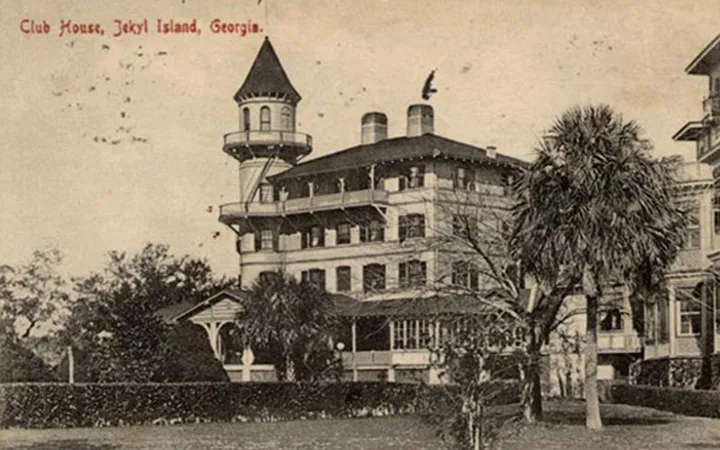
Even the Fed’s own official record acknowledges the discretion:
“The group used only first names to ensure privacy and to prevent discovery of their identities.”— Federal Reserve History, “Jekyll Island Conference” (1910)
The group’s goal was not altruistic. They sought to design a central bank that looked decentralized—a structure of regional Reserve Banks publicly presented as independent but coordinated under a single Washington board. The Jekyll Island plan became the template for the Aldrich Bill, and later, with progressive modifications, the Federal Reserve Act of 1913.
A Christmas Vote
When the final version reached Congress in December 1913, President Woodrow Wilson and Democratic leadership pressed for immediate passage before the Christmas recess. Most legislators had already left Washington; debate was limited. On December 23, 1913, the bill passed 282–60 in the House and 43–25 in the Senate.The public would not fully grasp the implications until decades later.
The new law established the Federal Reserve System as a hybrid entity—private in form, public in function. Its regional Reserve Banks were owned by member commercial banks, not the government; yet its policy board wielded the full authority of federal law.
As Senator Robert Latham Owen, one of the bill’s sponsors, later admitted, “The system was technically private but functionally governmental.”
A Hybrid Engine of Power
This structure—private capital performing public policy—became the model for the modern administrative state. The Fed was designed to protect the banking system from volatility, but it also insulated the banking system from democracy. Its creation effectively transferred the power to expand or contract the money supply from Congress, as authorized by Article I, Section 8, to a technocratic committee.
By the 1980s, the Federal Reserve had evolved from lender of last resort to the primary instrument of national policy.
Interest rates replaced legislation as the main tool of governance. By adjusting liquidity, the Fed could stimulate, stabilize, or subsidize entire sectors—an unelected board wielding powers Congress itself never could.
This was the quiet constitutional revolution of modern America:
Fiscal limits migrated from Capitol Hill to the FOMC.
The Constitution’s “power of the purse” became a power of the printing press.
2008: The Crisis That Never Ended
The Global Financial Crisis of 2008 marked the first open demonstration of the Fed’s new mandate—to preserve not just price stability, but entire markets.
Between 2008 and 2014, the Federal Reserve’s balance sheet expanded from $870 billion to $4.5 trillion through programs of Quantitative Easing (QE).³ In practice, this meant the Fed created digital dollars to buy government debt, monetizing deficits in everything but name.
Libertarians like Peter Schiff and Jim Grant warned that QE was not stimulus but monetary dependency—addiction to cheap money masquerading as recovery.
“You can’t print your way to prosperity any more than you can drink your way to sobriety.”— Peter Schiff, Crash Proof 2.0 (2011), p. 118
Meanwhile, the doctrine of “Too Big to Fail” institutionalized moral hazard. Banks, corporations, and governments learned that risk would be socialized, losses monetized, and profits privatized. The result was an economy that survived every shock—by surrendering more of its freedom.
Monetary Policy as Social Policy
After 2008, the Fed’s role expanded beyond finance. Low interest rates became the silent engine of fiscal policy by proxy: cheap debt enabled perpetual deficits, asset inflation enriched the politically connected while eroding middle-class savings, and the welfare state became a wealth-effects state—a society of 401(k) Keynesianism.
When Congress gridlocked, the Fed acted. When budgets failed, the Fed financed. By the 2010s, intervention was no longer exceptional; it was continuous. The Founders’ separation of powers had quietly given way to a separation of visibility: elected officials spent, unelected technocrats paid.
COVID-19: The Final Synthesis
In 2020, pandemic lockdowns shut down entire economies. Within weeks the Fed created more new money than in its first 100 years combined. Its balance sheet jumped from $4.2 trillion to $9 trillion in just 24 months.⁴ Congress borrowed $6 trillion under pandemic “rescue” packages—debt instantly absorbed by Fed purchases.
For libertarians, this was the final proof: the emergency state and fiat money had merged. The Federal Reserve became the Treasury’s central counterparty—a loop of perpetual motion where dollars are conjured to service obligations the government can no longer meet honestly.
As Rothbard foresaw:
“Fiat money is the monetary complement of the absolute state; both rest on coercion rather than consent.”— The Mystery of Banking (1983), p. 251
The Age of Perpetual Crisis
Each crisis—dot-com, 9/11, 2008, COVID—justified new powers that were never surrendered.
QE, bailouts, and emergency facilities that were “temporary” now define normal policy.
The Fed, once guardian of price stability, now manages employment, inequality, climate risk, even social-justice metrics.
By 2023 the U.S. national debt exceeded $33 trillion, unfunded obligations surpassed $100 trillion, and interest payments became the fastest-growing budget item.⁵
Yet the system continues, because the printing press has replaced the gold window as the guarantor of calm.
Monetary alchemy—turning debt into money—has replaced the hard economics of trade and production with the soft politics of liquidity. The state no longer commands through law but through balance-sheet expansion.
The Mainstream Monetary Defense
Mainstream economists defend the post-1971 monetary system as superior to the gold standard’s rigidity. Under Bretton Woods, they argue, countries couldn’t respond to asymmetric shocks—recessions spread because money supply couldn’t adjust. The Great Depression’s severity, monetarists note, resulted partly from Fed failure to expand money supply when deflation took hold.
Fiat money, proponents argue, allows countercyclical policy: expanding liquidity in recessions, contracting in booms. The 2008 financial crisis, they contend, would have become another Great Depression without aggressive Fed intervention. QE prevented deflationary spirals, stabilized financial markets, and enabled recovery.
On inflation, mainstream economists note that 2010-2020 saw historically low inflation despite massive QE—challenging the Austrian prediction of inevitable currency debasement. The Fed’s dual mandate (price stability and full employment) better serves modern economies than rigid commodity standards that amplified boom-bust cycles.
Regarding wage stagnation, non-Austrian economists emphasize globalization, technology, and education rather than monetary policy. Real compensation (including health benefits and retirement) has grown more than nominal wages suggest.
Libertarians respond that apparent stability was achieved through asset bubbles, debt accumulation, and moral hazard—problems deferred, not solved. Low CPI inflation masked asset-price inflation that enriched owners while workers’ wages stagnated. The system survives crises only by creating conditions for larger future crises.
The Libertarian Critique
For libertarians, the problem is not merely inflation but institutional dishonesty—a government that pretends to tax through representation while extracting value through devaluation. Sound money is not nostalgia; it is the foundation of moral government. Every dollar printed without corresponding productivity is a vote denied, a small act of expropriation from the future to the present.
As Ron Paul wrote:
“The issue is not just economics but ethics. Honest money means honest government.”— The Case for Gold (1982), p. 5
Why It Matters
A republic that funds itself by printing its own currency can survive any crisis—except accountability. What began as a tool to smooth fluctuations has become the operating system of permanent emergency.
The Founders feared an overmighty executive; they did not foresee a central bank that could rule invisibly by interest rate. The New Leviathan does not march in boots; it operates in basis points.


Comments