top of page
All Posts

The Law Above the Law: Cicero, Natural Rights & 1776
The Founders did not invent their politics; they read it. This episode traces the classical inheritance at the root of American constitutional design through three ancient figures and one cautionary contrast. Aristotle gave the Founders the empirical study of constitutions and the doctrine of the mixed regime anchored in a broad middle class. Polybius gave them anacyclosis — the wheel by which governments decay — and the recognition that a mixed constitution could slow the tu
Jun 202 min read


Why is Social Security Popular?
If Social Security returns so little compared to the alternative, leaves nothing to one’s heirs, and rests on a financial foundation this precarious, why is it so popular?
Jun 1615 min read

Why This History Matters Now
What is the difference between a right and an entitlement? This contemporary application episode takes the concept of natural rights inherited by the American Founders — introduced on Saturday in “The Golden Thread” — and applies it to the most consequential category confusion in modern politics: the belief that a government benefit funded by other people’s labor is a right. Using the 2026 Social Security solvency debate as its spine, the episode walks the hardest case honest
Jun 162 min read


“The Classical Inheritance” — Athens and Rome
The men who designed the American constitutional order treated antiquity as a laboratory of political experiment — failed experiments, mostly, and one or two qualified successes — from which the principles of constitutional design could be empirically extracted.
Jun 1426 min read

The Golden Thread
The series opener makes a single, startling claim: the truths the Declaration of Independence calls self-evident were not invented in Philadelphia. They were inherited — refined across more than two thousand years, in more than one civilization, by men who rarely knew one another. Jefferson himself said as much, naming Aristotle, Cicero, Locke, and Sidney as the “elementary books” behind the Declaration. This episode establishes that the Founders were readers before they were
Jun 132 min read


“The Golden Thread” — The Inheritance of Liberty
We hold these truths to be self-evident, that all men are created equal, that they are endowed by their Creator with certain unalienable Rights, that among these are Life, Liberty and the pursuit of Happiness.
Jun 725 min read
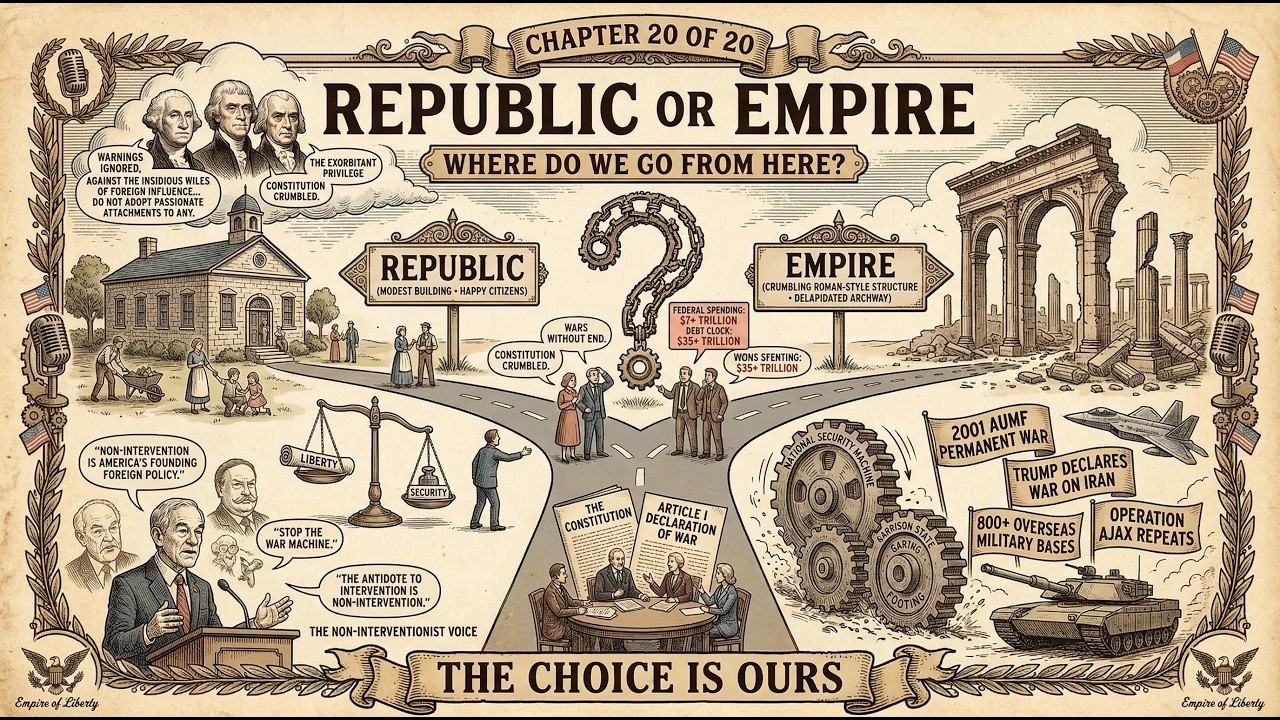
Republic or Empire — Where Do We Go From Here?
The finale of Empire of Liberty stands alone as a summary of the entire series. Opening with the cycle of democracy often attributed to Alexander Tytler, the episode tests that cycle against two centuries of American foreign policy, compresses the nineteen-installment synthesis into nine documented turns, engages the strongest interventionist counterargument in its strongest form, lays out the four pillars of constitutional restoration, and closes on Lord Acton’s insight that
Jun 61 min read


The Standard at Grand Rapids — 2026 Libertarian National Convention Recap
A convention should be judged first by what it accomplished, and the body that met in Grand Rapids accomplished more than its sharpest critics will credit. The case for the convention, stated as charitably as the record permits, is substantial.
May 3131 min read


"Republic or Empire”—Where Do We Go From Here?
This final article aims to do four things.
First, it synthesizes the long arc — not as a 1945 break with the founders’ republic, but as a two-century accumulation of choices, each of which could have been made differently, each of which can in principle be made differently again.
Second, it acknowledges the Roman example, which has hovered over the entire series. The Roman Republic did not fall to invasion. It was abandoned in stages, each stage seeming individually tolerabl
May 1760 min read
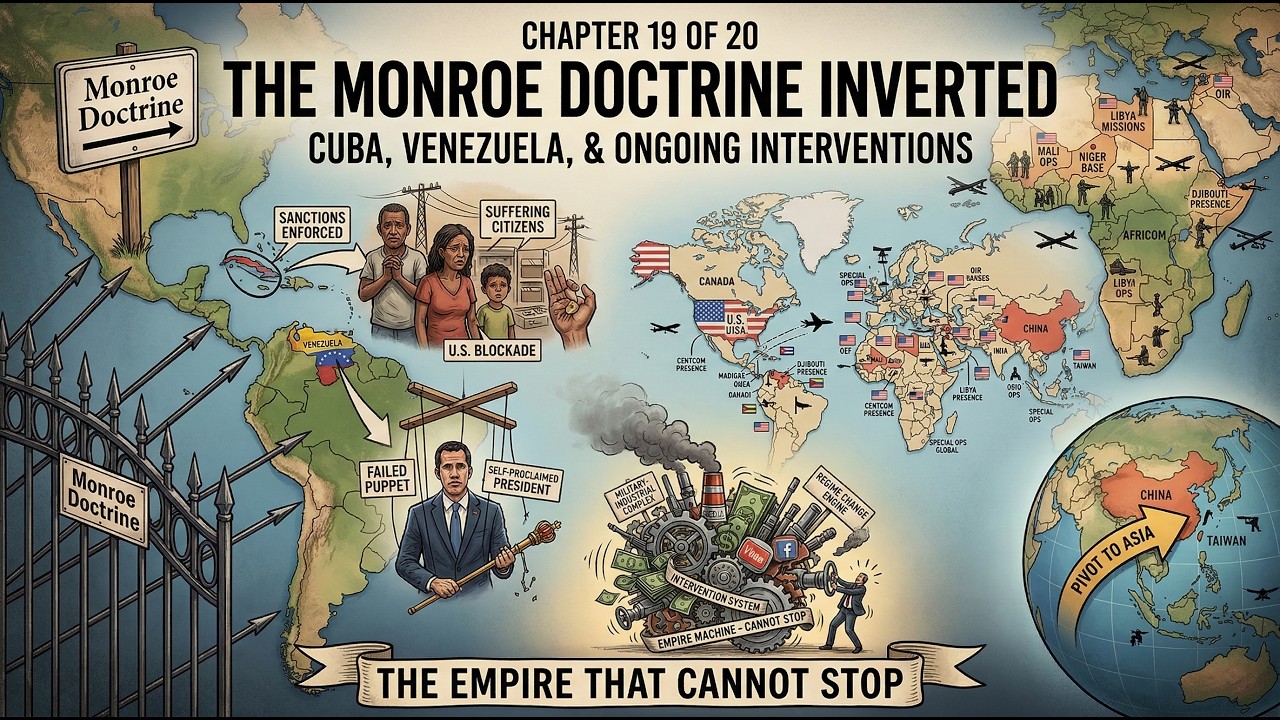
“The Monroe Doctrine Inverted” — Venezuela and the Ongoing Interventions
Episode 19 traces the two-hundred-year arc from James Monroe’s 1823 doctrine — originally a defensive warning to European powers to stay out of the Western Hemisphere — to its contemporary inversion into a claim of American authority to reshape Latin American governments at will.
May 161 min read

2026 Libertarian National Convention Feature: Part 1 - The Adjective and the Noun
The episode separates the libertarian idea — the lowercase-l, a tradition reaching back roughly twenty-five centuries — from the Libertarian Party — the capital-L, a coalition organized in a Westminster, Colorado, living room on December 11, 1971. It walks through the foundational commitments of the libertarian tradition, sketches its intellectual lineage from Cicero through the present, surveys five live conversations within the tradition, narrates the founding of the party
May 141 min read


The Adjective and the Noun — What "Libertarian" Means When It Stands Alone, and What Happened When It Became a Party
This three-part feature exists to ask what should happen there, what is likely to happen there, and what either outcome would mean. The first piece cannot begin at the convention. It has to begin at a distance from the convention, with the most basic question: what is being claimed, and by whom, when someone uses the word libertarian?
May 1234 min read

What Are Sanctions — Do They Work, and Who Pays the Price
The covert action toolkit under fire after revelations of extra-constitutional actions during the Church committee hearings and reports of 1975-76, have been expanded to include economic instruments that are viewed as "soft" power, but cause much more widespread damage. The substitution thesis posits that regime change objectives never faded after the revelations, rather the foreign policy establishment just exchanged paramilitary activity with primary and secondary sanctions
May 122 min read


The Monroe Doctrine Inverted — Venezuela and the Ongoing Interventions
This article examines Venezuela as the present-tense case study, surveys the ongoing operations that receive far less attention, and asks the only question that ultimately matters: what does the choice between republic and empire look like when the empire is not a memory but a current event?
May 1037 min read
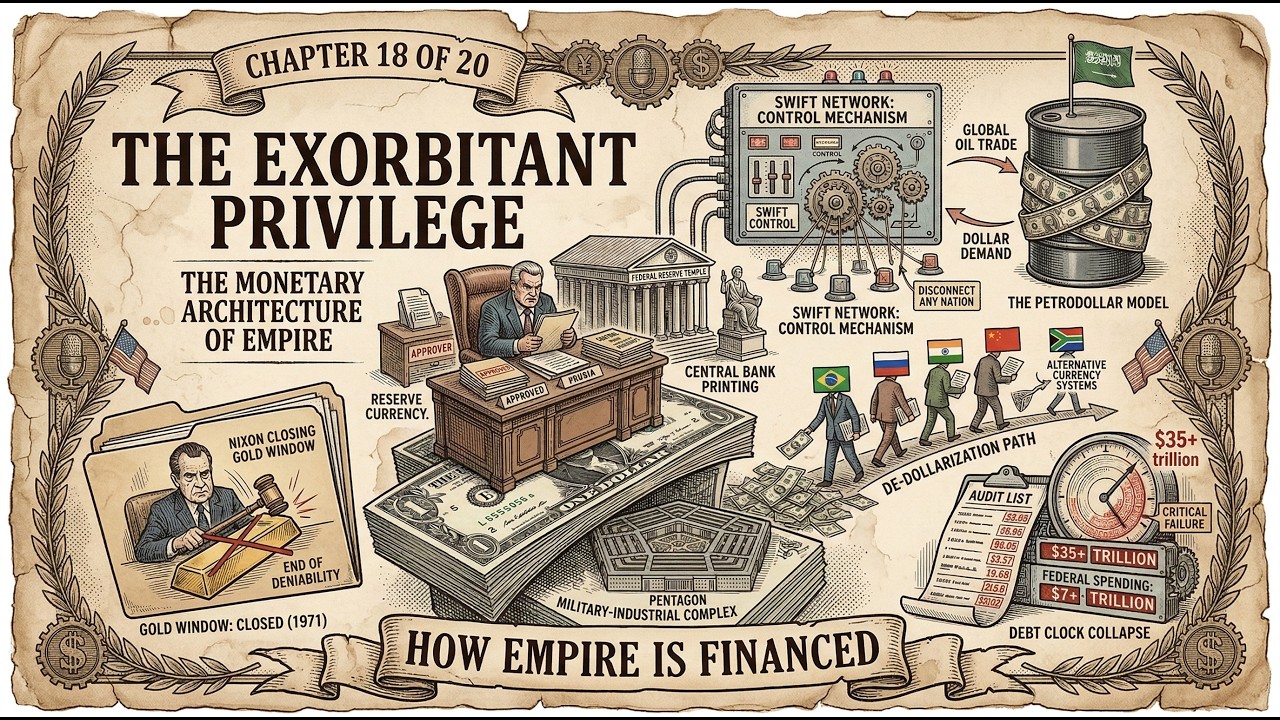
The Exorbitant Privilege
Episode 18 traces the monetary architecture that finances the American empire — from the founders’ gold-and-silver Constitution through the 1910 Jekyll Island meeting that produced the Federal Reserve, the 1933 gold confiscation, the 1971 Nixon Shock, the multi-pillar dollar hegemony system, the 2022 weaponization against Russia, and the April 2026 debt trajectory of thirty-nine trillion dollars and over one trillion in annual interest.
May 91 min read
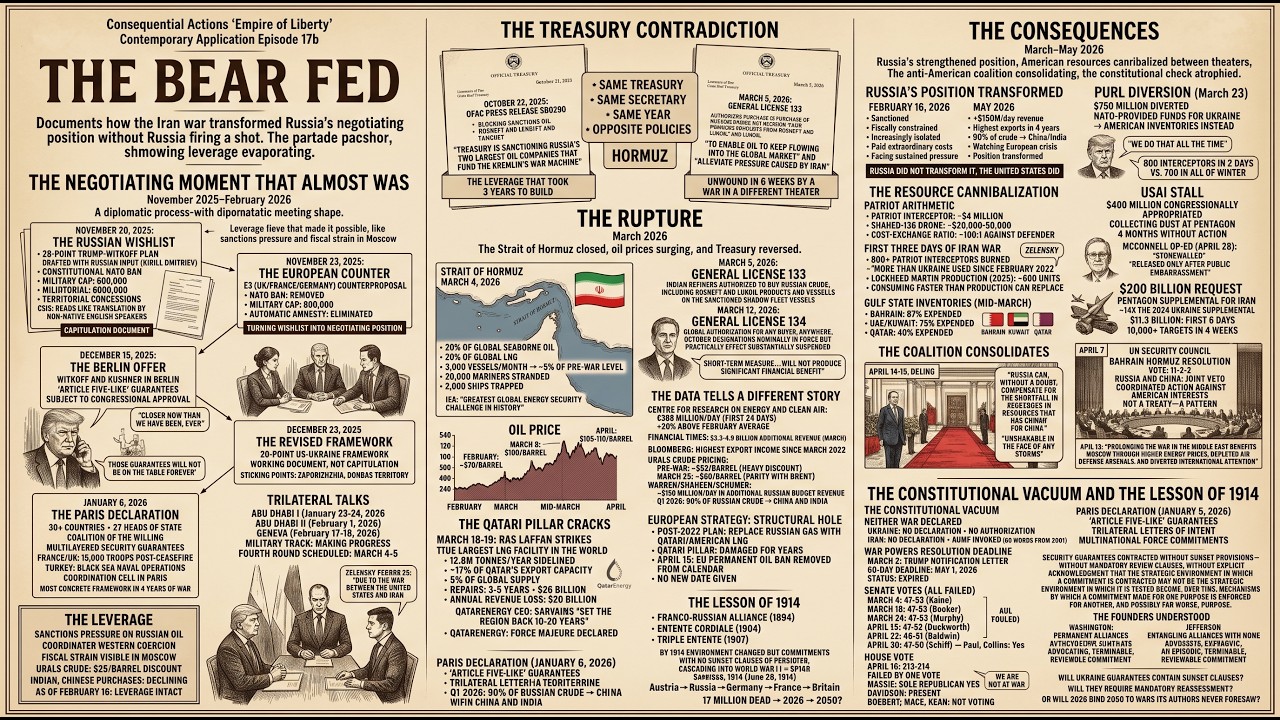
The Bear Fed — How the Iran War Handed Russia the Negotiating Position It Could Not Win on the Battlefield
This contemporary application episode examines the Russo-Ukrainian peace negotiations from the perspective of how the Iran war, launched on February twenty-eighth, 2026, materially altered the negotiating landscape in Russia’s favor.
May 52 min read


“The Exorbitant Privilege” — The Monetary Architecture of Empire
This article examines that architecture of US Debt and Finance. What it is, how it was built, what it enables, and why it is no longer working the way its designers intended. The military empire traced throughout this series could not exist without the monetary system that finances it. Understanding that system is the precondition for understanding both the power the United States has exercised over three generations and the limits it is now beginning to encounter.
May 338 min read
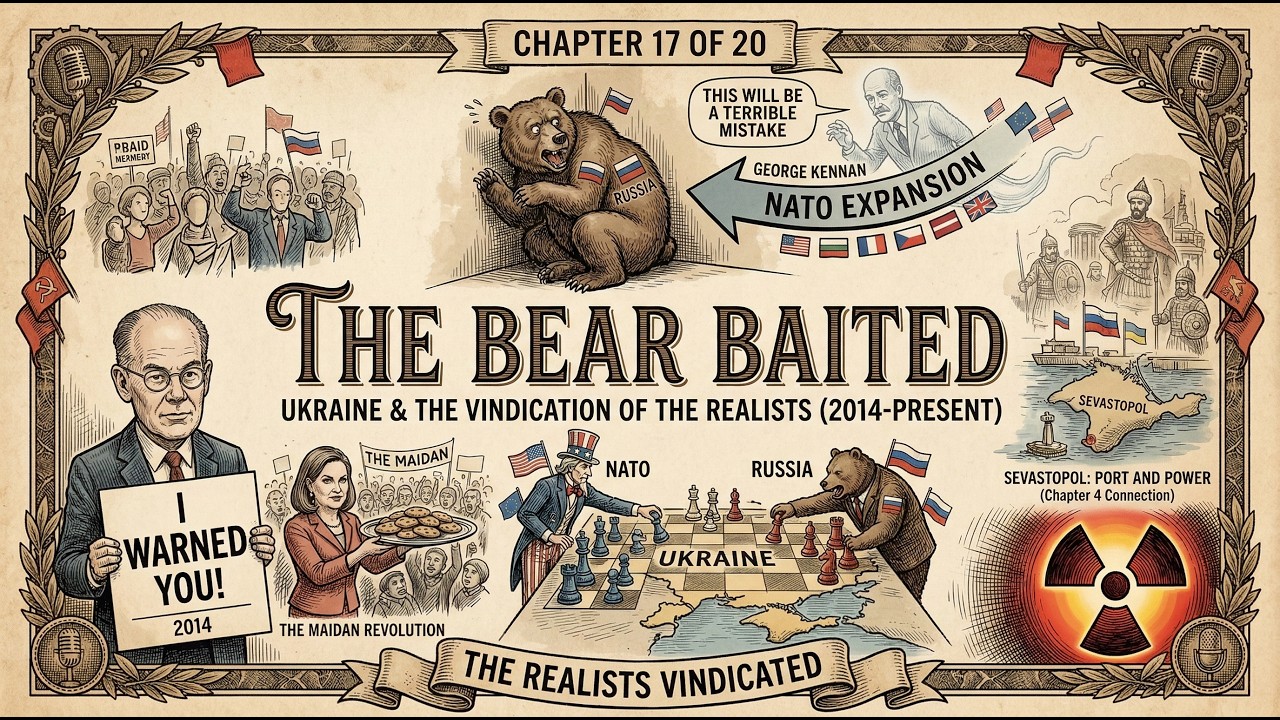
The Bear Baited
Episode 17 examines the Ukraine war as the predictable result of three decades of American policy choices. Following the argument of Article 17, the episode traces NATO expansion from Baker’s 1990 “not one inch eastward” assurance to the present, through the 2014 Maidan events, the Minsk agreements signed in bad faith, the failed December 2021 diplomacy, and the collapse of the Istanbul peace negotiations in April 2022.
May 21 min read

Whose Liberation, Whose Loss? — The Pattern of Intervention’s Aftermath, From Baghdad to Tehran
This contemporary application episode tests the central moral claim of American interventionism — that war can liberate populations — against the historical record of the past quarter century. Walking through Iraq, Libya, Afghanistan, and Syria in narrative form, the episode documents the consistent pattern: ancient Christian communities devastated, women’s lives constrained or destroyed, moderates eliminated, countries economically and physically wrecked.
Apr 281 min read


“The Bear Baited” — Ukraine and the Vindication of the Realists
“Expanding NATO would be the most fateful error of American policy in the entire post-cold-war era. Such a decision may be expected to inflame the nationalistic, anti-Western and militaristic tendencies in Russian opinion; to have an adverse effect on the development of Russian democracy; to restore the atmosphere of the cold war to East-West relations, and to impel Russian foreign policy in directions decidedly not to our liking.”—George F. Kennan, The New York Times, Februa
Apr 2631 min read
bottom of page