Entangling Alliances with None: The Founders' Vision of American Foreign Policy

Updated: May 1
“Peace, commerce, and honest friendship with all nations, entangling alliances with none.”—Thomas Jefferson, First Inaugural Address, 1801¹
The Forgotten Consensus
Broadcast on C-SPAN, it is not hard to picture the scene of a used-car type congressman, complete with a lackluster yet self-aggrandizing pitch, angling for more military aid to a distant nation, or the deployment of American forces to yet another conflict, or the expansion of alliance commitments that would obligate American blood and treasure to defend foreign borders. What strikes the observer is not the disagreement from other members of congress, but the agreement—the shared assumption, across party lines, that American global leadership is natural, inevitable, and permanent. “The indispensable nation,” as Madeleine Albright called it.² The arsenal of democracy. The leader of the free world.

However, let us consider: What would the founders make of this consensus?
The answer is not in question, it is not nuanced or ambiguous. It is clear, crystal-clear. They warned against it explicitly, repeatedly, and in terms that still resonate across the centuries. George Washington, in his Farewell Address, cautioned against “entangling our peace and prosperity in the toils of European ambition, rivalship, interest, humor or caprice.”³
Thomas Jefferson declared for “peace, commerce, and honest friendship with all nations, entangling alliances with none.”¹
James Madison warned that “no nation could preserve its freedom in the midst of continual warfare.”⁴
These were not idle musings but the considered judgments of men who had just fought a revolution, designed a constitution, and established a republic. They understood, with a clarity we have since lost, how empires rise and republics fall.
For roughly the first century of the American republic, these principles governed foreign policy. The United States traded with all nations but made permanent alliances with none. It maintained a small standing army and relied primarily on citizen militias. It avoided European quarrels and expected Europeans to avoid American affairs. When military force was necessary—as in the Barbary Wars—it was limited, proportional, and directed at specific, achievable objectives. The republic was not pacifist, but it was restrained. It was not isolated, but it was independent.
This was not naïveté born of weakness. It was wisdom born of understanding how republics preserve liberty—and how they lose it. The founders knew their history. They had studied the Roman Republic’s transformation into an empire and understood that the process was driven by foreign wars, military expansion, and the concentration of power that permanent warfare requires. They designed the American constitutional order specifically to resist these pressures: congressional control over declarations of war, limitations on military appropriations, separation of powers to check executive ambition.
This article establishes the baseline against which all subsequent departures will be measured. We will examine what the founders said, why they said it, and how the early republic implemented their principles in practice. For if we are to evaluate whether American foreign policy has served American interests—and this series will argue it largely has not—we must first understand what the alternative looked like. The founders bequeathed us a foreign policy. We abandoned it. The question is whether that abandonment was wise.
The Revolution’s Lessons
The Experience of Foreign Alliance
The founders’ foreign policy convictions were not abstract philosophy. They emerged from hard experience—specifically, from the complications of the French Alliance that had been essential to American victory in the Revolutionary War.

The Treaty of Alliance with France, signed in 1778, brought French military and naval support that proved decisive at Yorktown. Without France, American independence might not have been achieved. The founders, while grateful, also learned a lesson about the nature of alliances. Alliances create obligations that outlast their original purpose and entangle nations in each other’s subsequent quarrels.
The test came in 1793, when revolutionary France went to war with Britain and expected American support under the terms of the alliance. Citizen Edmond-Charles Genêt arrived as French minister and began commissioning American privateers to attack British shipping, fitting out military expeditions against Spanish Florida, and generally treating the United States as a French auxiliary. President Washington faced a choice: honor the alliance and be drawn into the European conflagration, or declare neutrality and risk French displeasure.
Washington chose neutrality. His Neutrality Proclamation of 1793 declared that the United States would “pursue a conduct friendly and impartial toward the belligerent Powers.”⁵ This was the first major statement of American foreign policy doctrine—and it was a doctrine of non-entanglement. The alliance with France had served its purpose. It would not be allowed to drag America into new wars that were none of her concern.
Alexander Hamilton, writing as “Pacificus,” defended the neutrality policy in a series of essays that established foundational principles.⁶ The alliance, he argued, had been defensive in nature; France was now the aggressor. More fundamentally, the United States had no interest in European power struggles. American security depended on American independence of action, not on subordination to any foreign power’s interests.
James Madison, writing as “Helvidius,” objected to Hamilton’s constitutional reasoning—he believed Hamilton was claiming too much executive authority in foreign affairs.⁷ But Madison did not object to neutrality itself. The disagreement was about process, not policy. Both men agreed that America should stay out of European wars.
Standing Armies and Republican Liberty
The Revolution taught a second lesson, equally formative: standing armies threaten liberty. The founders had experienced this directly. British troops quartered in colonial homes, British soldiers enforcing British laws, British military power deployed against British subjects who claimed British rights—these memories were fresh and bitter.
But the founders’ opposition to standing armies was not merely reactive. It drew on a deep tradition of classical republican thought that they had studied closely. Machiavelli had argued that republics must rely on citizen militias rather than mercenary armies, because citizens fight for their own liberty while mercenaries fight for pay and can be turned against the republic they nominally serve.⁸ The English Commonwealth writers—John Trenchard, Thomas Gordon, and others—had warned that standing armies in peacetime were instruments of tyranny, maintained to impress upon the populace rather than to defend against external threats.⁹ Montesquieu had analyzed how the separation of military and civil power was essential to preserving liberty.¹⁰
The Constitution reflected these concerns. Congress received the power to “raise and support Armies,” but military appropriations were limited to two years—forcing regular renewal and preventing the entrenchment of a permanent military establishment.¹¹ Congress, not the president, received the power to declare war—ensuring that the decision for war would require deliberation by the people’s representatives, not unilateral executive action. The Second Amendment guaranteed the right to keep and bear arms in the context of “a well regulated Militia”—the citizen alternative to the standing army.
Hamilton, in Federalist No. 8, made the structural argument explicit. A nation that maintains large standing armies, he wrote, will see “the military state” become “elevated above the civil.” The people will become accustomed to military authority and will gradually surrender their liberties.¹² By contrast, a nation protected by geography, as America was, could rely primarily on its navy for defense and its militia for emergencies. It need not maintain the large standing forces that would threaten republican government.
The logic was clear: permanent peace establishments require justification. That justification comes from threats. If threats are exaggerated or manufactured, the military establishment grows beyond what genuine security requires. And as the military grows, so does the power of the executive who commands it, the debt that finances it, and the culture of deference that sustains it. Foreign policy, in this view, was not separate from domestic liberty. It was intimately connected. A republic that chose empire abroad would eventually find tyranny at home.
Washington’s Farewell Address: The Foundational Text
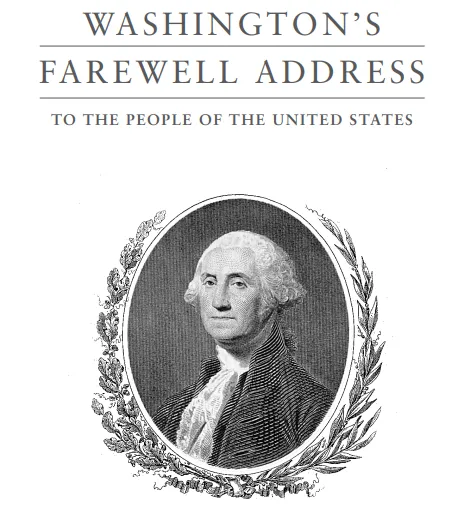
George Washington’s Farewell Address, published in September 1796 as he prepared to leave the presidency, is the foundational text of American foreign policy.¹³ It was not an impromptu reflection but a carefully crafted statement, composed with Alexander Hamilton’s assistance over many months, addressed to posterity as much as to contemporaries. Washington knew the weight his words would carry, and he chose them deliberately.
The Address covered many topics—the importance of national unity, the dangers of faction, the value of religion and morality—but its foreign policy passages became its most enduring legacy. They deserve quotation at length, for they constitute the closest thing America has to a founding doctrine of international relations.
The great rule of conduct for us in regard to foreign nations is in extending our commercial relations, to have with them as little political connection as possible. So far as we have already formed engagements, let them be fulfilled with perfect good faith. Here let us stop.³
Washington drew a sharp distinction between commercial relations and political commitments. Trade with all nations was desirable; binding alliances were not. The former enriched both parties; the latter subordinated American interests to foreign interests and created obligations that outlived their purpose.
Europe has a set of primary interests which to us have none; or a very remote relation. Hence she must be engaged in frequent controversies, the causes of which are essentially foreign to our concerns. Hence, therefore, it must be unwise in us to implicate ourselves by artificial ties in the ordinary vicissitudes of her politics, or the ordinary combinations and collisions of her friendships or enmities.³
This was not isolationism—Washington was deeply engaged with the world—but it was realism about interests. European powers fought over European questions: dynastic succession, colonial competition, balance of power. These were not American questions. American safety did not depend on which European dynasty sat on which European throne. American prosperity did not require that any particular European state prevail over its rivals. Why, then, should Americans die in European wars?
Our detached and distant situation invites and enables us to pursue a different course. If we remain one people under an efficient government, the period is not far off when we may defy material injury from external annoyance; when we may take such an attitude as will cause the neutrality we may at any time resolve upon to be scrupulously respected; when belligerent nations, under the impossibility of making acquisitions upon us, will not lightly hazard the giving us provocation; when we may choose peace or war, as our interest, guided by justice, shall counsel.³
Geography was America’s great advantage. Three thousand miles of ocean separated the new republic from European quarrels. No European power could invade and occupy the United States. No European navy, however powerful, could project sufficient force across the Atlantic to threaten American sovereignty. This was not a temporary condition to be transcended but a permanent blessing to be preserved. Washington’s question was pointed: “Why forego the advantages of so peculiar a situation? Why quit our own to stand upon foreign ground? Why, by interweaving our destiny with that of any part of Europe, entangle our peace and prosperity in the toils of European ambition, rivalship, interest, humor or caprice?”³
The Address concluded its foreign policy section with the principle that would echo through American history:
It is our true policy to steer clear of permanent alliances with any portion of the foreign world... Taking care always to keep ourselves by suitable establishments on a respectable defensive posture, we may safely trust to temporary alliances for extraordinary emergencies.³
Note the precision. Washington did not forbid all alliances—the French Alliance had been necessary and valuable. He forbade permanent alliances, binding commitments that would outlive their occasion. For genuine emergencies, temporary arrangements with other powers were acceptable. But the default position should be independence: no treaties that obligate American action regardless of American interest, no commitments that survive their justification.
Washington added a warning against both “passionate attachment” to foreign nations and “inveterate antipathy” toward them. Either distorted sound judgment. A nation that loved another would find reasons to support it even when support was unwise. A nation that hated another would find reasons to oppose it even when opposition served no purpose. Policy should be governed by interest and justice, not by emotion or ideology.
The Interventionist Objection
Defenders of American global engagement have a ready response: Washington was addressing a young, weak nation that could not project power. His advice was prudent for 1796 but cannot govern a global superpower in the twenty-first century. The world has changed; America’s position has changed; surely the principles must change as well.
But this objection misses Washington’s argument. He was not counseling restraint because America was weak. He was counseling restraint because foreign entanglements—regardless of the power of the entangled nation—require standing armies, accumulate debt, concentrate power in the executive, and corrupt republican virtue. These dynamics do not diminish as power increases; they intensify. The stronger the nation, the greater the temptation to intervene. The greater the intervention, the larger the military establishment required to sustain it. The larger the military, the more power flows to those who command it.
Rome was not weak when it transformed from republic to empire. It was at the height of its power. The transformation occurred precisely because military success abroad created military commanders whose power exceeded civilian control.¹⁴ Washington knew this history. His warning was directed not at weakness but at strength—at the temptations that strength creates and the corruptions it enables.
The question for Americans in any era is not whether we can intervene globally but whether doing so is compatible with republican self-government. The founders’ answer was clear. It remains to be tested against two centuries of experience.
Jefferson’s Formulation
Thomas Jefferson’s First Inaugural Address, delivered on March 4, 1801, provided the most quoted summary of the founders’ foreign policy doctrine:
Peace, commerce, and honest friendship with all nations, entangling alliances with none.¹
Note the positive content: peace, commerce, friendship. This was not hostility toward the world or withdrawal from it. Jefferson was not proposing that America close itself off from foreign contact. He was proposing that contact take specific forms—commercial, diplomatic, cultural—rather than military and political.
Note also the universality: “all nations.” The policy was not directed at particular countries or regions. America would trade with Britain and France, Spain and Portugal, emerging nations in Latin America and ancient civilizations in Asia. It would treat all with the same principle: honest dealing, peaceful relations, no favorites and no enemies except those who made themselves enemies through their own actions.
Finally, note the specific prohibition: “entangling alliances.” Jefferson did not prohibit treaties or agreements. He prohibited the kind of binding military commitments that would obligate American action regardless of American judgment. A trade agreement that benefited both parties was acceptable. An alliance that required America to fight when another nation was attacked, regardless of whether the attack concerned American interests, was not.
This was not isolationism—a slur that did not enter American political vocabulary until the twentieth century, applied to those who opposed entry into World War I.¹⁵ It was selective engagement: maximum commercial and cultural contact, minimum political and military commitment. It was, in fact, what most nations practice most of the time. Only the United States, in its recent imperial phase, has attempted permanent alliances that span the globe and commit American power to conflicts in every region.
Jefferson’s Tensions and Contradictions
An honest accounting requires acknowledging that Jefferson himself did not always practice what he preached. The Louisiana Purchase was an executive action of questionable constitutionality—Jefferson himself doubted whether the Constitution authorized it but proceeded anyway.¹⁶ The Barbary Wars were limited military actions conducted without formal declarations of war. The Embargo Act of 1807 was a massive intervention in commerce designed to avoid military entanglement with Britain and France, but it devastated American merchants and required extensive government enforcement.
These tensions are instructive. They show that even founders deeply committed to non-intervention faced hard choices where principles pulled in different directions. The Louisiana Purchase extended the republic without war but at the cost of constitutional looseness. The Barbary Wars protected American commerce with limited force but set a precedent for executive military action. The Embargo Act avoided foreign war but created domestic hardship.
The lesson is not that Jefferson was hypocritical but that non-intervention is a principle requiring judgment, not a formula producing automatic answers. The question in each case was how to preserve American independence and liberty while navigating a dangerous world. Jefferson made choices that can be questioned, but he made them within a framework that prioritized peace and restraint over war and expansion. That framework—not every specific decision—is what the founding generation bequeathed to posterity.
Madison’s Warning: War as the Enemy of Liberty
If Washington’s Farewell Address is the foundational text of American non-interventionism, James Madison’s “Political Observations” of 1795 is its most penetrating analysis.⁴ Madison was not merely counseling prudence; he was explaining the structural dynamics by which war destroys republican government. His warning is the most radical formulation of the founders’ case against foreign entanglement, and it deserves extended quotation:
Of all the enemies to public liberty war is, perhaps, the most to be dreaded, because it comprises and develops the germ of every other. War is the parent of armies; from these proceed debts and taxes; and armies, and debts, and taxes are the known instruments for bringing the many under the domination of the few.⁴
Madison’s argument was not moral or sentimental but structural. War requires armies. Armies require money. Money requires taxes—or, worse, debt. Taxes and debt transfer resources from citizens to government. They empower the few who control government at the expense of the many who fund it. The dynamics are impersonal and inexorable: choose war, and you have chosen the growth of the state.
Madison continued:
In war, too, the discretionary power of the Executive is extended; its influence in dealing out offices, honors, and emoluments is multiplied; and all the means of seducing the minds, are added to those of subduing the force, of the people... No nation could preserve its freedom in the midst of continual warfare.⁴
Here was the republican nightmare. War expands executive power—the commander-in-chief becomes the dominant figure in government. War multiplies patronage—military contracts, officer commissions, civilian positions in the war bureaucracy all become tools of political influence. War “seduces the minds” of the people—patriotic fervor suspends critical judgment and makes criticism appear disloyal. And war “subdues the force” of the people—emergency measures become permanent, liberties surrendered in crisis are not returned when crisis passes.
Madison’s conclusion was unequivocal: “No nation could preserve its freedom in the midst of continual warfare.” Not “might not” or “would find it difficult.” Could not. The relationship was categorical. Permanent war and free government were incompatible.
This warning will echo throughout our series. Every intervention we examine will be tested against Madison’s criteria. Did it concentrate executive power? It did. Did it accumulate debt? It did. Did it expand the standing military? It did. Did it habituate citizens to a permanent war footing? It did. The American national security state—the surveillance apparatus, the military-industrial complex, the imperial presidency, the $35 trillion debt—is Madison’s prophecy fulfilled.
The Early Tests
The Quasi-War with France (1798-1800)
The founders’ principles faced their first major test during the undeclared naval war with France in the late 1790s. French vessels had begun seizing American merchant ships in retaliation for American neutrality in the Franco-British conflict. The XYZ Affair—in which French officials demanded bribes as a precondition for negotiations—inflamed American opinion. War fever swept the country. The cry “Millions for defense, but not one cent for tribute!” echoed through Congress.
President John Adams authorized naval operations against French shipping, and an undeclared war at sea continued for two years. But the domestic consequences were as Madison had predicted. The Alien and Sedition Acts, passed in 1798, represented the first major restrictions on civil liberties in American history.¹⁷ The Sedition Act made it a crime to publish “false, scandalous, and malicious writing” against the government—a direct assault on the First Amendment. Newspaper editors were prosecuted. Opposition politicians were threatened.
Adams, to his credit, ultimately chose negotiation over escalation. The Convention of 1800 ended the conflict without a formal declaration of war. But the pattern had been established: even limited conflict generated pressure for expanded executive power and restricted civil liberties. Madison’s warning was validated within three years of his writing it.
The Barbary Wars (1801-1805, 1815)
The Barbary Wars illustrate what limited, defensive military action looked like under founding principles. Pirates operating from the North African coast had been seizing American merchant ships and enslaving American sailors. Previous administrations had paid tribute for protection; Jefferson refused. He sent naval forces to the Mediterranean with congressional authorization for offensive operations.
The campaigns were limited and proportional. The objective was specific and achievable: end piracy and secure American commerce. There was no attempt at regime change, no occupation, no transformation of North African politics. The Marines landed “on the shores of Tripoli” to rescue hostages and pressure the local ruler, not to rebuild Tripolitan society. When the objective was achieved—treaties secured, tribute ended—the forces withdrew.
Contrast this with the post-9/11 wars. The initial justification was similar: attack on Americans, need for protective response. But the scope exploded beyond any proportional relationship to the original threat. Twenty years in Afghanistan. Regime change in Iraq. Nation-building that consumed trillions. Mission creep that transformed a response to terrorism into an attempt to remake the Middle East. The Barbary Wars took years, not decades. They cost thousands, not trillions. They achieved their objectives and ended. They are the model the founders would recognize; the forever wars are the nightmare they warned against.
The War of 1812
The War of 1812 is often sanitized in American memory as a “second war of independence” that confirmed American sovereignty. The reality was grimmer. It was a poorly planned, badly executed war of choice that nearly broke the union and achieved none of its stated objectives.
The causes were genuine grievances: British impressment of American sailors, British support for Indian resistance on the frontier, British trade restrictions during the Napoleonic Wars. But the “War Hawks” in Congress—led by Henry Clay and John C. Calhoun—also saw opportunity: conquest of Canada, expansion of American territory, assertion of national honor. They pushed for war over the objections of Federalists who understood that America was unprepared for conflict with Britain.
The war went badly. The invasion of Canada failed. Washington itself was captured and burned. The economy suffered from British blockade. The Treaty of Ghent, which ended the war, restored the status quo ante—no territorial changes, no resolution of impressment, no vindication of American claims. New England, which had opposed the war, came close to secession at the Hartford Convention.
The War of 1812 demonstrated the dangers Madison himself had identified, even though Madison as president prosecuted it. Executive power expanded. Debt accumulated. Internal division reached the breaking point. The republic survived—barely—but the war illustrated how fragile republican institutions are when tested by the pressures of armed conflict.
The Monroe Doctrine: Defensive Perimeter or Imperial Claim?
The Monroe Doctrine of 1823 is often cited as a departure from non-intervention—proof that even the founding generation embraced a sphere of influence in which American power would dominate.¹⁸ This reading is mistaken. The original doctrine was defensive, not offensive; it established a perimeter, not a mandate.
The context was fear of European intervention in the Americas. Spain’s Latin American colonies were achieving independence, and there was concern that the Holy Alliance—the conservative monarchies of Europe—might attempt to restore Spanish rule. Russia was expanding down the Pacific coast and making claims that threatened American interests in the Oregon territory. President James Monroe, in his annual message to Congress, announced a policy of mutual non-interference:
In the wars of the European powers in matters relating to themselves we have never taken any part, nor does it comport with our policy to do so. It is only when our rights are invaded or seriously menaced that we resent injuries or make preparation for our defense.¹⁸
The reciprocal commitment was equally clear: America would not interfere in European affairs. The Western Hemisphere was closed to further European colonization, but this was a defensive posture—keep out—not an offensive one—go in. The doctrine said nothing about American intervention in Latin American nations. It said nothing about American domination of the hemisphere. It drew a line and asked European powers to respect it.
Later generations would corrupt this doctrine beyond recognition. Theodore Roosevelt’s Corollary claimed the right to intervene in Latin American countries to prevent European intervention—turning a defensive perimeter into a justification for American imperialism.¹⁹ Cold War applications extended American claims to global scope. But the original Monroe Doctrine was consistent with the founders’ principles: non-entanglement in European affairs, non-acceptance of European entanglement in American affairs, and no commitment to project American power into other nations.
The Baseline Established
The founders bequeathed America a foreign policy. Its principles can be summarized:
First, commercial relations with all nations; political entanglement with none. Trade enriches; alliances obligate. Maximize the former; minimize the latter.
Second, no permanent alliances; temporary arrangements for genuine emergencies only. Commitments made for one purpose should not bind future generations to purposes unrelated to the original.
Third, preference for militia over standing armies. Citizens who fight for their own liberty are safer than professionals who fight for pay. Large permanent military establishments threaten the liberty they are meant to protect.
Fourth, war as last resort, requiring congressional declaration. The decision for war is too consequential to be left to one man. The people’s representatives must deliberate and commit before the nation goes to war.
Fifth, limited objectives when force is necessary. Wars should achieve specific, achievable goals—not transform foreign societies, not impose American values, not make the world safe for democracy.
Sixth, recognition that Europe’s quarrels are not America’s quarrels. Geography provides security. European balance-of-power politics are foreign to American interests. Let Europeans manage European affairs.
Seventh, understanding that war itself threatens republican institutions, regardless of war’s outcome. The concentration of power, the accumulation of debt, the habituation to emergency authority—these dynamics operate whether victory or defeat follows. The republic is endangered not only by losing wars but by winning them.
These principles were not products of weakness or naïveté. They emerged from sophisticated understanding of how republics die—understanding grounded in classical learning, historical study, and recent experience. The founders had studied Rome. They had studied the English Civil War and the Glorious Revolution. They had just fought a revolution of their own and designed a constitution to prevent the consolidation of power that revolutions so often produce. Their foreign policy was of a piece with their constitutional design: limit power, divide power, check power—at home and abroad.
The series that follows will trace how America departed from these principles—sometimes gradually, sometimes dramatically—and will ask at each juncture: Was the departure necessary? Did it serve American interests? What were the costs in blood, treasure, liberty, and republican character? What were the long-term consequences? Could the founders’ wisdom have produced better outcomes?
These are not academic questions. They are urgent ones. As this series will document, American foreign policy since 1898—and especially since 1945—has produced a trail of unintended consequences, failed interventions, empowered enemies, and eroded liberties that would vindicate the founders’ warnings beyond their darkest expectations. The question is not whether their principles were right for their time. The question is whether we can recover them for ours.
Self-Reflection Prompts
These questions are designed to help you clarify your own thinking about American foreign policy. There are no right or wrong answers—only more or less examined positions.
Do you believe the founders’ foreign policy principles were products of their time, inapplicable to a modern superpower? If so, what specifically changed that invalidates their reasoning about standing armies, debt, and executive power? If not, how should their principles be applied today?
Madison warned that “no nation could preserve its freedom in the midst of continual warfare.” America has been at war, somewhere, almost continuously since 1941. Has American freedom been preserved, diminished, or transformed in this period? What evidence supports your answer?
Washington warned against “passionate attachment” to foreign nations. Can you identify examples in contemporary discourse where attachment to a foreign nation appears to shape American policy debates? Does this attachment serve American interests?
The founders distinguished between commercial engagement (desirable) and political entanglement (dangerous). Is this distinction still meaningful? Is it possible to have extensive commercial relations without political commitments, or does economic interdependence inevitably create political obligations?
Endnotes
¹ Jefferson, Thomas. First Inaugural Address, March 4, 1801. Available at: https://avalon.law.yale.edu/19th_century/jefinau1.asp
² Albright, Madeleine. Interview on NBC’s Today Show, February 19, 1998.
³ Washington, George. Farewell Address, September 19, 1796. Available at: https://avalon.law.yale.edu/18th_century/washing.asp
⁴ Madison, James. “Political Observations,” April 20, 1795. In Letters and Other Writings of James Madison, Vol. IV. J.B. Lippincott & Co., 1865, pp. 491-492. Available at: https://founders.archives.gov/documents/Madison/01-15-02-0423
⁵ Washington, George. Neutrality Proclamation, April 22, 1793. Available at: https://avalon.law.yale.edu/18th_century/neutra93.asp
⁶ Hamilton, Alexander. “Pacificus No. 1,” June 29, 1793. Available at: https://founders.archives.gov/documents/Hamilton/01-15-02-0038
⁷ Madison, James. “Helvidius No. 1,” August 24, 1793. Available at: https://founders.archives.gov/documents/Madison/01-15-02-0056
⁸ Machiavelli, Niccolò. Discourses on Livy (1531). Trans. Harvey C. Mansfield and Nathan Tarcov. University of Chicago Press, 1996, Book II, Chapters 18-20.
⁹ Trenchard, John and Thomas Gordon. Cato’s Letters (1720-1723). Ed. Ronald Hamowy. Liberty Fund, 1995, Letters 94-95.
¹⁰ Montesquieu, Charles de Secondat, Baron de. The Spirit of the Laws (1748). Trans. Anne M. Cohler, Basia Carolyn Miller, and Harold Samuel Stone. Cambridge University Press, 1989, Book XI.
¹¹ U.S. Constitution, Article I, Section 8, Clauses 12-14.
¹² Hamilton, Alexander. Federalist No. 8, November 20, 1787. Available at: https://avalon.law.yale.edu/18th_century/fed08.asp
¹³ For analysis of the Farewell Address’s composition and influence, see: Gilbert, Felix. To the Farewell Address: Ideas of Early American Foreign Policy. Princeton University Press, 1961.
¹⁴ For analysis of the Roman Republic’s transformation, see: Beard, Mary. SPQR: A History of Ancient Rome. Liveright, 2015, Chapters 6-8; and Syme, Ronald. The Roman Revolution. Oxford University Press, 1939.
¹⁵ The term “isolationist” was first widely applied to opponents of American entry into World War I. See: Nichols, Christopher McKnight. Promise and Peril: America at the Dawn of a Global Age. Harvard University Press, 2011.
¹⁶ For Jefferson’s constitutional doubts about the Louisiana Purchase, see: Cerami, Charles. Jefferson’s Great Gamble: The Remarkable Story of Jefferson, Napoleon and the Men Behind the Louisiana Purchase. Sourcebooks, 2003, pp. 177-195.
¹⁷ For analysis of the Alien and Sedition Acts, see: Stone, Geoffrey R. Perilous Times: Free Speech in Wartime from the Sedition Act of 1798 to the War on Terrorism. W.W. Norton, 2004, Chapter 1.
¹⁸ Monroe, James. Seventh Annual Message to Congress, December 2, 1823. Available at: https://avalon.law.yale.edu/19th_century/monroe.asp
¹⁹ Roosevelt, Theodore. Fourth Annual Message to Congress, December 6, 1904. Available at: https://www.presidency.ucsb.edu/documents/fourth-annual-message-15
Recommended Reading
Buchanan, Patrick J. A Republic, Not an Empire: Reclaiming America’s Destiny. Regnery Publishing, 1999.
McDougall, Walter A. Promised Land, Crusader State: The American Encounter with the World Since 1776. Houghton Mifflin, 1997.
Paul, Ron. A Foreign Policy of Freedom. Foundation for Rational Economics and Education, 2007.
Raimondo, Justin. Reclaiming the American Right: The Lost Legacy of the Conservative Movement. ISI Books, 2008.
Tucker, Robert W. and David C. Hendrickson. Empire of Liberty: The Statecraft of Thomas Jefferson. Oxford University Press, 1990.
Comments