The Surveillance Economy: From Data Collection to Digital Control

From Counter-Terror to Total Information
In Part 1, we examined how the terrorism emergency normalized mass surveillance despite constitutional concerns. When Congress passed the Patriot Act (2001), it opened the constitutional door. Silicon Valley built the architecture behind it.
What began as signals intelligence has become a national data economy in which every online act — emails, purchases, searches, movements — feeds both profit and policy.
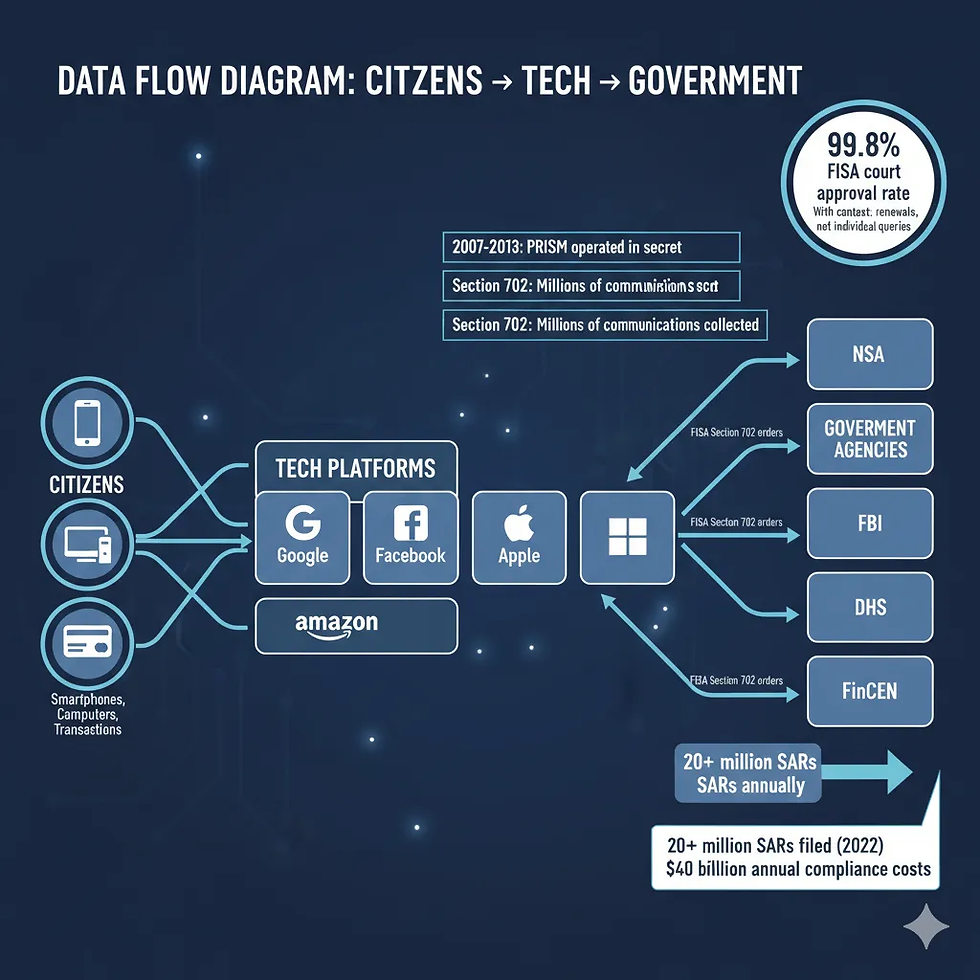
By 2003 the National Security Agency launched Stellar Wind, vacuuming global communications through telecom backbones. After 2007, PRISM compelled private platforms — Google, Facebook, Apple, Microsoft — to provide user data under classified FISA Section 702 orders.¹
The NSA called it “bulk collection.” Libertarians called it mass surveillance without suspicion.
Edward Snowden—an NSA contractor who fled to Russia and remains wanted on espionage charges—revealed in 2013 that the line between corporate databases and government intelligence had effectively vanished. The administrative state no longer needed warrants; it needed partnership agreements.
His disclosures, while controversial, sparked reforms including the 2015 USA Freedom Act and exposed false statements by the Director of National Intelligence James Clapper’s congressional testimony.
To note, while all of this surveillance may seem useful on the surface to enable the proverbial good guys to protect innocents against bad actors; it must also be recognized as a tool that can also be directed at political adversaries. By mining information and/or creating leverage in order to shift the balance of power or move the Overton window (the range of acceptable political discourse) these tools can benefit any particular ideology. A scenario that has the potential to damage a nation’s ongoing longevity, or national identity, much more so than any battle or terrorist attack.
The Compliance Economy
Section 311 of the Patriot Act gave the Treasury’s Financial Crimes Enforcement Network (FinCEN) authority to designate any bank a “primary money-laundering concern.”
Once designated, that institution could be cut off from the global dollar system — no trial, no hearing, just administrative decree. That is a significant leverage tool that can be used on any institution to bend them to the will of the State.
By the 2010s these powers applied not only to terrorists and traffickers but to entire nations (Iran, Russia) and even to individual citizens accused of violating sanctions or tax rules. Economist Peter Schiff warned that “the dollar has become … a weapon of policy.” (The Real Crash, 2012, p. 207.)
Internationally, countries storing wealth in U.S. Dollars, as the global reserve currency, suddenly had to consider the ramifications should they run afoul of a specific political administration. This then brings into question the agnostic value of the currency itself. After all if your wealth can be frozen if in the form of USD when having a disagreement with a US President, then perhaps an alternate form of currency would be more flexible and preferable, diminishing overall Dollar preference.
Domestic banks also became extensions of the surveillance bureaucracy — filing over 20 million Suspicious Activity Reports (SARs) in 2022 alone.² According to a 2022 LexisNexis study, U.S. financial institutions’ AML compliance costs exceeded $40 billion annually — a hidden tax on financial privacy.³
Libertarian critics warned that the state had quietly nationalized the payments system in everything but name.
As Murray Rothbard observed:
“Direct ownership of industry is not required when every transaction must take place under State inspection.”— Power and Market: Government and the Economy (1977 [1970]), pp. 109–110
Big Tech: The New Administrative Partner
In the 2000s, internet companies insisted they were private actors, but by the 2010s, they were quasi-regulators, policing speech, payments, and identity under federal guidance. In 2022 the Department of Homeland Security even announced a Disinformation Governance Board intended to “coordinate counter-misinformation activities.”
Fortunately, public backlash from across the political spectrum saw it as an official Ministry of Truth. Within weeks, DHS suspended the effort, and by August 2022 it was formally disbanded. Its short life nevertheless revealed the administrative ambition—to manage information itself as a matter of national security, even if the bureaucracy had not yet found the means.⁴
Under the broader banner of “safety,” private firms adopted government standards of risk. The First Amendment’s bar on state censorship was sidestepped by delegation: when government cannot forbid speech, it can always recommend that platforms remove it.
George Orwell foresaw the pattern:
“If liberty means anything at all, it means the right to tell people what they do not want to hear.”— “The Freedom of the Press,” preface to Animal Farm (1952 ed.), p. xvii
Silicon Valley: From Competition to Compliance
While market forces drive Big Tech toward privacy and user trust, government pressure constantly reshapes those incentives. The Facebook–Cambridge Analytica hearings (2018) revealed bipartisan demands that platforms “do more” to police misinformation, foreign influence, and hate speech. The result was alignment — between Washington’s political imperatives and Silicon Valley’s market consolidation.
The Twitter Files (2022–2023) showed how FBI, DHS, and CDC officials routinely flagged accounts and topics for moderation under “trusted-partnership” channels.Though formally voluntary, these arrangements carried implicit threats: platforms that resisted risked regulation, antitrust action, or loss of federal contracts.
At the same time, concentration of infrastructure made true alternatives unviable. When Parler surged as an alternative to Twitter in early 2021, Amazon Web Services terminated its hosting agreement and Google removed it from the Play Store, citing content-moderation failures.
The message was clear: in the modern digital economy, infrastructure itself is a gatekeeper.
This is not classic censorship by law but enforcement by leverage — a hybrid system where market power and government policy coalesce.
As Friedrich Hayek warned in The Road to Serfdom (1944):
“The more the State plans, the more difficult planning becomes for the individual.”— p. 97
Here, the planning is digital — algorithms curated for “safety,” backed by administrative expectation, and sustained by near-monopolistic networks.
Libertarians see this as the technological realization of cooperative federalism: the merger of state authority and private compliance into a single mechanism of control.
Whereas the political party in control of the levers (i.e. Democrats or Republicans) or their ideological peers, liberals, populists, or even conservatives may enjoy the benefits of the pressure and influence they can wield in the short term, the rub lies in the fact that the tool can be and will be used permanently against free speech, free thought, or any redress against the actions of the State.
As Ron Paul wrote:
“Freedom can survive only where privacy still exists.”— Liberty Defined: 50 Essential Issues That Affect Our Freedom (2011), p. 193
The Tech Industry Defense
Technology companies admittedly face near impossible demands: criticized simultaneously for allowing harmful content and for excessive moderation. When they comply with lawful FISA orders, they’re accused of surveillance partnerships; when they resist (Apple vs. FBI, 2016), they’re accused of protecting criminals.
Companies publish transparency reports showing government data requests. They’ve expanded encryption (Signal, WhatsApp end-to-end). They note that Section 702 legally targets foreign terrorists, not Americans, and FISA courts provide judicial oversight.
Content moderation, they argue, addresses genuine harms—terrorism recruitment, child exploitation, incitement to violence—that platforms would be liable for hosting. The alternative to private moderation is government regulation, which would raise First Amendment concerns directly.
Libertarians respond that legal compulsion doesn’t make mass surveillance constitutional, that transparency reports reveal the surveillance’s scale, and that the government-tech partnership—whether compelled or voluntary—creates a censorship infrastructure that outlasts any single administration’s intentions.
Surveillance as Welfare
After 9/11, security programs absorbed data systems once built for welfare administration.
Multiple federal programs expanded data linkages: Real ID (2005) established federal standards for state licenses, the Affordable Care Act (2010) required insurance verification through existing tax databases, and E-Verify created an optional employment verification system. Privacy advocates noted these systems increasingly linked citizens to federal records, though proponents argued each served distinct administrative functions with different legal frameworks.
In effect though the citizen became a credential — a data profile to be scanned before entry, payment, or employment. This digital access has the potential to become a point of leverage or compliance, necessary in order to gain access to fundamental services.
The Libertarian Diagnosis
The surveillance economy completes the evolution that began with the Great Society: first the state funded life, then it measured it, and now it monitors it.
To libertarians, this is not progress but perversion— the administrative state achieving total visibility. What started as “trust but verify” has become “verify to exist.”
Why It Matters
Freedom requires the right to act unobserved — to think, transact, and dissent without pre-clearance.
When observation becomes constant, freedom shrinks to whatever remains unseen.
The surveillance economy does not abolish liberty; it administers it.


Comments