“The Golden Thread” — The Inheritance of Liberty

“We hold these truths to be self-evident, that all men are created equal, that they are endowed by their Creator with certain unalienable Rights, that among these are Life, Liberty and the pursuit of Happiness. — That to secure these rights, Governments are instituted among Men, deriving their just powers from the consent of the governed.”— The Declaration of Independence, July 4, 1776¹
Listen Again
Every American schoolchild has encountered these words. They are carved into monuments, printed in civics texts, recited at naturalization ceremonies, and rehearsed on the Fourth of July until they become wallpaper — present, familiar, and almost invisible.
Listen again.
A document announcing the dissolution of political bonds does not need to make this claim. It could assert simple grievance. It could appeal to the rights of Englishmen under the British constitution. It could rest itself on prudence, on practicality, on the failure of a distant king to rule well. Instead, thirty-six words into its most famous passage, the Declaration invokes a tribunal higher than Parliament, higher than the common law, higher than any earthly authority whatever. It appeals to truth.
Not custom. Not tradition. Not even history. Truth. And not just any truths — truths held to be self-evident.
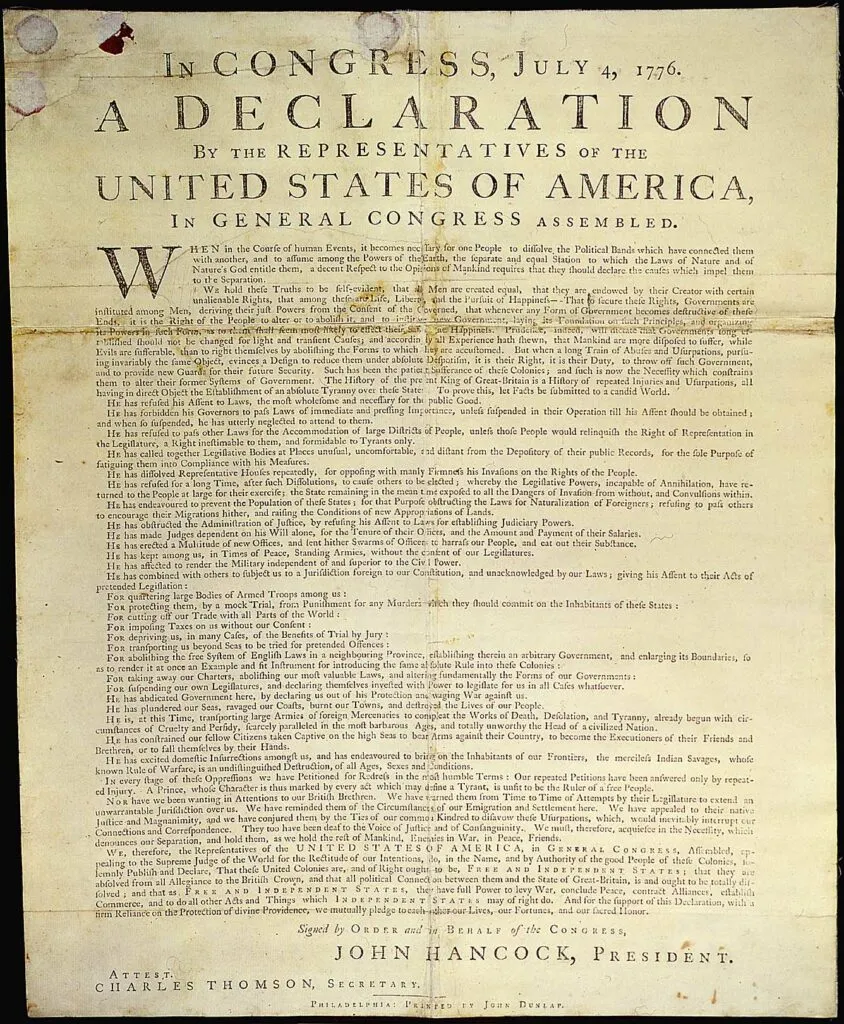
The claim is astonishing, and it deserves astonishment. Five propositions are pronounced with the confidence of a mathematician stating an axiom: that human equality is real, that rights are inherent rather than granted, that among these are life, liberty, and the pursuit of happiness, that governments exist to secure them, and that governmental authority derives from consent. Five claims. Thirty-six words. An entire political philosophy compressed into a sentence.
Where did these truths come from? Who discovered them? How did they become self-evident? And if they truly are self-evident — plain as daylight, obvious to any rational mind — why must they be taught at all?
These are the questions this series will answer, week by week, across twenty-two installments. The answer, in brief, is this: the truths the Declaration pronounces were not invented in Philadelphia in the summer of 1776. They were inherited. They were refined across more than two millennia of human reflection, in more than one civilization, by men who rarely knew one another, working in languages and circumstances that the signers of the Declaration could scarcely have imagined. Thomas Jefferson did not invent the idea of natural rights. John Locke did not invent it either, though he gave it its most famous English formulation. Neither did Aquinas, nor Cicero, nor Aristotle. What each did was to receive something, to refine it, and to pass it forward along a chain of thought — a golden thread — that runs from the agora of Athens to the hall of the Pennsylvania State House, where on a sweltering July day fifty-six men pledged their lives, their fortunes, and their sacred honor to its defense.
That thread is the subject of this series. Before we trace it, we must establish three things: that there was a thread at all, what books the Founders were reading when they picked it up, and how to think about liberty in a way that will serve us through every article that follows.
The Question That Is Never Asked
Americans memorize the Declaration; they rarely interrogate its sources.
This is strange, because Jefferson himself told us where the ideas came from. Forty-nine years after he drafted the Declaration, in the final year of his life, he wrote to Henry Lee to defend the document against the charge that it contained nothing original. The charge was true. Jefferson did not deny it. He embraced it.
In his letter of May 8, 1825, Jefferson explained that the Declaration was never meant to be original. It was meant to express what educated Americans already believed. Its authority, Jefferson said, rested on the harmonizing sentiments of the day — sentiments found in conversation, in letters, in printed essays, and in what he called the elementary books of public right. He named four such books by author: Aristotle, Cicero, Locke, and Sidney.²
This is extraordinary. The author of America’s foundational political declaration tells us explicitly that his document was a synthesis, not a creation. He names the ancient Greek who wrote three and a half centuries before Christ, the Roman consul who died in the civil wars that ended the Republic, the seventeenth-century Englishman who watched the Glorious Revolution unfold, and the Whig martyr whose head was struck from his shoulders in 1683 for writing a book Charles II found too republican. Four men, separated by two thousand years, three languages, and four political orders. And Jefferson places them in a line, as the elementary books from which the American mind was formed.
Jefferson was not boasting of his learning. He was describing a reality. The signers of the Declaration — fifty-six men drawn from law, farming, medicine, trade, and pulpit — shared a common library of reference. They had read the same classical authors, often in the original Latin and Greek. They had wrestled with the same English constitutional texts, from Magna Carta through Coke’s Institutes through Locke’s Two Treatises. They had absorbed the Scottish moralists and the French philosophes. And they had done so not as curiosities but as working resources — arguments to be deployed, frameworks to be applied, precedents to be invoked.
To understand what the Declaration means, we must understand what its authors meant by it. And to understand that, we must know what they had read.
A Room Full of Books
In 1815, after British troops burned the Capitol and destroyed the young Library of Congress, Thomas Jefferson sold his personal library to the United States government. The collection comprised 6,487 volumes.³ It included works in Greek, Latin, French, Italian, Spanish, German, and English. It covered law, political philosophy, history, natural science, agriculture, architecture, music, and theology. It was, at the time of its purchase, the largest and most carefully chosen personal library in America. And it was the working library of the man who had drafted the Declaration of Independence.
Jefferson’s library was remarkable, but it was not unique in kind. James Madison kept a comparable working library at Montpelier. John Adams read so voraciously and annotated so fiercely that his personal volumes — now preserved in the Boston Public Library — are a running commentary on the entire Enlightenment, scrawled in the margins in Adams’ unmistakable hand.⁴ George Washington’s library at Mount Vernon held more than 900 titles across some 1,200 volumes at his death. Alexander Hamilton, who had access to King’s College’s library as a student, famously wrote The Farmer Refuted at twenty citing Grotius, Pufendorf, Locke, Montesquieu, Blackstone, and Hume from memory.⁵ James Wilson, who signed both the Declaration and the Constitution, delivered lectures at the College of Philadelphia in 1790 and 1791 that remain one of the most thoroughly sourced philosophical expositions in American legal history — Wilson moves from Cicero to Aquinas to Grotius to Hooker to Locke to Burlamaqui to Vattel without pausing for breath.
These men were readers. Their political thought was not instinct; it was cultivated.

Consider the most instructive case. In the autumn of 1784, James Madison, then a Virginia legislator, wrote to Thomas Jefferson in Paris with a request. Madison wanted books — specifically, books on the history and operation of republican and federal governments, ancient and modern. Over the following eighteen months, Jefferson shipped him trunks of volumes: histories of the Achaean League, the Amphictyonic Council, the Lycian Confederacy, the Swiss Cantons, the Dutch United Provinces, and the German Empire. Madison studied these works with the discipline of a man preparing for examination. By April of 1787 — six weeks before the Constitutional Convention opened in Philadelphia — he had produced two preparatory memoranda: “Notes on Ancient and Modern Confederacies,” composed the previous spring, and “Vices of the Political System of the United States,” just completed.⁶ These were the intellectual foundation of what Madison brought to Philadelphia, and much of what he brought became the Constitution.
Madison did not invent the idea of a compound republic. He found it in the books Jefferson sent him, and in the ancient authors he had studied since boyhood at Princeton.
What books mattered most? The historical record is unusually clear. Political scientist Donald Lutz conducted a systematic study of political writing in America between 1760 and 1805, examining 916 political writings containing more than three thousand cited references. His findings have become a landmark in founding-era scholarship. The most cited source by a considerable margin was the Bible, which provided roughly thirty-four percent of all citations in the sample. Among secular authorities, Montesquieu ranked first at 8.3%, Blackstone second at 7.9%, and Locke close behind at approximately 3%. The classical authors — Plutarch, Cicero, Tacitus, Livy, Polybius — collectively outpaced any single modern source.⁷
The specific volumes appear and reappear in the Founders’ correspondence. Jefferson’s list of essential books for a young man’s education, sent to Robert Skipwith in 1771, named Locke’s Essay Concerning Human Understanding, Sidney’s Discourses Concerning Government, Bolingbroke’s Patriot King, and Montesquieu’s The Spirit of the Laws.⁸ John Adams read Cicero’s orations annually for recreation. Patrick Henry quoted Livy in his legislative speeches. Hamilton carried Plutarch into battle. And Cato’s Letters — the weekly essays by John Trenchard and Thomas Gordon published in London between 1720 and 1723, arguing for natural rights, religious toleration, freedom of speech, and resistance to tyranny — circulated in colonial newspapers with such frequency that Bernard Bailyn has argued, in his study of the colonial pamphlet literature, that Trenchard and Gordon — more than Locke himself — provided the most immediate vocabulary of American revolutionary argument.⁹
Locke’s Second Treatise of Government — the work that gives us, in its plainest English form, the argument that men are by nature free and equal, that government exists by consent, and that tyranny may be resisted — was quoted by name, paraphrased without citation, and echoed in structure throughout the American pamphlet literature of the 1760s and 1770s. Sidney’s Discourses Concerning Government, published posthumously in 1698 after its author had been executed for the manuscript’s alleged seditious content, taught the Americans that resistance to unjust authority was not merely a right but a duty.¹⁰
To trace the golden thread, then, is to follow the specific texts that passed from hand to hand across the generations, carrying the same essential claims in ever-sharper language: that men are not born to rule one another, that authority requires consent, that law must be superior to the will of the ruler, and that when rulers break faith with the purposes of government, the people may alter or abolish it.
These were not the Founders’ discoveries. They were their inheritance.
The Cast to Come
Over the course of twenty-two articles, this series will introduce a cast of philosophers, jurists, theologians, statesmen, and dissidents. A brief preview is in order, so that readers know who is coming and why.

The journey begins in Athens, with Aristotle’s analysis of constitutions and his concept of the mixed polity, which held that the best political order balances the one, the few, and the many. It continues to Rome, with Polybius’ examination of the Roman Republic’s separation of powers and Cicero’s formulation of natural law — the claim that there is a law above all human law, discoverable by reason, binding on all rational beings everywhere.
The thread then moves eastward to Jerusalem, where the Hebrew covenant tradition introduces the radical idea that even kings are subject to law, that the ruler and the ruled are bound together by obligations higher than power. It moves through the House of Wisdom in Baghdad, where Islamic scholars preserved and commented on the Greek philosophical tradition when Christian Europe had largely forgotten it, and where Averroes, Avicenna, and al-Farabi transmitted Aristotle back to the Latin West.
In the medieval synthesis, Thomas Aquinas weaves natural law into Christian theology, and the Magna Carta establishes — against a king who considered himself above the law — that even the sovereign is bound by chartered liberties. In the Reformation, Martin Luther insists on the liberty of conscience against ecclesiastical compulsion, and Calvinist resistance theorists develop the argument that tyrants may be lawfully deposed. The Dutch build the first modern republic. Sir Edward Coke declares in 1610 that the common law will control any act of Parliament that contradicts right reason — and is dismissed from the bench for the heresy.
The Levellers of the 1640s demand written constitutions, popular sovereignty, and universal adult male suffrage a full century and a half before the Americans. Algernon Sidney writes his Discourses Concerning Government and dies for the book’s contents. John Locke publishes the Two Treatises in 1689 under protective anonymity. In 1688, the Glorious Revolution establishes parliamentary supremacy — a triumph with consequences the Americans would learn to regret.
In the Scottish Enlightenment, Francis Hutcheson teaches that rulers may be resisted when they betray the people’s trust, and Adam Smith publishes The Wealth of Nations in the same year the Declaration is signed. In the French Enlightenment, Montesquieu systematizes the separation of powers in The Spirit of the Laws, and a fork in the road opens between the liberty tradition that produced 1776 and the rationalist tradition that would produce 1789 and its guillotine.
The synthesis reaches America, where colonists already living self-governing lives draw on the Great Law of Peace of the Iroquois Confederacy, wrestle with colonial charters, fight a revolution, write a Constitution, encounter the Anti-Federalist objection, and codify the Bill of Rights.
Each figure in this cast has earned a place in the story. Each will receive, in turn, the attention his contribution deserves. This article introduces the cast only to dispel any illusion that the Founders worked from a blank page. They did not. They worked from a library — a library stocked across centuries by men who themselves worked from libraries.
The Truths Are Self-Evident Because They Are True
A philosophical question hovers over the entire series, and it must be addressed at the outset. The Declaration says these truths are self-evident. But plainly they have not always been evident to all people. Tyrants have denied them. Theologians have denied them. Entire civilizations have organized themselves around their denial. If the truths of natural rights and human equality were obvious, they would not have required two thousand years of argument to articulate, and they would not be under renewed attack in our own time.
The Founders were aware of this difficulty, and they had an answer for it. The truths are self-evident not in the sense that every person sees them immediately, but in the sense that every person who considers them carefully and honestly can see them — that they are grounded in the nature of human persons and discoverable by the exercise of reason. They are self-evident in the way that a geometric theorem is self-evident to a trained mind: not intuitively obvious to a five-year-old, but necessarily true upon proper reflection.
The Declaration’s appeal to “the Laws of Nature and of Nature’s God” is not a rhetorical flourish. It is a philosophical commitment. It holds that there is a moral order to the universe, that this order is discoverable, that human beings occupy a specific place within it, and that certain rights follow from what human beings are. The signers held a range of theological views — Jefferson a rational deist, Adams a Unitarian, Witherspoon a Presbyterian minister, Carroll a Roman Catholic — but they shared a conviction that natural rights were discovered rather than invented. They were not granted by Parliament. They were not bestowed by kings. They could not be voted into existence, and they could not be voted out.
This series will take the same view. Human beings are fallible. Human ideas can be incomplete, mistaken, or ruinous. Much of human history is the record of ideas that turned out to be dead ends or catastrophes. But some ideas, by the testimony of centuries and the weight of sustained reflection, approach something more enduring. The discovery that no person owns another by nature, that coercion requires justification, that rulers serve rather than command, that conscience stands above decree — these are not the private opinions of one culture or one era. They are, I contend, among the most carefully verified discoveries of the human mind. Whether one understands them as divinely inspired, or as the deepest yield of human reason, or — as most of the Founders did — as both at once, the claim remains that they are not arbitrary. They are true.
This is the wager of the Declaration, and it is the wager of this series. If the wager is correct, the history that follows is the record of a great discovery. If the wager is wrong, the history is merely a curiosity. The defense of natural rights in the modern world depends on whether this claim can be held honestly by thinking people. This series will hold it honestly.
The Liberty Test
The reader will carry one instrument through every article that follows. It is the single most important tool in the libertarian analytical kit, and it can be stated in three questions.
The Liberty Test.
First: Could an individual morally do this to another individual? If you attempted it in your own name, toward your own neighbor, without the sanction of any government whatever, would it be recognized as just — or as a crime?
Second: If an individual cannot morally do this, can a group of individuals delegate that power to government? Government is not a different kind of thing from the people who compose it. It is a set of agents acting under authority delegated by principals. An agent cannot possess powers the principal never had to give.
Third: If both answers are “no,” then the action is aggression — regardless of who performs it. The badge does not change the ethics. The robe does not change the ethics. The majority vote does not change the ethics. The uniform does not matter. The morality of an act is determined by the act itself, not by the costume of the actor.
That is the Test. It will be applied in every article and every episode of this series. It should be applied by every reader to every policy proposal, every law, every tax, every regulation, every court ruling, every executive order, and every political argument encountered for the rest of our lives. The Test is not a policy preference. It is a standard of consistent ethical reasoning.
Consider a plain example. If your neighbor knocked at your door and demanded thirty-five percent of your income on pain of imprisonment, you would recognize his demand as armed robbery. There is no moral difference if he returns with ten neighbors, all agreeing that they are entitled to your income. There is no moral difference if one hundred neighbors sign a petition to that effect. There is no moral difference if one thousand do so. The number of people who agree to take your property does not transform the taking into consent. Your consent is the only consent that matters for an action taken against you. And yet government, through the mechanism of majority vote, claims exactly this — that what an individual could not do, that what ten could not do, that what one thousand could not do, ten million or one hundred million can do, so long as the taking is processed through the proper forms. By what philosophical magic is the aggression laundered?
This is the point at which libertarianism parts company with every other political philosophy on offer. The Founders understood the difficulty. They did not pretend they had solved it. They attempted to build a system in which the taking was minimized, the consent was as genuine as possible, the powers were enumerated and limited, and the rulers were held accountable — and even then they warned, repeatedly and in alarmed tones, that the system they had built would not preserve itself.
Fancy Hats and Larger Mobs.
A phrase will recur in this series, because it condenses the Test into a mnemonic. Government officials wear fancy hats. They have titles, ceremonies, official vehicles, seals, flags, and courts. None of this changes what they do. A police officer who confiscates property without cause has taken property without cause. A legislator who votes to seize half of a citizen’s labor has voted to seize half of a citizen’s labor. A president who orders the killing of a person the law has not convicted has ordered an extrajudicial killing. The costume is decorative. The act is the act.
Democracies add to the costume a second claim: that majorities may do what individuals may not. This is what is meant by the larger mob. A mob of ten thousand acting without procedural authority would be called a riot. A mob of ten thousand acting with procedural authority is called an election. The procedural machinery is real, and it matters — but it does not transform the ethics of aggression into the ethics of consent. It merely organizes the aggression into forms that are less chaotic and more regular. This is an improvement over mob rule. It is not the same thing as legitimate authority.
The Liberty Test will not resolve every policy question in a single stroke. Many questions turn on factual matters, on institutional design, on prudential judgments about second-order consequences. But the Test establishes the bar. Any action that fails the Test requires a very strong positive justification for why the delegation is nonetheless legitimate. Most government actions in the modern administrative state fail the Test. This series will help the reader see why.
The Transmission of Ideas
One further thread must be traced before we begin in earnest. The inheritance this series describes is not the property of a single civilization. It is a common human heritage.
The Greeks asked the foundational questions about justice, law, and the good city. The Romans gave those questions the rigor of jurisprudence and the formulation of natural law that binds all rational beings. The Hebrew prophets insisted that even kings are under law, that there is a moral order not subject to royal command. Islamic scholars in Baghdad and Córdoba preserved the Greek philosophical corpus during centuries when most of it had disappeared from Christian Europe, and it was through Arabic commentaries on Aristotle that medieval Europe rediscovered its own philosophical foundations. Christian theologians integrated natural law into a theological framework that gave it universal reach. English common lawyers developed the concept of due process across six centuries of practical litigation. Scottish moralists built the philosophical apparatus that made the American synthesis possible. And Native American confederacies — the Iroquois in particular — provided a living example of a federal republic whose influence Benjamin Franklin acknowledged directly.
No serious history of liberty can be told as the property of one people, one race, one creed, or one hemisphere. The Founders were heirs to a patrimony contributed by Athens and Jerusalem and Rome, by Baghdad and Oxford and Edinburgh, by the hills of Westmorland and the longhouses of the Mohawk. This series will honor that breadth. It will show, across twenty-two installments, that the American achievement was the synthesis of a genuinely cross-civilizational inheritance — one that remains available to any people anywhere who chooses to carry it forward.
This is the first reason the truths are rightly called self-evident. They have been independently discovered, at different times, by different peoples, working in different languages, from different premises. Convergence is evidence of reality. When the Stoics of Rome, the Talmudists of Judea, the jurists of Córdoba, the schoolmen of Paris, the common lawyers of London, the moralists of Edinburgh, and the sachems of the Iroquois Confederacy arrive at overlapping conclusions about human dignity and the limits of power, the conclusions deserve to be taken seriously as discoveries rather than dismissed as the parochial prejudices of one tribe.
The Skeptic’s Case
An honest history must give the strongest opposing arguments a fair hearing. Three challenges to the inheritance thesis have serious intellectual defenders and must be addressed before we proceed. Each will receive deeper treatment in later articles. They are introduced here so that readers know what they must hold open throughout the journey.
The Economic Interpretation. The first challenge comes from Charles Beard’s An Economic Interpretation of the Constitution of the United States, published in 1913. Beard argued that the Founders were not philosophers but property holders, and that the Constitution was less the fruit of disinterested natural-rights reasoning than a mechanism to protect the creditor class, the large land holders, and the holders of continental securities from debtor populism and state-level redistributionism.¹¹ The Declaration’s universal language, on this reading, was cover — a rhetorical flourish that concealed the class interests of the men who drafted it. The more recent sequel to Beard, developed in academic history from the 1960s onward, adds racial and gender critiques: that the “all men” of 1776 meant white propertied adult males, and that the subsequent expansion of rights happened in spite of the Founders’ intentions rather than because of them.
The Particularist Critique. The second challenge comes from a broader intellectual movement that holds rights-language itself to be culturally contingent. Natural rights, on this view, are a Western invention of the seventeenth and eighteenth centuries, products of a specific Protestant-commercial-Enlightenment moment. They are not universal. They do not reflect a discoverable moral order. They are one set of cultural preferences among many, no more philosophically privileged than the preferences of cultures that organized themselves around hierarchy, honor, clan, or collective survival. To impose natural-rights frameworks on peoples who have not chosen them is, on this account, a form of cultural imperialism.
The Utilitarian Challenge. The third challenge comes from a tradition that traces its modern form to Jeremy Bentham in the 1780s and reaches its most eloquent expression in John Stuart Mill’s On Liberty in 1859. Mill argued — brilliantly and sympathetically — that the value of liberty lies not in any metaphysical claim about natural rights but in the social goods that liberty produces: human development, the improvement of character, the advancement of truth through open discussion, and the general happiness of mankind.¹² Bentham had been blunter still, calling natural rights “nonsense upon stilts.” On the utilitarian view, what matters is human welfare; liberty is justified insofar as it serves welfare, and constrained insofar as it does not.
Each of these challenges deserves respect. Each will receive sustained engagement later in the series. But this series will argue that none of them ultimately defeats the natural-rights framework the Founders inherited.
Against Beard: the economic interpretation has been carefully dismantled by generations of subsequent historians, most notably Forrest McDonald, whose We the People: The Economic Origins of the Constitution demonstrated that Beard’s methodology was selective and that the alignment between economic interest and constitutional position Beard claimed does not hold up when the full documentary record is consulted.¹³ The Founders plainly did hold property, and property holders plainly benefited from a stable constitutional order. But to argue that they reduced to their economic interests — that their reading of Cicero was window dressing — is to explain away the most thoroughly documented intellectual preparation in American political history.
Against the particularist critique: the claim that rights-talk is culturally contingent is itself, by its own standards, merely a cultural preference. If the critic genuinely believes there is no discoverable moral order, he cannot without contradiction assert that cultural imperialism is wrong in any non-culturally-contingent sense. The position is self-consuming. Moreover, as this series will show, the natural rights tradition is not exclusively Western. Islamic, Hebrew, and Native American traditions each contribute essential components. The Greeks who first asked the questions did not think of themselves as Westerners. The tradition is a human tradition, open to all who will carry it forward.
Against the utilitarian challenge: Mill’s argument is the most serious of the three, and it is ultimately the most dangerous. A framework that grounds liberty in social utility rather than in natural right is vulnerable to any argument for utility-maximizing coercion. If liberty is instrumental to happiness, then whenever a sufficiently confident expert or a sufficiently large majority believes that coercion will produce more happiness, liberty must yield. This is the philosophical door through which the administrative state entered the twentieth century. Mill himself struggled, honorably, to close the door — but he could not, and his successors did not. A rigorous utilitarianism offers no principled defense against the argument that forcing people to be happy is permissible when it works.¹⁴ The natural-rights framework holds that persons may not be used as means to the happiness of others, because they are ends in themselves. This is the firmer ground.
The reader need not accept these rebuttals on the first article’s say-so. The arguments will unfold across the series. But the reader should know at the outset that this series engages the strongest opposing cases seriously, and that the choice to follow the Founders’ inheritance is a considered one.
The Responsibility
We began with wonder. Two thousand years of thought converged on a sentence drafted in a Philadelphia room in the summer of 1776. Men who had read Aristotle in Greek and Cicero in Latin, who had memorized long passages of Sidney and Locke, who had argued with Montesquieu and corresponded across oceans about the writings of Hutcheson and Hume, produced a document whose thirty-six most famous words distilled an inheritance.
Wonder is the right first response. But wonder alone is not enough.
The Founders did not hand us a finished thing. They handed us a charge. “What must free people understand to remain free?” is the question that drives this series, and it is put to the reader as directly as possible. The ideas do not preserve themselves. They exist only so long as they are known, understood, applied, taught, and defended. Every generation that inherits them faces the same choice the founding generation faced: to receive the inheritance, refine it, and hand it forward — or to let it dissipate through neglect and ignorance until only the monuments remain.
This series is a small contribution to the preservation. Each article will trace one stage of the thread. Each episode will extend the treatment in spoken form. Each contemporary-application installment will show how the principles apply to the liberty debates of our own moment. Twenty-two weeks is not enough time to tell the whole story, but it is enough time to equip a serious reader with the scaffolding on which the rest of a lifetime of reading can be built.
The reader should know what is coming and should know why it matters. Athens is coming, and Rome. Jerusalem is coming, and Baghdad, and Córdoba. The Magna Carta is coming, and Aquinas, and Luther, and Coke, and the Levellers. Sidney is coming, and Locke, and Montesquieu. Hutcheson and Smith are coming, and so is Jefferson. Madison is coming, and so is Mason, and so is the unlovely but essential company of the Anti-Federalists without whom the Bill of Rights would not exist. And at the end, a coda will consider what we have done with the inheritance — and what may yet be done to recover it.
This is the road to 1776. Let us walk it together.
Self-Reflection Prompts
The Declaration calls its truths “self-evident,” yet the same truths have been denied by most governments in most eras of human history. In what sense can something be self-evident that is also, manifestly, not universally accepted? How does the Founders’ understanding of self-evidence differ from a modern common-sense reading of the phrase?
Apply the Liberty Test to a specific government action you encounter this week — a tax, a regulation, a licensing requirement, a use of emergency power. First, ask whether an individual could morally perform the same act against another individual. Second, ask whether a group could delegate that power to an agent. Third, note where the action falls. What do you conclude?
Consider the claim that natural rights are a Western cultural invention rather than a universal human inheritance. What evidence would confirm the claim? What evidence would refute it? Which account more accurately describes the historical record as you understand it?
The Founders were readers before they were revolutionaries. They drew on a specific library of ancient and modern authors. What books and authors have shaped your own understanding of liberty, law, and government? If you were compiling a working library for a young citizen today, which five volumes would you place on the first shelf?
As the author, I will contend that certain ideas about human dignity and natural rights approach something timeless — perhaps divinely inspired, perhaps the deepest yield of human reason, perhaps both. Is this a claim you find plausible? On what grounds? If you reject it, what is the alternative foundation for the moral authority of natural rights?
Endnotes
The Declaration of Independence (July 4, 1776). Full text available at the National Archives, https://www.archives.gov/founding-docs/declaration-transcript. The preamble quoted is from the second paragraph as engrossed on parchment and signed by the delegates to the Second Continental Congress.
Thomas Jefferson to Henry Lee, May 8, 1825. Jefferson wrote: “All its authority rests then on the harmonising sentiments of the day, whether expressed, in conversation, in letters, printed essays or in the elementary books of public right, as Aristotle, Cicero, Locke, Sidney &c.” The letter is available in full at Founders Online, National Archives, https://founders.archives.gov/documents/Jefferson/98-01-02-5212. The letter is a response to Lee’s inquiry about charges that Jefferson had copied from John Locke or from an earlier draft attributed to Richard Henry Lee.
Kevin J. Hayes, The Road to Monticello: The Life and Mind of Thomas Jefferson (New York: Oxford University Press, 2008), 580–83. Jefferson’s library was purchased by Congress on January 30, 1815, for $23,950. The collection comprised 6,487 volumes. A portion was destroyed in an 1851 fire at the Library of Congress.
Zoltán Haraszti, John Adams and the Prophets of Progress (Cambridge: Harvard University Press, 1952). Haraszti’s study of Adams’ annotations, drawing on the Adams collection at the Boston Public Library, established the depth and precision of Adams’ engagement with Rousseau, Turgot, Condorcet, Mary Wollstonecraft, and others.
Alexander Hamilton, The Farmer Refuted, February 23, 1775. In The Papers of Alexander Hamilton, ed. Harold C. Syrett (New York: Columbia University Press, 1961), 1:81–165. Hamilton was twenty years old when he composed the pamphlet, adopting the now-standard scholarly consensus (following Ron Chernow and most modern biographers) that Hamilton was born on January 11, 1755.
James Madison, “Notes on Ancient and Modern Confederacies” (April–June 1786) and “Vices of the Political System of the United States” (April 1787). In The Papers of James Madison, ed. Robert A. Rutland et al. (Chicago: University of Chicago Press, 1975), 9:3–24, 345–58. Madison’s April 27, 1785 book list sent to Jefferson is in The Papers of James Madison, 8:350–51.
Donald S. Lutz, “The Relative Influence of European Writers on Late Eighteenth-Century American Political Thought,” American Political Science Review 78, no. 1 (March 1984): 189–97. The citation analysis covered 916 items published in America between 1760 and 1805. The Bible accounted for roughly 34 percent of citations overall, Montesquieu 8.3 percent, Blackstone 7.9 percent, and Locke 2.9 percent. Lutz’s methodology has been debated, but his catalog remains the most systematic empirical study of the founders’ citation practice.
Thomas Jefferson to Robert Skipwith, August 3, 1771. In The Papers of Thomas Jefferson, ed. Julian P. Boyd (Princeton: Princeton University Press, 1950), 1:76–81. Jefferson appended a list of 148 volumes suitable for a young gentleman’s library. Available at Founders Online, https://founders.archives.gov/documents/Jefferson/01-01-02-0056.
Bernard Bailyn, The Ideological Origins of the American Revolution, enlarged ed. (Cambridge: Harvard University Press, 1992), 35: “To the colonists the most important of these publicists and intellectual middlemen were those spokesmen for extreme libertarianism, John Trenchard and Thomas Gordon.” Bailyn’s analysis of the colonial pamphlet literature of 1760–1776 established the central role of Cato’s Letters in transmitting radical Whig vocabulary to American political writing.
Algernon Sidney, Discourses Concerning Government, ed. Thomas G. West (Indianapolis: Liberty Fund, 1996). Sidney was executed on December 7, 1683, on Tower Hill. The Discourses manuscript was used as the second witness required for a treason conviction under a constructive doctrine Chief Justice George Jeffreys applied with notorious liberality. The book was first published in 1698, after the Glorious Revolution.
Charles A. Beard, An Economic Interpretation of the Constitution of the United States (New York: Macmillan, 1913). Beard’s thesis held that the Constitution was drafted primarily to advance the interests of holders of public securities, money lenders, manufacturers, and the mercantile class.
John Stuart Mill, On Liberty (London: John W. Parker and Son, 1859). Mill’s formulation was famously not grounded in natural rights: “It is proper to state that I forego any advantage which could be derived to my argument from the idea of abstract right, as a thing independent of utility. I regard utility as the ultimate appeal on all ethical questions; but it must be utility in the largest sense, grounded on the permanent interests of man as a progressive being” (ch. 1).
Forrest McDonald, We the People: The Economic Origins of the Constitution (Chicago: University of Chicago Press, 1958). McDonald’s empirical examination of the economic holdings and political positions of the Constitutional Convention’s delegates, and of the ratifying conventions, found that Beard’s claimed alignment between economic interest and constitutional position did not hold up to systematic scrutiny.
For the classical critique of utilitarianism on precisely these grounds, see H. L. A. Hart, “Are There Any Natural Rights?” Philosophical Review 64, no. 2 (April 1955): 175–91; and Robert Nozick, Anarchy, State, and Utopia (New York: Basic Books, 1974), chap. 3, on the inviolability of persons as “a distinct constraint” on utility-maximizing action.
Sources and Further Reading
Primary Sources
The Declaration of Independence (1776). National Archives: https://www.archives.gov/founding-docs/declaration.
The Federalist Papers (1787–1788). Available at Liberty Fund’s Online Library of Liberty.
Founders Online (National Archives): https://founders.archives.gov. Searchable archive of the complete papers of Washington, Adams, Jefferson, Hamilton, Madison, and Franklin.
Aristotle, Politics. Multiple modern translations available; Loeb Classical Library edition recommended.
Marcus Tullius Cicero, De Re Publica and De Legibus. Loeb Classical Library edition, trans. C. W. Keyes.
Polybius, The Histories, Book VI. Loeb Classical Library edition, trans. W. R. Paton.
Thomas Aquinas, Summa Theologica, I-II, q. 90–97 (on the kinds of law).
Magna Carta (1215). British Library translation and original Latin.
Sir Edward Coke, Reports and Institutes of the Laws of England.
John Locke, Two Treatises of Government, ed. Peter Laslett. Cambridge University Press edition preferred.
Algernon Sidney, Discourses Concerning Government. Liberty Fund edition.
John Trenchard and Thomas Gordon, Cato’s Letters, ed. Ronald Hamowy. Liberty Fund edition.
Montesquieu, The Spirit of the Laws. Cambridge University Press edition.
James Wilson, Collected Works, ed. Kermit L. Hall and Mark David Hall. Liberty Fund edition.
Secondary Works
Bernard Bailyn, The Ideological Origins of the American Revolution (1967; enlarged ed., 1992).
Gordon S. Wood, The Creation of the American Republic, 1776–1787 (1969).
Forrest McDonald, Novus Ordo Seclorum: The Intellectual Origins of the Constitution (1985).
Forrest McDonald, We the People: The Economic Origins of the Constitution (1958).
Trevor Colbourn, The Lamp of Experience (1965).
Caroline Robbins, The Eighteenth-Century Commonwealthman (1959).
Kevin J. Hayes, The Road to Monticello: The Life and Mind of Thomas Jefferson (2008).
Donald S. Lutz, The Origins of American Constitutionalism (1988).
Murray N. Rothbard, The Ethics of Liberty (1982).
Zoltán Haraszti, John Adams and the Prophets of Progress (1952).
Reference
Donald S. Lutz, “The Relative Influence of European Writers on Late Eighteenth-Century American Political Thought,” American Political Science Review 78, no. 1 (March 1984): 189–97. The empirical study of founding-era citations.



Comments