“Higher Law” — Medieval Foundations

Updated: Sep 13
SELF-EVIDENT The Road to 1776 Article 4 of 22
“No free man shall be seized or imprisoned, or stripped of his rights or possessions, or outlawed or exiled, or deprived of his standing in any other way, nor will we proceed with force against him, or send others to do so, except by the lawful judgment of his equals or by the law of the land.”— Magna Carta, clause 39, June 1215¹
From Philosophy to Politics
In June of 1215, in a meadow beside the Thames called Runnymede, a defeated and furious king set his seal to a document he had no intention of honoring. King John of England had lost a war in France, alienated his barons through years of extortion and arbitrary justice, and quarreled so bitterly with the Pope that the whole of England had been placed under interdict. Cornered by an armed baronial coalition that had already taken London, he agreed to terms. The terms were written down. The document would come to be called the Great Charter — Magna Carta.
It was not a charter of liberty in any sense the Founders would later mean. It was a peace treaty between a king and his aristocracy, most of its sixty-three clauses concerned with feudal inheritance dues, fish weirs (ancient barriers) on the Thames, the treatment of Welsh and Scottish hostages, and the debts owed to moneylenders. The barons who forced it were not democrats. They were a propertied warrior class protecting their own privileges against a king who had abused them. Within ten weeks, John had written to Rome, and Pope Innocent III obligingly declared the whole agreement null and void — “illegal, unjust, harmful to royal rights, and shameful to the English people,” in the words of the papal bull — and absolved the king of any obligation to keep it.² The charter was dead almost before the wax had cooled. Civil war resumed. John died the following year of dysentery, with the document legally nulified.

And yet it did not stay dead. Reissued under John’s young son, revised, confirmed and reconfirmed dozens of times across the following centuries, the Great Charter survived its own annulment and outlived the feudal world that produced it. Four hundred years later, an English judge named Sir Edward Coke would reach back to clauses 39 and 40 and read into them protections their drafters never imagined — and the American colonists would read Coke. By the time Jefferson sat down in Philadelphia, Magna Carta had become something its barons would not have recognized: a foundation stone of the proposition that even the highest earthly power is bound by law it did not make and cannot suspend at will.
Read again to clause 39. Strip away the feudal context and the medieval Latin, and what remains is a principle that would become the spine of Anglo-American liberty. No free man may be deprived of life, liberty, or property except by the judgment of his peers or by the law of the land. Not by the king’s pleasure. Not by his suspicion. Not by his need. By law — settled, known, applicable to ruler and ruled alike.
This is the subject of the present article: the medieval centuries in which the inheritance traced in the first three installments of this series was put to immediate political and legal use. Athens had given the West reason and the idea of the mixed constitution. Jerusalem had given it the covenant and the conviction that even kings stand under a law above themselves. Rome had given it natural law and the architecture of a republic. The House of Wisdom had preserved and transmitted the Greek philosophical inheritance back to a Latin West that had largely lost it.³ Now the schoolmen and the lawyers of medieval Europe would take that recovered inheritance and forge from it the working doctrines of constitutional government: that law is discovered rather than merely commanded, that an unjust law is no true law at all, that authority derives in some sense from the community it governs, and that the man who rules unjustly may, under carefully defined conditions, be resisted.
This is where the inheritance stops being philosophy and starts becoming politics.
The King Is Under the Law
The deepest principle of the medieval contribution is also the simplest to state and the hardest for power to accept: that the ruler is not the source of law but its servant. The Hebrew prophets had said as much to the kings of Israel.⁴ The Stoics and Cicero had grounded it in a natural law binding on all rational beings. But it was in the high medieval period that the principle hardened into legal doctrine, repeated in the law books and, eventually, enforceable in the courts.
Its most famous English expression belongs to Henry de Bracton, a thirteenth-century royal judge whose treatise On the Laws and Customs of England became the foundational text of the English common law. Bracton was no revolutionary; he served the Crown. And yet he wrote a sentence that monarchs would spend the next four centuries trying to evade: the king “ought not to be under man, but under God and under the law, because the law makes the king.”⁵ Rex non debet esse sub homine, sed sub Deo et sub lege. The king is under no man — but he is under God and the law, for it is the law that makes him a king and not a tyrant. Take away the law, and the crown is merely a band of metal worn by the strongest brigand in the realm.
This was not a claim that the king answered to some other man who might command him. That would simply relocate sovereignty. It was a subtler and more durable claim: that above the king, and above every man, stands a law that no human will enacted and no human will may abolish. The king finds the law; he does not found it. His authority is real, but it is delegated and conditional, held in trust for the ends the law exists to serve.
Law Discovered, Not Made
Here we reach a distinction that modern readers easily miss, because the modern world has largely lost it. To the medieval legal mind, law was not primarily legislation — not a command issued by a sovereign will, to be obeyed because the sovereign issued it. Law was something closer to a discovery: a body of right reason and ancient custom, grounded in the nature of things and the practice of the community, which the judge and the lawyer uncovered rather than invented. The common law of England was understood as immemorial custom, refined case by case, “discovered” in the sense that a mathematician discovers a theorem rather than authors it.
The consequence of this view was profound. If law is made by the sovereign’s will, then whatever the sovereign wills is law, and the only check on tyranny is the sovereign’s conscience. But if law is discovered — if it exists independently of any ruler’s command, and the ruler’s enactments are valid only insofar as they conform to it — then there is a standard above the ruler by which his commands may be judged and, if necessary, found wanting. The whole edifice of constitutionalism rests on this foundation. A constitution is, at bottom, the claim that some law stands above the lawmaker.
The common law would carry this conviction forward into the seventeenth-century constitutional struggles that are the subject of later articles in this series. When Sir Edward Coke told King James I in 1610 that the common law would control acts of Parliament repugnant to right reason, he was not inventing a doctrine.⁶ He was reaching back through Bracton to a medieval inheritance that had never entirely been lost. That story belongs to Arc III. What matters here is that the foundation was laid in the medieval centuries: the law is not the king’s, and the king is not above the law.
Aquinas and the Architecture of Law
If Bracton gave the medieval principle its legal form, it was Thomas Aquinas who gave it its philosophical architecture. He is the central figure of this article, and in a sense the central figure of the entire natural-law tradition that runs through this series. Article 3 closed by promising that he would be taken up directly. Here he is.⁷

Aquinas was a Dominican friar, born around 1225 to a noble family in the Kingdom of Sicily, who against his family’s wishes joined a new and suspect order of mendicant preachers and devoted his life to the reconciliation of faith and reason. He studied at Paris and Cologne, taught at the greatest universities of Christendom, and produced in his Summa Theologica one of the most ambitious intellectual structures ever attempted by a single mind. He died in 1274, not yet fifty, leaving the work unfinished. Within fifty years he was canonized; within centuries he had become the central theologian of the Catholic Church. For our purposes, what matters is a relatively compact section of the Summa — the “Treatise on Law,” questions 90 through 97 of the first part of the second part — in which Aquinas worked out an account of law that would shape Western political thought for the next seven hundred years.⁸
The argument depended on a recovery that this series has already traced. Aquinas could write as he did only because the philosophical inheritance of Athens had been returned to the Latin West, and it had been returned in large part through the Islamic transmission described in Article 3. Aquinas read Aristotle in Latin translations made from Arabic and from the Greek, and he engaged so constantly with the great Andalusian philosopher Ibn Rushd — Averroes, “the Commentator” — that the engagement runs through the whole of his mature work.⁹ When Aquinas argued against Averroes on the immortality of the individual soul, he was not dismissing him; he was wrestling with the most formidable Aristotelian of the preceding century. The synthesis of Athens, Jerusalem, and Rome that the medieval West achieved was built, quite literally, on books that Muslim and Jewish scholars had preserved, translated, and illuminated when Christian Europe could not. Aquinas is the transmission of Article 3 made flesh.
The Fourfold Hierarchy
The heart of the Treatise on Law is a hierarchy of four kinds of law, descending from the mind of God to the statutes of men.
The first is the eternal law — the rational order by which God governs all creation, the divine wisdom directing all things to their proper ends. No creature grasps it in full; it is the law as it exists in the mind of God.
The second is the natural law — and this is the basis on which the whole tradition turns. The natural law is the eternal law as it is accessible to human reason. Rational creatures, Aquinas argued, participate in the eternal law in a special way: they can apprehend, by the light of reason alone, the basic principles of right action. The first precept of the natural law is that good is to be done and pursued and evil avoided; from this flow the inclinations to preserve life, to live in society, to seek truth, and to act according to reason. Crucially, the natural law is universal and knowable. It is not confined to those who have received special revelation. A pagan, a Muslim, a Jew, a person who has never heard the Gospel — any rational being — can in principle discern its precepts, because reason itself is the faculty by which it is known. This is the doctrine that Cicero had articulated in Rome and that Jefferson would echo in the Declaration’s appeal to “the Laws of Nature and of Nature’s God.”
The third is the human law — the positive law, the actual statutes and ordinances enacted by human authority for the governance of particular communities. And here Aquinas drew the conclusion that gives this article its title. Human law derives its force from the natural law. A human enactment that conforms to natural law and serves the common good is genuine law, binding in conscience. But a human enactment that contradicts the natural law is something else entirely.
The fourth is the divine law — the law revealed in Scripture, given because the supernatural end of man exceeds what reason alone can attain, and because human judgment is too uncertain to be left without guidance on the deepest matters. The divine law supplements the natural; it does not contradict it.
Lex Iniusta Non Est Lex
From this architecture came the doctrine that would echo through seven centuries of resistance to tyranny. Aquinas held that an unjust law is not a law in the full sense at all — lex iniusta non est lex, in the formulation later distilled from his argument. A law that exceeds the authority of the lawgiver, or that is contrary to the common good, or that violates the natural law, “is no longer a law but rather a perversion of law,” and “does not bind in conscience.”¹⁰
This is among the most consequential sentences in the history of political thought, and it must be rendered honestly, because it is more carefully hedged than it is often remembered to be. Aquinas did not hand later generations a blank warrant for disobedience. He distinguished laws that are unjust because they are contrary to human good — burdensome, unequal, imposed for the ruler’s private benefit rather than the common good — from laws that are unjust because they are contrary to the divine good, commanding what God forbids. The first sort, he said, do not bind in conscience as a matter of strict justice, yet a man may still be obliged to obey them to avoid scandal or public disturbance, since the peace of the community is itself a good. The second sort — laws commanding what is positively sinful — must never be obeyed, for here one must obey God rather than men.¹¹
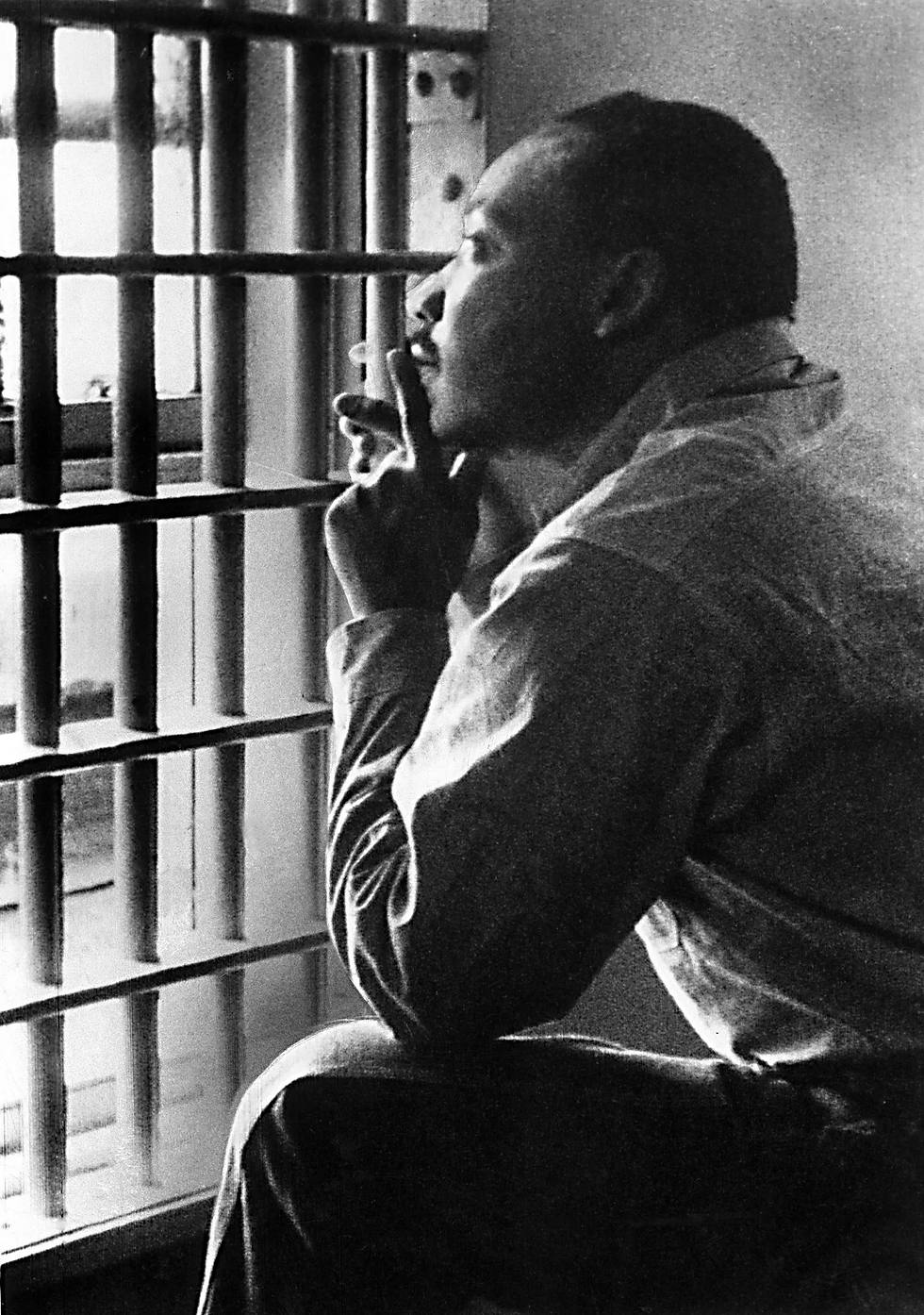
The principle, then, is real and radical, but it is disciplined. It is not the modern claim that each individual may disobey whatever law offends his private conscience. It is the claim that there exists an objective standard, accessible to reason, above all human enactment, against which human enactment may be measured and by which it may be found to be no true law at all. That standard does not dissolve the obligation to maintain public order lightly. But it establishes, against every theory of unlimited sovereignty, that the lawgiver is not the final word. Six centuries later, a Baptist minister sitting in a Birmingham jail would quote Aquinas by name to explain why a man has not only a legal but a moral responsibility to disobey unjust laws.¹² The line runs straight from the Dominican’s cell to the jail cell, and it runs through the conviction that law answers to something higher than power.
The Right to Resist
What of the tyrant himself — not merely his unjust statute, but his unjust rule? Here too Aquinas spoke, and here too he must be read with care, because the libertarian temptation is to enlist him as a clean theorist of the right of revolution, and he was not quite that.
Aquinas held that a government directed to the common good is legitimate and that a government directed to the private good of the ruler is a perversion — tyranny, the worst of the corrupt forms.¹³ He held that the tyrant, by betraying the end for which authority exists, forfeits his claim to obedience. But he was deeply wary of the cure being worse than the disease. Private, unauthorized rebellion — sedition — he condemned, both because it is apt to fail and bring greater suffering, and because the man who appoints himself the avenger of the public is as likely to become a tyrant in his turn. Aquinas’s preferred remedies were institutional: that the community which has the authority to set up a king has the authority to restrain or depose one who turns tyrant; that resistance, where it is justified, belongs properly to public authority and the community acting through its proper channels, not to the private assassin.¹⁴
It is a careful, conservative, profoundly responsible doctrine — and it is the seed of everything that follows. The Calvinist resistance theorists of the sixteenth century, the subject of a later article in this series, would take Aquinas’s hedged and institutional account and sharpen it into a full theory of lawful resistance by lesser magistrates. Locke would inherit the transformed doctrine and give it its most famous form in the right of the people to alter or abolish a government that has become destructive of its ends. Jefferson would write that right into the Declaration. The chain begins here, with a thirteenth-century friar who would have been horrified by the guillotine but who established the premise from which the whole edifice was built: that authority is a trust held for the common good, and that the ruler who betrays the trust has broken the bond that obliged obedience.
Marsilius and the Authority of the Whole
If Aquinas gave the tradition its natural-law spine, it was a Paduan physician and political theorist named Marsilius who pushed hardest, and earliest, toward the principle of popular sovereignty. His Defensor Pacis — The Defender of the Peace — appeared in 1324, and it was radical enough that its author was forced to flee for his life when his authorship became known.¹⁵
Marsilius wrote in the middle of a long and bitter struggle between the Holy Roman Emperor and the papacy over the boundaries of secular and spiritual authority, and his immediate purpose was to deny the Pope any coercive power in temporal affairs. But in the course of that argument he advanced a theory of political authority that reached well beyond the quarrel that occasioned it. The legitimate source of law, Marsilius argued, is the legislator humanus — the human legislator — and that legislator is the universitas civium, the whole body of the citizens, or its “weightier part.”¹⁶ Law derives its authority not from the wisdom of the ruler, nor from any sanction descending from above, but from the consent of the community that is to live under it. The ruler — the “executive part” — holds his office from the community and is accountable to it. A ruler who exceeds his commission may be corrected or removed by the authority that established him.
This is a startling anticipation of arguments that would not reach their full development until the seventeenth and eighteenth centuries. Four hundred years before the Levellers demanded a written constitution grounded in popular consent, Marsilius had located the source of legitimate law in the body of the citizens. It is no accident that this series will return to him implicitly again and again, for the thread that runs from the universitas civium to “We the People” is continuous.
Honesty requires a complication, however, and it is one the careful reader of this series will have come to expect. Marsilius is not a straightforward proto-libertarian, and his doctrine cuts in more than one direction. His central aim was to subordinate the Church entirely to the secular power, and the concentrated state authority he built up to accomplish that subordination can be read as readily as a forerunner of the all-competent modern state as of popular self-government. The “weightier part” of the citizens is a notoriously elastic phrase, and Marsilius did not mean by it anything like universal suffrage. His legislator could authorize a great deal of coercion once it had spoken. The same logic that makes the community the source of law can make the community’s enactments unlimited, if nothing stands above them. Marsilius reminds us that popular sovereignty and individual liberty are not the same thing, and that a doctrine locating all authority in the people can become a doctrine of unlimited authority as easily as a doctrine of freedom — a lesson the series will have grim occasion to revisit when it reaches 1789 and the road that led from the rights of man to the Terror.
The Lawyers of the Church
One further medieval contribution deserves notice, though it must be kept brief, because it runs quietly beneath much of what has already been said. The canon lawyers of the medieval Church — the scholars who systematized the law of the Church beginning with Gratian’s Decretum around 1140 — developed, in the course of working out how authority operated within ecclesiastical corporations, a set of principles that would prove enormously fertile for secular constitutional thought.¹⁷
Chief among them was a maxim drawn from Roman private law and given new and expansive life by the canonists: quod omnes tangit ab omnibus approbetur — what touches all must be approved by all.¹⁸ Originally a technical rule about the consent of co-guardians, it became in the hands of the canonists a principle of representation and consent: that those who are bound by a decision have a right to a voice in making it. The canonists worked out theories of corporation, of representation, of how a community acts through its head while retaining an authority that the head does not exhaust, and of the conditions under which the members of a corporation might act against a head who had failed in his office. These were developed for the governance of dioceses and religious orders and the universal Church. But they did not stay there. The conciliar movement that argued a general council of the Church stood above the Pope drew directly on this inheritance, and the secular constitutionalists who followed drew on it in turn. The idea that legitimate authority involves consent, representation, and accountability was worked out, in considerable technical detail, by men in clerical robes long before it animated any parliament.
The transmission of ideas this series has traced from civilization to civilization runs here from one domain to another — from the law of the Church to the law of the state. It is a reminder that the genealogy of liberty does not run only through the figures we celebrate as its heroes. It runs also through obscure canonists working out the governance of corporations, whose technical solutions to ecclesiastical problems became, generations later, the grammar of constitutional government.
The Honest Reckoning
A history that flattered the Middle Ages into a golden age of liberty would forfeit the trust this series depends upon. The medieval world that produced Bracton and Aquinas and Marsilius was also a world of serfdom, in which the great majority of human beings were bound to the land and to the will of a lord. It was a world of savage religious persecution. It launched the Crusades, with their massacres of Muslims, Jews, and Eastern Christians alike. It built the machinery of the Inquisition. It expelled the Jews from England in 1290 and from much of Europe in the centuries that followed, and subjected those who remained to humiliation, plunder, and periodic slaughter. The same Magna Carta whose clause 39 we have celebrated contains clauses regulating the debts owed to Jewish moneylenders in terms that treated a whole people as the king’s chattel.¹⁹
The sharpest tension of all sits at the very center of this article. Thomas Aquinas, who taught that the natural law is universal and accessible to every rational being regardless of creed, also held that obstinate heretics, after due admonition, might rightly be handed over to the secular authority to be put to death.²⁰ The man who gave the West its most powerful argument that there exists a moral order binding on all persons and discoverable by all reason also endorsed the killing of those who, having once professed the faith, persisted in error about it. This is not a contradiction that can be dissolved with a sympathetic gloss, and this series will not attempt to dissolve it. It must be named plainly: the doctrine of universal natural law and the practice of lethal religious coercion coexisted in the same mind, and the coexistence is a scandal to the doctrine.
To say this is not to discard the contribution. It is to insist on the standard this series has applied from the first article and will apply to the Founders themselves when their turn comes: that genuine philosophical achievement and grave moral failure can inhabit the same person and the same civilization, and that intellectual honesty requires us to hold both in view at once. The principle that even the king stands under the law was real, and it was the medieval scholars who forged it. The principle that an unjust law is no law was real, and it was Aquinas who gave it its enduring form. That the men who articulated these principles did not extend them to the serf, the heretic, or the Jewish citizen is not a reason to abandon the principles. It is a reason to carry them further than their authors dared — which is precisely what later generations would do, and precisely what the inheritance demands of those who receive it.
The Skeptic’s Case
An honest history must give the strongest opposing arguments a fair hearing before it proceeds. Three challenges to the account offered here have serious defenders, and each deserves to be stated at full strength.
The Anachronism Objection
The first and most formidable objection holds that this entire article commits the cardinal sin of Whig history: reading the present into the past. The medieval “liberties” of Magna Carta, the critic argues, were nothing like modern liberty. They were liberties, plural — specific, particular, feudal privileges belonging to specific corporate bodies. The barons at Runnymede were not defending the rights of man; they were defending the inheritance customs and tax exemptions of a warrior aristocracy. To read clause 39 as a charter of universal due process is to impose on a feudal document a meaning it acquired only centuries later, in the hands of seventeenth-century lawyers with their own political agenda. The same charge applies to the whole article: Aquinas was a medieval theologian working out problems internal to scholastic Christianity, not a forerunner of liberalism, and to enlist him in the genealogy of 1776 is to kidnap him from his own century.
The objection has real force, and the candid answer is to concede a great deal of it. The barons were not liberals. Magna Carta in 1215 was a feudal settlement, and clause 39 meant less, in its own moment, than it would later be made to mean. The history told here is in part the history of how later generations read the medieval inheritance — what they found in it, and what they built from it. But the concession is not fatal, for two reasons. First, the later reading was not a fabrication imposed on inert material; it was a development of something genuinely present. Clause 39 really does say that the king may not proceed against a free man except by lawful judgment or the law of the land, and that principle, however limited its original application, is the seed from which the broader doctrine grew. Coke did not invent due process out of nothing; he generalized a principle that was actually there. Second, and more deeply, the charge of anachronism cuts against the critic as well. To insist that medieval ideas can only mean what their authors consciously intended is itself a contestable theory of meaning. Ideas have logical implications their authors do not foresee. The principle that the king is under the law has a logic that runs past the barons who first invoked it, and the working-out of that logic across the centuries is not a distortion of the inheritance but its fulfillment.
The Theological-Dependence Objection
The second objection holds that the medieval contribution is fatally dependent on theological premises that no longer command assent. Aquinas’s natural law is the eternal law of a particular God, knowable because a rational Creator built rationality into the universe and into the human mind that apprehends it. Strip away the theism, the critic argues, and the whole structure collapses. There is no eternal law because there is no eternal lawgiver; there is no natural law accessible to reason because there is no guarantee that reason tracks any moral order at all. What is left is merely human preference dressed in metaphysical robes. The medieval foundation, on this account, cannot bear the weight a secular age would place on it.
This challenge is more serious than the first, and the honest reply does not pretend the difficulty away. It is true that Aquinas grounded the natural law in God, and true that a thoroughgoing materialism has trouble accounting for any law binding on reason as such. But two things may be said. The first is that the natural-law tradition has never depended on every premise of Thomist theology to do its work. Cicero grounded natural law in a divine reason pervading the cosmos; the Stoics in the logos; Aquinas in the Christian God; later thinkers in human nature as such, or in the bare requirements of practical reason. The tradition has proven remarkably portable across these foundations, which suggests that what it is tracking is more robust than any single metaphysical scaffolding erected to explain it. The second is that the alternative is not as comfortable as the critic supposes. A view that grounds rights in nothing but human preference must accept that there is no preference-independent sense in which tyranny is wrong — that the torturer and his victim simply have different preferences, and that nothing but power decides between them. Most people, including most critics, do not actually believe this when the torture is real. The intuition that some things are wrong whatever anyone prefers is precisely the intuition the natural-law tradition exists to articulate. One may reject the medieval explanation of that intuition while still owing the tradition the debt of having seen it clearly.
The Discontinuity Objection
The third objection grants that the medieval scholars said interesting things but denies that there is any real thread connecting them to 1776. The line from Magna Carta to the Constitution, the critic argues, is a myth — a story the seventeenth-century English told themselves and the eighteenth-century Americans inherited, in which a continuous “ancient constitution” of immemorial liberty had always existed and merely needed to be reclaimed from usurping kings. But the continuity is invented. Coke’s medievalism was bad history. The barons of 1215 had nothing to do with the merchants and lawyers of 1776. The appearance of a golden thread is an artifact of later mythmaking, not a feature of the actual past.
The reply concedes the mythologizing and denies that it is the whole story. Coke’s history was indeed selective, and the seventeenth-century idea of an unbroken ancient constitution was in part a useful fiction. This series does not claim that a single self-conscious tradition of liberty marched unbroken from Runnymede to Philadelphia. The thread is not a chain in which each link consciously grasps the last. It is something looser and more interesting: a recurrence of certain ideas, in different forms, in different centuries, as thinkers facing the perennial problem of arbitrary power reached again and again for similar solutions — the law above the king, the unjust law that does not bind, the authority that derives from the community. That these recurrences were sometimes connected by genuine textual transmission and sometimes by independent rediscovery does not make the pattern an illusion. The Founders really did read Coke, and Coke really did read Bracton, and Bracton really did write that the king is under the law. The mythology exaggerated the continuity; it did not invent the ideas. And ideas, once articulated, remain available to be found again. The thread is real. It is simply not a single strand but a braid, and some of its fibers were spun afresh in each generation that needed them.
None of these objections is frivolous, and none, this series will continue to argue, defeats the case. The medieval centuries took an inheritance and made it operational. What had been philosophy in Athens and prophecy in Jerusalem became, in the hands of the schoolmen and the lawyers, the working doctrine that the highest power on earth is not the highest authority — that above the king stands the law, and above the law stands a justice that no king made and none may unmake.
The Arc Completed
We have reached the end of the first stage of the road. Four articles have traced the inheritance from its ancient sources to the threshold of the modern world. Athens gave us reason, the mixed constitution, and the conviction that the political community exists for the good life of its members. Rome gave us natural law, the republic, and the tragic knowledge of how a republic dies. Jerusalem gave us the covenant and the prophets who told kings to their faces that they stood under a higher law. The House of Wisdom preserved the philosophical inheritance through the centuries when the Latin West could not, and returned it transformed. And the medieval schoolmen and lawyers, working with the recovered inheritance, forged from it the doctrines that would arm every later generation against arbitrary power: that the king is under the law, that law is discovered and not merely commanded, that an unjust law is no true law, that authority derives from the community and is held in trust for its good, and that the ruler who betrays the trust may be called to account.
This is the foundation. Everything that follows is built upon it.
But a foundation is not a house. The medieval synthesis established the principles; it did not establish the institutions or the practice that would make them effective against power. The doctrine that the king is under the law is one thing; a Parliament willing to behead a king who denied it is another. The principle that conscience answers to God above any earthly authority is one thing; a friar nailing his defiance to a church door and surviving to build a movement on it is another. The inheritance had been articulated. Now it would be fought over.
The next arc of this series turns to the Reformation and the resistance theory it unleashed — to Martin Luther standing before the Emperor and refusing to recant, to the Calvinist theorists who took Aquinas’s hedged account of resistance and forged it into a doctrine of lawful rebellion, and to the Dutch who built the first modern republic out of a revolt against the greatest empire of the age. The contemplative arc closes; the militant arc begins. The schoolmen worked at their desks. The men who come next worked at the barricades.
This is the road to 1776. We have laid the foundation. Now we begin to build.
Self-Reflection Prompts
Bracton wrote that the king “ought not to be under man, but under God and under the law, because the law makes the king.” In a republic with no king, who or what occupies the place Bracton assigned to the law — the authority above the highest officeholder? When a modern executive, legislature, or administrative agency acts, is there in practice a law above it that constrains it, or has the principle that “the law makes the king” quietly become the principle that the lawmaker makes the law?
Aquinas held that an unjust law is no true law and does not bind in conscience, but he also warned that one may be obliged to obey even an unjust law to avoid scandal and preserve public order. Identify a law you consider unjust. Apply Aquinas’s distinction: is it unjust because it is merely burdensome or unequal, or because it commands what is positively wrong? What does his framework suggest you owe it — and where do you part company with him, if you do?
Apply the Liberty Test to the medieval principle at the heart of this article. An individual may not seize his neighbor’s person or property except by some lawful and known process. Does it follow that the government may? Magna Carta’s clause 39 says the king may not — except by the judgment of peers or the law of the land. Where, in your own society, does government deprive individuals of liberty or property by processes that no private individual could lawfully bypass — and where, by contrast, has it claimed a power to deprive without any process an individual could not also claim?
Marsilius located the source of legitimate law in the universitas civium, the whole body of the citizens. The article argues that popular sovereignty and individual liberty are not the same thing — that a doctrine locating all authority in the people can become a doctrine of unlimited authority. Do you find this distinction persuasive? Can you name a case in which the will of the people, fully and fairly expressed, was itself the instrument by which liberty was destroyed? What, if anything, stands above the people in your own constitutional order?
This article named directly a scandal at the center of the natural-law tradition: that Aquinas taught the universality of natural law and also endorsed the execution of heretics. The series holds that genuine philosophical achievement and grave moral failure can inhabit the same mind, and that honesty requires holding both in view. Is this the right disposition toward the flawed authors of the ideas we inherit — or does it ask too much, or too little? When the Founders’ turn comes, and their own contradiction between the doctrine of human equality and the practice of human slavery is laid open, what standard do you want to have already committed yourself to applying?
Endnotes
Magna Carta (1215), clause 39. The translation here follows the British Library’s rendering of the 1215 text from the original Latin; the British Library provides both the Latin and a modern English translation at https://www.bl.uk/magna-carta/articles/magna-carta-english-translation. Clauses 39 and 40 were combined into a single clause (clause 29) in the definitive 1225 reissue. The numbering used throughout this article follows the 1215 original.
Pope Innocent III, the bull Etsi karissimus (August 24, 1215), annulling Magna Carta. The bull declared the charter null and void and prohibited the king from observing it, on the grounds that it had been extracted by force. See J. C. Holt, Magna Carta, 3rd ed., ed. George Garnett and John Hudson (Cambridge: Cambridge University Press, 2015), 379–84, which prints and analyzes the papal documents. Holt remains the standard scholarly account of the charter’s making and afterlife.
The recovery and transmission of the classical philosophical inheritance through the Islamic world and the translation centers of medieval Spain is the subject of Article 3 of this series, “Athens, Jerusalem, and the House of Wisdom.”
The prophetic confrontation with royal power — Nathan before David, Elijah before Ahab, Samuel’s warning about the ways of kings in 1 Samuel 8 — is treated in Article 3 of this series.
Henry de Bracton, De Legibus et Consuetudinibus Angliae (On the Laws and Customs of England), c. 1235. The passage is rendered in Samuel E. Thorne’s translation: “The king must not be under man but under God and under the law, because law makes the king.” See Bracton on the Laws and Customs of England, trans. Samuel E. Thorne, 4 vols. (Cambridge: Harvard University Press, Belknap Press, 1968–1977), 2:33. The authorship and dating of the treatise are debated; it is associated with Bracton but incorporates earlier material and was revised after his death in 1268.
Dr. Bonham’s Case (1610), 8 Coke’s Reports 114a. Coke’s declaration that “the common law will controul Acts of Parliament, and sometimes adjudge them to be utterly void” is the subject of Article 8 of this series and is noted here only to mark the medieval foundation on which Coke built.
Article 3 of this series closed by naming Aquinas as the recipient of the transmitted Aristotelian inheritance and promising that the medieval synthesis — “Magna Carta, Aquinas, the canon-law tradition, and the early arguments for resistance to unjust authority” — would be taken up in the present article.
Thomas Aquinas, Summa Theologica, I-II, qq. 90–97 (the “Treatise on Law”). Quotations and citations here follow the translation of the Fathers of the English Dominican Province (1920), widely available, including at the New Advent edition, https://www.newadvent.org/summa/. The relevant questions: q. 90 (the essence of law), q. 91 (the kinds of law), q. 93 (the eternal law), q. 94 (the natural law), q. 95 (human law), q. 96 (the power of human law).
On Aquinas’s engagement with Averroes (Ibn Rushd) and the broader recovery of Aristotle, see Ralph McInerny, Aquinas (Cambridge: Polity Press, 2004), and Richard E. Rubenstein, Aristotle’s Children: How Christians, Muslims, and Jews Rediscovered Ancient Wisdom and Illuminated the Dark Ages (New York: Harcourt, 2003). Averroes is “the Commentator” in the standard scholastic shorthand, as Aristotle is “the Philosopher.”
Aquinas, Summa Theologica, I-II, q. 95, a. 2: “every human law has just so much of the nature of law as it is derived from the law of nature. But if in any point it deflects from the law of nature, it is no longer a law but a perversion of law.” See also q. 96, a. 4, on whether human law binds a man in conscience.
Aquinas, Summa Theologica, I-II, q. 96, a. 4. Aquinas distinguishes laws unjust “by being contrary to human good” — which “do not bind in conscience, except perhaps in order to avoid scandal or disturbance” — from laws unjust “by being opposed to the Divine good,” which “must nowise be observed, because, as stated in Acts 5:29, we ought to obey God rather than man.”
Martin Luther King, Jr., “Letter from Birmingham Jail” (April 16, 1963). King wrote: “To put it in the terms of St. Thomas Aquinas: An unjust law is a human law that is not rooted in eternal law and natural law.” The letter cites Aquinas by name as the authority for the distinction between just and unjust laws.
Aquinas, De Regno (On Kingship), Book I, on the forms of government and the perversion of rule directed to the private good of the ruler. See also Summa Theologica, I-II, q. 92, a. 1, ad 4, and II-II, q. 42, on sedition.
Aquinas, Summa Theologica, II-II, q. 42, a. 2, ad 3: “there is no sedition in disturbing a government of this kind [tyranny] ... it is the tyrant rather that is guilty of sedition.” On the community’s authority over the king it has established, see De Regno, Book I, and the discussion in John Finnis, Aquinas: Moral, Political, and Legal Theory (Oxford: Oxford University Press, 1998), 287–91.
Marsilius of Padua, Defensor Pacis (1324). The standard English translation is The Defender of the Peace, ed. and trans. Annabel Brett (Cambridge: Cambridge University Press, 2005). On Marsilius’s flight to the protection of the Emperor Louis of Bavaria after his authorship became known, see Brett’s introduction.
Marsilius, Defensor Pacis, Discourse I, chs. 12–13, on the legislator humanus as the universitas civium or its valentior pars (”weightier part”). The interpretation of the “weightier part” — whether it is to be read quantitatively, qualitatively, or both — is a longstanding question in the scholarship; see Brett’s introduction and notes.
Gratian, Concordia discordantium canonum (the Decretum), c. 1140. On the canonists’ development of constitutional ideas, the classic study is Brian Tierney, Religion, Law, and the Growth of Constitutional Thought, 1150–1650 (Cambridge: Cambridge University Press, 1982), and Tierney, Foundations of the Conciliar Theory (1955; enlarged ed., Leiden: Brill, 1998).
Quod omnes tangit ab omnibus approbetur — “what touches all must be approved by all.” The maxim originates in Justinian’s Code (C. 5.59.5.2) as a rule of private law governing co-guardians and was developed by the medieval canonists and civilians into a principle of consent and representation. See Tierney, Religion, Law, and the Growth of Constitutional Thought, 25–28, and Gaines Post, Studies in Medieval Legal Thought: Public Law and the State, 1100–1322 (Princeton: Princeton University Press, 1964), 163–238.
Magna Carta (1215), clauses 10 and 11, concerning debts owed to Jewish moneylenders and their treatment upon the death of the debtor. On the condition of the Jews of medieval England and the expulsion of 1290, see Robert C. Stacey, “Parliamentary Negotiation and the Expulsion of the Jews from England,” in Thirteenth Century England VI, ed. Michael Prestwich, Richard Britnell, and Robin Frame (Woodbridge: Boydell Press, 1997), 77–101.
Aquinas, Summa Theologica, II-II, q. 11, a. 3, on whether heretics ought to be tolerated. Aquinas answered that heretics, after a first and second admonition, “may not only be excommunicated but also justly put to death,” being delivered by the Church to the secular tribunal. The passage is quoted and discussed honestly in most serious treatments of Aquinas’s political thought, including Finnis, Aquinas, 293–94.
Sources and Further Reading
Primary Sources
Magna Carta (1215). British Library, Latin text and English translation, https://www.bl.uk/magna-carta. The 1297 inspeximus is held by the U.S. National Archives.
Henry de Bracton, On the Laws and Customs of England (De Legibus et Consuetudinibus Angliae). Trans. Samuel E. Thorne. 4 vols. Cambridge: Harvard University Press, Belknap Press, 1968–1977.
Thomas Aquinas, Summa Theologica, I-II, qq. 90–97 (the Treatise on Law). Trans. Fathers of the English Dominican Province. Available at New Advent, https://www.newadvent.org/summa/.
Thomas Aquinas, On Kingship (De Regno), to the King of Cyprus. Trans. Gerald B. Phelan, rev. I. Th. Eschmann. Toronto: Pontifical Institute of Mediaeval Studies, 1949.
Marsilius of Padua, The Defender of the Peace (Defensor Pacis). Ed. and trans. Annabel Brett. Cambridge: Cambridge University Press, 2005.
Gratian, The Treatise on Laws (Decretum DD. 1–20). Trans. Augustine Thompson and James Gordley. Washington, D.C.: Catholic University of America Press, 1993.
Secondary Works
J. C. Holt. Magna Carta. 3rd ed. Ed. George Garnett and John Hudson. Cambridge: Cambridge University Press, 2015.
Brian Tierney. Religion, Law, and the Growth of Constitutional Thought, 1150–1650. Cambridge: Cambridge University Press, 1982.
Brian Tierney. The Idea of Natural Rights: Studies on Natural Rights, Natural Law, and Church Law, 1150–1625. Atlanta: Scholars Press, 1997.
John Finnis. Aquinas: Moral, Political, and Legal Theory. Oxford: Oxford University Press, 1998.
Ralph McInerny. Aquinas. Cambridge: Polity Press, 2004.
Richard E. Rubenstein. Aristotle’s Children: How Christians, Muslims, and Jews Rediscovered Ancient Wisdom and Illuminated the Dark Ages. New York: Harcourt, 2003.
Gaines Post. Studies in Medieval Legal Thought: Public Law and the State, 1100–1322. Princeton: Princeton University Press, 1964.
Harold J. Berman. Law and Revolution: The Formation of the Western Legal Tradition. Cambridge: Harvard University Press, 1983.
Quentin Skinner. The Foundations of Modern Political Thought. Vol. 1, The Renaissance. Cambridge: Cambridge University Press, 1978.



Comments