Here I Stand — Luther, Conscience, and the Breaking of Authority

Updated: Sep 18
SELF-EVIDENT The Road to 1776 Article 5 of 22
“Unless I am convinced by the testimony of the Scriptures or by clear reason, I am bound by the Scriptures I have quoted, and my conscience is captive to the Word of God. I cannot and I will not recant anything, since it is neither safe nor right to go against conscience.”— Martin Luther, before the Diet of Worms, April 18, 1521¹
Worms
On the afternoon of April 18, 1521, in the German city of Worms, a thirty-seven-year-old monk stood alone in a crowded hall and refused an order backed by the two highest authorities in Western Christendom.
Before him sat Charles V, Holy Roman Emperor, ruler of a dynastic complex that stretched across Spain, the Low Countries, Italian possessions, the Holy Roman Empire, and newly expanding American dominions — an inheritance already so vast that contemporaries could speak of it as an empire of global proportion. Arrayed around the young emperor were the prince-electors, the archbishops, the papal representatives, the assembled dignitaries of the Empire and the Church. On a table lay a stack of books. The monk was asked two questions. Were these books his? And would he recant what he had written in them?
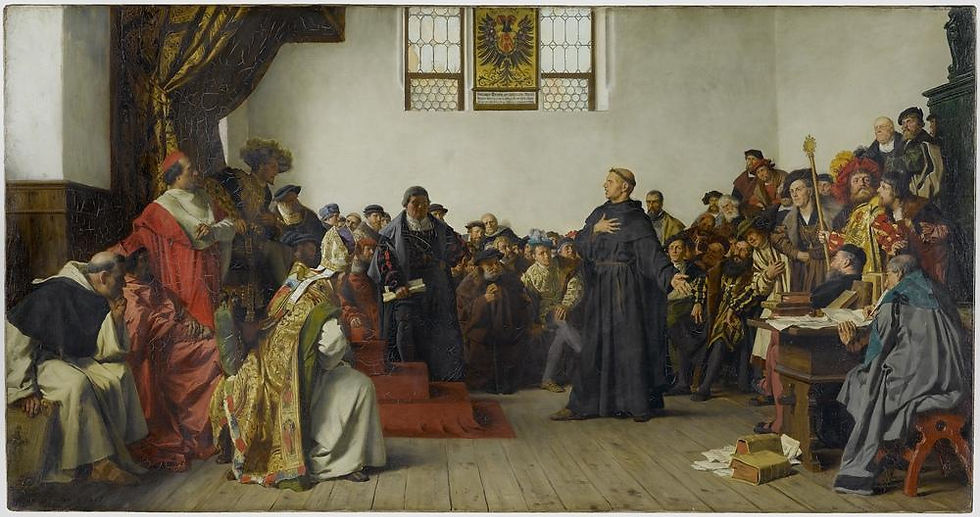
To the first question he answered yes. To the second, after asking for a day to consider, he answered no. He would not recant, he said, unless he could be convinced by Scripture or by clear reason that he was wrong, because a conscience bound by the Word of God could not in safety or in honesty be made to say what it did not believe. To recant against conscience would be to sin. And so he would not.
Posterity remembers the moment for a ringing phrase — “Here I stand, I can do no other” — and the phrase deserves a word of honesty in its telling. The stirring line appears in the earliest printed account of the speech, but it was not taken down by the notaries in the hall, and the scholarship has never been able to confirm that Luther actually spoke it.² The sentiment was certainly real; the sentence, the phrasing itself, is doubtful and likely added as a later embellishment to capture the scene. What Luther verifiably said was quieter and, in its way, more radical: that his conscience was captive to the Word of God, and that against conscience he could not and would not act.
Consider what this claim required. A single friar, excommunicated by the Pope and now facing the Emperor, was asserting that his own conscience — informed by Scripture, reasoning for itself — stood as a higher authority than the combined judgment of the institutional Church that had governed the spiritual life of Western Europe for a thousand years. He was not merely disagreeing with the Church on a point of doctrine. He was denying that the Church had the final authority to tell him what to believe. He was placing a conscience bound by Scripture and answerable to reason above the final judgment of the institution.
This is where our story turns from the desk to the world. The previous article closed the contemplative arc of this series — the schoolmen and the lawyers who articulated, in the quiet of the study, that the king is under the law and that an unjust law is no law. Now the articulated principle meets power directly. Luther did not intend to teach the world a lesson in political liberty. He was a theologian consumed by a theological question, the question of how a sinner is made right with God. But in answering it as he did, he let loose a principle he could not contain, and could not, for the rest of his life, call back. If the individual conscience may stand in judgment over the highest institutional authority in Christendom, then a question follows that Luther never meant to ask and spent his later years trying to suppress: what other authority might that conscience judge?
Consider again the monk at Worms. He thought he was defending the Word of God against a corrupt Church. He was also, without meaning to, teaching Europe that authority — all authority — answers to something higher than itself.
The World Before the Protest
Disclaimer: This article is at its core about secular politics, there is no implication made about the contemporary superiority of Catholicism, or Protestantism, or any other sect of Christianity. Or for that matter a judgement on Judaism, Islamism, Hinduism, or one’s own religious beliefs. It is an article of history, it is for all audiences, and as always, it is a look at the consequences derived from actions of the past.
To understand why one monk’s defiance shook a continent, the modern reader must first set aside a modern assumption. We are accustomed to thinking of a church as one institution among many in a society, concerned with worship and private belief, separate from the machinery of the state. The medieval Church was nothing of the kind. It was the dominant institution of European life, and it was as much a political and economic power as a spiritual one.
The Church of the later Middle Ages was among the largest landowners in Europe, holding in some regions, by some estimates, a quarter or more of all the land. It levied its own taxes — the tithe, a tenth of a person’s produce or income, collected across all of Christendom. It ran its own courts, with jurisdiction not only over the clergy but over vast areas of ordinary life: marriage, wills, oaths, morals, and the adjudication of heresy, with the gravest penalties often carried out through secular power. Its language, Latin, was the language of law, learning, and administration. Its officials staffed the chanceries of kings. The Pope was not merely a spiritual father; he was a temporal prince who ruled central Italy, raised armies, and treated with kings as a sovereign among sovereigns. To be excommunicated was not only to be cut off from the sacraments and the hope of heaven; in conflicts involving rulers it could be joined to claims that subjects were released from their allegiance, opening the door for a prince’s enemies to move against him — though this was a weapon of high politics, not an automatic consequence of every excommunication. The Church held the keys to salvation and a great share of the levers of earthly power at the same time.
An institution of such reach, staffed by ordinary and fallen men, accumulated the corruptions that reliably attend the union of spiritual claims with worldly power. Three deserve naming, because they are the concrete grievances against which Luther protested, and the reader who does not know them will not grasp what his protest was about.
The first was the sale of indulgences. In Catholic teaching, an indulgence was a remission of the temporal punishment due for sins already forgiven — a drawing upon the treasury of merit accumulated by Christ and the saints. Similar to a contemporary judge issuing a sentence of time-served, or more even analogous, no punishment at all based upon a history of good behavior. Whatever its theological subtleties, by Luther’s day the practice had degenerated into something that looked, to a great many observers, like the sale of forgiveness for money. In 1517 a Dominican friar named Johann Tetzel was traveling through Germany selling indulgences to fund the rebuilding of Saint Peter’s Basilica in Rome, and a portion of the proceeds, unknown to the buyers, went secretly to repay the enormous debt a German archbishop had incurred to purchase his office. The common people were told, in effect, that they could buy their dead relatives out of purgatory. A jingle attributed to Tetzel’s campaign captured the crudity of it: as soon as the coin in the coffer rings, the soul from purgatory springs.³ To a monk who had spent years in spiritual agony over how a sinner could be justified before a holy God, the spectacle of salvation being hawked for coin was not a minor abuse. It was a corruption at the very heart of the matter.
The second was pluralism and absenteeism — the holding of multiple church offices at once by men who performed the duties of none. A well-connected cleric might hold several bishoprics and a fistful of lesser benefices simultaneously, drawing the income from each while hiring poorly paid substitutes to do the actual work, or leaving the work undone. The archbishop whose debt Tetzel’s indulgences were secretly repaying, Albert of Brandenburg, held two archbishoprics and a bishopric together while below the canonical age for even one, a dispensation for which he had paid Rome handsomely. The office of a shepherd of souls had become, for many, a revenue stream.
The third was simony — the buying and selling of church offices themselves, named for Simon Magus, who in the Book of Acts tried to purchase the power of the Holy Spirit. Offices from the papacy down were, with distressing frequency, obtained through money and influence rather than merit or piety. And presiding over the whole was a Renaissance papacy that had become a byword for worldliness: popes who fathered children, waged wars, patronized artists with the wealth of the faithful, and pursued the aggrandizement of their families with an energy they rarely brought to the care of souls.
None of this was secret, and none of it was new to Luther. For more than a century, reformers had protested these abuses. Calls for reform “in head and members” had echoed through church councils. The Englishman John Wycliffe in the fourteenth century and the Czech Jan Hus in the fifteenth had gone further, challenging the authority of the hierarchy itself — and Hus had been burned at the stake in 1415 for his trouble, despite a promise of safe conduct. The tinder had been gathering for generations. What turned Luther’s protest from one more spark into a continental fire was partly the man, partly the moment, and partly a machine that none of his predecessors had possessed.
The Ninety-Five Theses and the Machine
On October 31, 1517 — the tradition holds — Martin Luther posted on the door of the Castle Church in Wittenberg a list of ninety-five theses, propositions for academic debate on the subject of indulgences.⁴ The church door served as the university’s bulletin board, and the act, in itself, was ordinary. Luther wrote in Latin, as a scholar addressing scholars. He was not, in that moment, calling for a revolution. He was inviting a disputation on a matter of theology and pastoral practice, and his theses, for all their sharpness, still assumed a Church that could be corrected from within.
What happened next was not ordinary, and it is the reason Luther’s name is known where the names of a hundred earlier reformers are forgotten. Within weeks, printed Latin editions were circulating well beyond Wittenberg; by the end of 1517 the theses had appeared in Leipzig, Nuremberg, and Basel. German translations followed quickly, and the controversy spread through the German lands with a speed that would have been impossible in any previous century. A local academic exercise had become a public sensation.

The machine that made this possible was the printing press. Johannes Gutenberg had perfected movable-type printing in Mainz around 1450, and in the seventy years since, presses had spread across Europe, driving down the cost of the written word and driving up its reach. Luther grasped the instrument as no one before him had. He wrote in German, in a vigorous, earthy, accessible prose that ordinary literate people could read and that those who could not read could understand when it was read aloud. He wrote constantly, and he wrote to be printed. In the years after 1517 his pamphlets sold in the hundreds of thousands. He became, in the phrase the historian Andrew Pettegree has made current, the first great mass-media figure of the print age — a man whose ideas reached a public directly, over the heads of the institution that would have silenced him, faster than that institution could respond.⁵
This is the transmission of ideas — a thread this series has followed from the copyists of the ancient world through the translators of the House of Wisdom — arriving at its technological transformation. For most of human history, the reproduction of a text meant a scribe copying it by hand, slowly and expensively, which meant that ideas were scarce, controlled, and easily suppressed by whoever controlled the scribes. The press shattered that control. An idea, once set in type, could be reproduced faster than authority could gather it up and burn it. When the Church moved to condemn Luther, it found that it could not catch him, because it was no longer fighting a man; it was fighting a flood of printed paper it had no means to dam. The democratization of knowledge that the press began would run forward through the pamphlet wars of the English Revolution, the Enlightenment, the revolutionary press of 1776, and every struggle since in which a people has claimed the right to read and reason for itself. Liberty has always depended on the free movement of ideas. Luther was the first to prove, on a continental scale, what a free press could do to an authority that claimed the sole right to define the truth.

The Priesthood of All Believers
Beneath the quarrel over indulgences lay a deeper claim, and it is the one with the longest political shadow. Luther taught what came to be called the priesthood of all believers: that every Christian stands in a direct relationship with God, requiring no priestly caste to mediate between the individual soul and its Creator.⁶ The ordained clergy, in this view, held an office and a function, but not a superior spiritual status. They were not a separate order of humanity possessing exclusive access to the divine. Before God, the plowman and the pope stood on the same ground.
Luther meant this as theology, and its immediate targets were the sacramental monopoly of the priesthood and the vast apparatus of mediation the medieval Church had built. But a doctrine has a logic, and the logic of this one ran well past its author’s intentions. If no priest is needed to stand between the individual and God, then the individual must read and interpret for himself. This is why Luther labored to translate the Bible into German: a faith of unmediated access requires a people who can encounter the sacred text directly, in their own tongue, without the filter of an official interpreter. And a people taught to read and reason about the highest matters, to weigh the claims of authority against the text and their own understanding, does not easily unlearn the habit when the subject changes from theology to politics.
The leveling implication was unmistakable, and it did not escape notice. If all believers are spiritually equal, if the hierarchy that ranked souls from peasant to pope reflects human office rather than divine order, then the whole graded architecture of medieval society — which had always claimed a sacred sanction — stood exposed as a human arrangement rather than a decree of heaven. Luther himself drew no such radical social conclusion; his concern was the altar, not the manor. But in later Protestant hands — among the more radical reformers, and eventually among the English Puritans and sectarians — the leveling implication would be carried into politics. The English Levellers of the next century, whom a later article in this series will take up, would press the logic of spiritual equality toward a demand for political equality, arguing that the poorest man in England had a life to live and therefore a voice to cast. The seed of that argument lay in the doctrine that before God there are no ranks. What began as a claim about salvation would become, through a long chain of hands Luther neither knew nor would have approved, a claim about government.
Erasmus and the Road Not Taken
To see clearly what Luther was, it helps to set him beside the man who was, for a moment, his greatest potential ally and became instead his most illuminating opposite. Desiderius Erasmus of Rotterdam was the foremost scholar of the age, the prince of the Northern humanists, a man whose learning and wit commanded the respect of all Europe. And Erasmus wanted the Church reformed. He had spent his career exposing the ignorance and corruption of the clergy, satirizing the superstitions of popular religion, and calling for a return to the simple ethical teaching of Christ. His scholarly edition of the Greek New Testament, published in 1516, put the original text into the hands of scholars and gave Luther and others the very tool they would use to challenge the Latin Vulgate on which so much church teaching rested. In a real sense, Erasmus laid the egg that Luther hatched — a quip of the period that Erasmus himself ruefully acknowledged, while insisting he had laid a different bird than the one that emerged.⁷

The difference between the two men is the difference between two theories of how corrupt institutions should be met. Erasmus believed in reform from within — in patient scholarship, gentle satire, moral suasion, and the gradual improvement of the Church by the slow spread of learning and piety. He dreaded schism above almost all things, because he foresaw with painful clarity what a rupture in Christendom would cost: not reform but war, not renewal but the tearing apart of Europe along confessional lines. He was not wrong to fear it. When the break came, it brought with it more than a century of religious warfare that would kill millions.
Luther believed the time for gentle reform was past. Some corruptions, he had concluded, are not abuses within a sound structure but symptoms of a rotten one, and no amount of patient suasion will move an institution that has a stake in the corruption. Where Erasmus saw a Church to be improved, Luther increasingly saw a system to be defied. The two men came to open conflict in 1524 and 1525 over the question of free will — Erasmus defending the freedom of the human will to cooperate in its own salvation, Luther insisting on the bondage of the will and the sovereignty of divine grace. The theological dispute matters less, for our purposes, than what it revealed: Erasmus was temperamentally and philosophically a man of the mean, of balance, of the preserved institution reformed; Luther was a man of the absolute, who having found what he took to be the truth would follow it through schism, upheaval, and war rather than soften it for the sake of peace.
Both men were partly right, and that their disagreement has never been settled. Erasmus was right that the rupture would be catastrophic, and it was. Luther was right that the principle he defended could not have survived the compromises Erasmus was willing to make, and it could not. The road not taken — reform from within, unity preserved, the slow improvement of the institution — was a real road, and a humane one. But, as a political reality, it was not the road that produced the modern conscience. That was produced by the man willing to stand alone against the institution and say that his judgment, and not its authority, would govern what he believed. The cost was terrible. The consequence was the principle on which every later liberty of conscience would be built.
The Principle Escapes the Man
Here we arrive at the analytical heart of the article, and at a distinction the reader must hold firmly, because the whole argument depends on it. This series does not claim that Martin Luther was a friend of political liberty. In many respects he was its enemy. The claim is narrower and stranger: that Luther introduced into Western life a principle whose logic he could not control, which escaped his intentions and armed movements he would have condemned.
The principle must be stated with care, because it is easy to modernize and thereby to misunderstand. Luther did not give Europe a doctrine of autonomous private conscience, sovereign simply because it is one’s own. His conscience was binding, as he understood it, not because it was his but because it had been captured by Scripture and could not honestly deny what Scripture and evident reason had not refuted. The principle was this: that a conscience bound to an authority higher than any human institution may stand in judgment over that institution and refuse it obedience. Luther applied the principle to the Church alone. He never meant it to touch the civil magistrate. On the contrary, he came to preach obedience to secular rulers with a fervor that his critics have never let him forget. But he could not fix the boundary he wanted, because the logic of the principle does not respect it. Once it is established that an institution’s authority is not final — that there is a higher standard, accessible to the individual, against which the institution may be measured and found wanting — the argument is available against every institution, including the state. Luther had unlocked a door and could not thereafter decide who was permitted to walk through it.
The question posed itself almost at once. If conscience, armed with Scripture, could judge the Pope, why could it not judge the prince? If the individual need not obey a Church that commanded what God forbade, why must he obey a king who did the same? Luther’s answer was to draw a sharp line between the spiritual and the temporal realms — the doctrine that would come to be called the two kingdoms — and to consign obedience to earthly rulers almost without limit to the temporal side of the line. But the line would not hold, because he had already taught the deeper lesson too well. He had taught that authority is conditional, that it answers to a higher law, and that the individual conscience is the place where that higher law is finally registered. The resistance theorists who followed — especially in the Reformed and radical Protestant worlds — could draw on the precedent Luther set at Worms, even as they moved far beyond anything Luther himself would have allowed. Theirs was never the only source; they drew as well on medieval constitutionalism, canon law, scholastic natural law, covenant theology, and the older Roman and common-law inheritances this series has traced. But the act at Worms had shown, in the most public way imaginable, that the highest institution in Christendom could be told no by a conscience answerable to a higher law, and that example was available to everyone who came after, whether they invoked his name or not.
This is what this series means by tyranny as teacher, applied now at the level of an idea. The lesson of Worms was not the lesson Luther meant to give. He meant to defend the Word of God against a corrupt Church. He taught, instead, that no earthly authority is beyond the judgment of a conscience answerable to something higher — and that lesson, once learned, could not be confined to the Church. The Reformation would spend the next century discovering the political implications of its own founding act. The next article in this series takes up the theorists who made those implications explicit. But the germ of all of it is here, in a monk who thought he was talking only about salvation and was, without knowing it, teaching Europe how to say no to power.
The Honest Reckoning
A series committed to intellectual honesty cannot celebrate the courage of Worms without confronting the record of the man who displayed it, and that record is, in crucial respects, appalling. The same disposition this series applied to Aristotle’s defense of slavery and to Aquinas’s endorsement of executing heretics must be applied to Luther, and it must be applied without flinching, because the failures here are grave.
Begin with the peasants. In 1524 and 1525, the German peasantry rose in the greatest popular revolt Europe had seen, demanding relief from serfdom, from crushing dues, from the arbitrary power of their lords. And they rose, in part, in the language Luther had given them. They had heard the gospel of Christian freedom, the priesthood of all believers, the equality of souls before God, and they had drawn from it the reasonable inference that a Christian ought not to be held as a serf. They appealed to Luther, expecting the champion of liberty to champion theirs. His response moved in two stages, and the sequence makes it worse rather than better. He had at first tried to admonish both sides, rebuking the princes for the abuses that had provoked the revolt even as he warned the peasants against taking up the sword. But once the rising escalated, he turned decisively and savagely against the rebels. In a tract whose title states its content — Against the Robbing and Murdering Hordes of Peasants — Luther called upon the princes to put the rebellion down without mercy, urging them to smite, slay, and stab the insurgents as one would kill a mad dog, and promising heaven to those who died doing it.⁸ The princes obliged. Something on the order of one hundred thousand peasants were slaughtered. The man who had stood alone against the Emperor in the name of conscience now urged the wholesale killing of common people who had taken his own principle and applied it to their chains.
The contradiction is not incidental; it is central, and it must be named as what it is. Luther recoiled from the political implications of his own theology the moment they threatened social order, and he recoiled savagely. His doctrine of the two kingdoms, articulated especially in his 1523 treatise on temporal authority and then brought to bear during the Peasants’ War, handed the secular prince an authority over the bodies and outward lives of subjects that was nearly unlimited, reserving conscience to an inward, spiritual realm that offered little protection against tyranny in practice. The prophet of conscience against the Church became a preacher of near-absolute obedience to the state. That later movements would nonetheless extract a liberating principle from his work is a testament to the power of the principle — not to the intentions of the man, which at this crucial juncture were the intentions of a frightened defender of order against the very people his words had stirred.
And there is worse, which honesty forbids passing over. In his later years Luther turned on the Jews with a venom that disfigures his legacy beyond any softening. Having once hoped they might convert to his reformed gospel and found that they would not, he wrote in 1543 a tract, On the Jews and Their Lies, that is among the most vicious documents of religious hatred produced by a major figure of the age. It called for the burning of synagogues and Jewish homes, the confiscation of their books, the prohibition of their worship, and their reduction to servile labor.⁹ There is no context that redeems this, and this series offers none. It was hatred, and it bore terrible fruit: four centuries later the propagandists of the Third Reich would exploit Luther’s writings against the Jews, folding them into a modern racial antisemitism that drew as well on older Christian traditions of anti-Jewish hostility. That the man who taught Europe the sovereignty of conscience could also compose a manual for persecution is a scandal to the principle he is honored for, exactly as Aquinas’s endorsement of the stake was a scandal to his doctrine of universal natural law.
Why, then, does he appear in this series at all? For the same reason Aristotle and Aquinas do, and for the same reason the Founders will when their own contradiction between the creed of equality and the practice of slavery is laid open in a later article. The standard this series has adopted, and will not abandon when it becomes uncomfortable, is that genuine contribution and grave failure can inhabit the same person, and that we can examine both without letting either erase the other. Luther gave the West a principle of incalculable value and then spent much of his life betraying its implications. Both facts are true. The principle is not discredited by the failures of the man who introduced it, any more than the doctrine of human equality is discredited by the slaveholding of the men who proclaimed it. What the failures demand is not that we discard the inheritance, but that we carry it further and more faithfully than those who first articulated it — which is precisely the work of the generations that followed, and precisely the demand the inheritance makes of anyone who receives it.
The Skeptic’s Case
Two serious objections stand against the account offered here, and each deserves to be put at full strength.
The Objection That Luther Was No Friend of Liberty
The first objection is the one the preceding section has already made in part, and it is formidable precisely because so much of it is true. Luther, the critic argues, was in no meaningful sense a friend of freedom. He empowered princes and preached near-absolute obedience to them. He called for the massacre of peasants who took his own words seriously. He composed a program of persecution against the Jews. His doctrine of the two kingdoms handed the state the body and left conscience a purely inward liberty that no ruler need respect in practice. To enlist such a man in a genealogy of liberty, the objection concludes, is not merely generous; it is perverse — a laundering of an authoritarian into a libertarian by selective quotation.
The objection is strong, and the reply does not deny the record; it denies the inference. The argument of this article has never been that Luther intended liberty or embodied it. It is that he introduced a principle whose consequences outran his intentions — and the history of ideas is full of such cases, because ideas, once articulated, are not the property of their authors. The man who first establishes that authority answers to conscience does not thereby get to decide which authorities and which consciences. Luther wanted the principle to apply to the Church and stop there. It did not stop there, and it could not, because the logic that legitimizes private judgment against one institution legitimizes it against all. The credit Luther receives in this series is not the credit due a champion of freedom. It is the credit due a man who, meaning to do one thing, made another thing possible — who unlocked a door he wished had stayed shut for everyone but himself. That is a real historical contribution, and it is not diminished by being unintended. Indeed the whole theme of tyranny as teacher, which this series has traced from the beginning, is precisely the observation that liberty is often taught by those who did not mean to teach it.
The Objection That the Reformation Brought Slaughter, Not Freedom
The second objection strikes at the consequences. Whatever principle Luther loosed, the critic argues, what it actually produced in the century after Worms was not liberty but carnage. The Reformation shattered the unity of Christendom and plunged Europe into more than a hundred years of religious war — the French Wars of Religion, the Saint Bartholomew’s Day Massacre with its thousands of Protestant dead, the Dutch revolt, and above all the Thirty Years’ War, which killed a horrifying share of the population of the German lands. If conscience-against-authority is such a gift to freedom, the objection asks, why did its first and largest historical result resemble a slaughter house? Erasmus foresaw exactly this and counseled against the rupture. Perhaps he was right, and the whole episode is better understood as a catastrophe than as a milestone on the road to liberty.
This is the weightiest objection, and the reply must concede its facts entirely. The wars were real, the death was staggering, and Erasmus’s warning was vindicated in blood. The Reformation did not deliver religious liberty in the sixteenth century; it delivered religious war. But the concession points toward the answer rather than away from it. Religious liberty, when it finally came, came in significant part as the exhausted conclusion drawn from that very carnage — the hard-won recognition, purchased at unbearable cost, that a society which tries to compel conscience by the sword produces only corpses and hypocrites, and that the only durable peace is one that lets conscience alone. The toleration that emerged in the following century was built on the graves of the confessional wars, by men who had learned from the slaughter what the slaughter had to teach. This does not make the killing good; nothing makes the killing good. But it locates the killing correctly in the story. The principle that conscience may not be coerced was not handed down clean and costless at Worms. It was forged, slowly and terribly, in the discovery that the alternative was worse — that the attempt to force conscience does not preserve unity but destroys the peace, and that a people is freer, and safer, when it stops trying.
And this points, finally, past the objection to a larger truth that will occupy this series in the arcs to come. The critic who credits religious liberty to later skepticism rather than to the Reformation is half right, and the half he is right about does not defeat the argument but completes it. Toleration did draw on the disenchantment that the wars of religion produced. But the deeper principle underneath toleration — that the individual conscience possesses a dignity and an authority that no institution may override — was the Reformation’s own bequest, and the skeptics who built on it were building on a foundation Luther had laid. The house of religious liberty was raised by many hands over many generations, some of them believers and some of them doubters. But the cornerstone was set at Worms, by a man who would have been appalled at much of what was built upon it.
The Question Left Open
We have watched a single principle break loose from a single man and begin its long career in the world. Luther established, at the cost of a shattered Christendom and against the whole weight of the institution that had governed the European soul for a millennium, that the individual conscience answers to an authority higher than any earthly power, and may on that ground refuse obedience. It is among the most consequential establishments in the history of liberty, and it was made by a man who spent much of his life recoiling from its implications.
But Luther left a question unanswered — indeed he refused to answer it, and labored to prevent it from being asked. He had shown that conscience may judge authority. He had not shown when, and by whom, and through what lawful means, resistance to a tyrannical authority becomes not merely a private refusal but a rightful act. That a Christian must obey God rather than men when the two conflict was, by Luther’s day, an ancient teaching. But may a subject actively resist a tyrant, or only passively decline to sin? If resistance is ever lawful, who may undertake it — any individual, or only those who hold some office of their own? On what authority, and within what limits? Luther’s instinct, especially after the peasants rose, was to answer that resistance is almost never lawful, that the subject owes the prince obedience in all things temporal, and that the remedy for tyranny is prayer and endurance. But he had already made that answer unstable by teaching the sovereignty of conscience, and the theorists who came after him — many of them his fellow reformers in the Calvinist tradition — would take up the question he had left open and give it the systematic answer he refused.
When may resistance to tyranny be called lawful? That is the question of the next article, and it is where the Reformation’s loose principle of conscience begins to harden into a doctrine of political right. The monk at Worms said no to the Church in the name of a higher law. The next generation would ask, with rigor and at length, when a people may say no to a king — and would build, from the answer, a bridge that ran directly toward Philadelphia.
This is the road to 1776. The conscience has been set free. Now it must learn what, lawfully, it may do.
Self-Reflection Prompts
Luther claimed that his conscience, informed by Scripture and reason, stood as a higher authority than the institutional Church. Every claim of conscience against authority raises the same difficulty: how does one distinguish a genuine higher law from mere private preference dressed as principle? Luther believed he was bound by the Word of God; the peasants believed they were too; the princes who killed them believed the same. When you set your own conscience against an authority, what makes your claim more than an assertion of will — and would the test you propose have vindicated Luther, the peasants, both, or neither?
The article argues that Luther introduced a principle whose logic escaped his control — that private judgment, once legitimized against the Church, became available against every institution, including the state. Is this a feature of the principle or a flaw in it? A doctrine that authorizes conscience against all authority authorizes it against good authority as well as bad. How, if at all, can a free society honor the sovereignty of individual conscience while still maintaining the order without which no liberty survives?
Apply the Liberty Test to the coercion of conscience. When the medieval Church, or a confessional state, compelled belief and punished dissent, it claimed a power that no private individual could rightfully claim over another — the power to force a neighbor, on pain of ruin or death, to profess what he did not believe. Where in your own society does government still claim a power to compel profession, expression, or participation against conscience that no individual could lawfully exercise over another? And where has the line between protecting conscience and privileging it become genuinely hard to draw?
Erasmus and Luther embody two responses to a corrupt institution: patient reform from within, and open rupture. Erasmus foresaw that rupture would bring catastrophe, and it did; Luther held that the principle he defended could not survive the compromises reform would require, and perhaps it could not. Faced with an institution you believe to be corrupt in some fundamental way, which path do you think is more often right — and what does your answer cost, in the cases where it is wrong?
Endnotes
Martin Luther, response at the Diet of Worms, April 18, 1521. The text follows the standard English rendering in Luther’s Works, American Edition, ed. Jaroslav Pelikan and Helmut T. Lehmann, vol. 32, Career of the Reformer II, ed. George W. Forell (Philadelphia: Fortress Press; St. Louis: Concordia, 1958), 112–113. The full reply reads in part: “Unless I am convinced by the testimony of the Scriptures or by clear reason (for I do not trust either in the pope or in councils alone, since it is well known that they have often erred and contradicted themselves), I am bound by the Scriptures I have quoted and my conscience is captive to the Word of God. I cannot and I will not recant anything, since it is neither safe nor right to go against conscience.”
On the doubtful authenticity of the words “Here I stand, I can do no other,” see the discussion in Luther’s Works, vol. 32, 112–113 n. 9, and Roland H. Bainton, Here I Stand: A Life of Martin Luther (New York: Abingdon-Cokesbury, 1950), 144, which notes that the words appear in the earliest printed version of the speech but were not recorded by the notaries present. Scholars regard the sentiment as consistent with Luther’s position while treating the specific sentence as a likely later addition.
The couplet “As soon as the coin in the coffer rings, / the soul from purgatory springs” is traditionally attributed to Johann Tetzel’s indulgence preaching and is referenced by Luther in the Ninety-Five Theses (thesis 27), which condemns those who “preach that as soon as the penny jingles into the money-box, the soul flies out [of purgatory].” See Martin Luther, Ninety-Five Theses (1517), in Luther’s Works, vol. 31, Career of the Reformer I, ed. Harold J. Grimm (Philadelphia: Muhlenberg Press, 1957), 27–28.
Martin Luther, Disputation on the Power and Efficacy of Indulgences (the Ninety-Five Theses), October 31, 1517, in Luther’s Works, vol. 31, 25–33. The tradition that Luther physically nailed the theses to the door of the Castle Church at Wittenberg has been questioned by some scholars, though the composition and circulation of the theses on or about that date is not in serious dispute; the date is commemorated as the beginning of the Reformation.
The characterization of Luther as the first great mass-media figure of the print age follows Andrew Pettegree, Brand Luther: 1517, Printing, and the Making of the Reformation (New York: Penguin Press, 2015), which documents Luther’s mastery of the vernacular pamphlet and the print economy of the German lands. On the rapid spread of the Ninety-Five Theses through print — with Latin editions appearing in Leipzig, Nuremberg, and Basel by the end of 1517 — see the Library of Congress catalog entry for the Ninety-Five Theses and Pettegree, Brand Luther, chs. 3–4. On the broader transformation, see Elizabeth L. Eisenstein, The Printing Press as an Agent of Change (Cambridge: Cambridge University Press, 1979).
Luther developed the doctrine of the priesthood of all believers most directly in To the Christian Nobility of the German Nation (1520), in Luther’s Works, vol. 44, The Christian in Society I, ed. James Atkinson (Philadelphia: Fortress Press, 1966), 123–217, and in The Freedom of a Christian (1520), in Luther’s Works, vol. 31, 327–377.
The quip that “Erasmus laid the egg that Luther hatched” circulated in various forms in the sixteenth century; Erasmus is reported to have replied that he had laid a hen’s egg but Luther had hatched a very different bird. On Erasmus, his edition of the Greek New Testament (the Novum Instrumentum, 1516), and his break with Luther over free will, see Roland H. Bainton, Erasmus of Christendom (New York: Charles Scribner’s Sons, 1969), esp. 186–195 on the De Libero Arbitrio (1524) and Luther’s reply, De Servo Arbitrio (On the Bondage of the Will, 1525).
Luther’s response to the revolt moved in stages: his Admonition to Peace: A Reply to the Twelve Articles of the Peasants in Swabia (1525), which rebuked the princes as well as the peasants, preceded the far harsher Against the Robbing and Murdering Hordes of Peasants (1525), in which he urged the authorities to “smite, slay, and stab” the rebels. Both are in Luther’s Works, vol. 46, The Christian in Society III, ed. Robert C. Schultz (Philadelphia: Fortress Press, 1967), Admonition to Peace at 17–43 and Against the Robbing and Murdering Hordes at 45–55. Luther’s doctrine of temporal authority is set out in Temporal Authority: To What Extent It Should Be Obeyed (1523), in Luther’s Works, vol. 45, The Christian in Society II, ed. Walther I. Brandt (Philadelphia: Muhlenberg Press, 1962), 75–129. On the death toll of the German Peasants’ War, commonly estimated at approximately 100,000, see Peter Blickle, The Revolution of 1525: The German Peasants’ War from a New Perspective, trans. Thomas A. Brady Jr. and H. C. Erik Midelfort (Baltimore: Johns Hopkins University Press, 1981).
Martin Luther, On the Jews and Their Lies (1543), in Luther’s Works, vol. 47, The Christian in Society IV, ed. Franklin Sherman (Philadelphia: Fortress Press, 1971), 121–306. The tract’s recommendations, including the burning of synagogues and Jewish homes and the confiscation of Jewish writings, are set out at 268–293. On Luther’s anti-Jewish writings and their later appropriation, see Thomas Kaufmann, Luther’s Jews: A Journey into Anti-Semitism, trans. Lesley Sharpe and Jeremy Noakes (Oxford: Oxford University Press, 2017); the editor’s introduction to Luther’s Works, vol. 47; and Bainton, Here I Stand, 297–298. On the indirect and contested relationship between older Christian anti-Judaism and modern racial antisemitism, see the discussion in Kaufmann, Luther’s Jews.
Sources and Further Reading
Primary Sources
Martin Luther. Luther’s Works. American Edition. 55 vols. Ed. Jaroslav Pelikan and Helmut T. Lehmann. St. Louis: Concordia; Philadelphia: Fortress Press, 1955–1986. Especially vol. 31 (Ninety-Five Theses; The Freedom of a Christian), vol. 32 (the reply at Worms), vol. 44 (To the Christian Nobility), vol. 46 (Against the Robbing and Murdering Hordes of Peasants), and vol. 47 (On the Jews and Their Lies).
Martin Luther. The Freedom of a Christian (1520). In Luther’s Works, vol. 31.
Martin Luther. To the Christian Nobility of the German Nation (1520). In Luther’s Works, vol. 44.
Desiderius Erasmus. Novum Instrumentum Omne (the Greek New Testament, 1516).
Desiderius Erasmus. On Free Will (De Libero Arbitrio) (1524), and Martin Luther, On the Bondage of the Will (De Servo Arbitrio) (1525). In Luther and Erasmus: Free Will and Salvation, ed. and trans. E. Gordon Rupp and Philip S. Watson. Library of Christian Classics. Philadelphia: Westminster Press, 1969.
Secondary Works
Roland H. Bainton. Here I Stand: A Life of Martin Luther. New York: Abingdon-Cokesbury, 1950.
Roland H. Bainton. Erasmus of Christendom. New York: Charles Scribner’s Sons, 1969.
Heiko A. Oberman. Luther: Man Between God and the Devil. Trans. Eileen Walliser-Schwarzbart. New Haven: Yale University Press, 1989.
Lyndal Roper. Martin Luther: Renegade and Prophet. New York: Random House, 2017.
Peter Blickle. The Revolution of 1525: The German Peasants’ War from a New Perspective. Trans. Thomas A. Brady Jr. and H. C. Erik Midelfort. Baltimore: Johns Hopkins University Press, 1981.
Elizabeth L. Eisenstein. The Printing Press as an Agent of Change. Cambridge: Cambridge University Press, 1979.
Brad S. Gregory. The Unintended Reformation: How a Religious Revolution Secularized Society. Cambridge: Harvard University Press, 2012.
Diarmaid MacCulloch. The Reformation: A History. New York: Viking, 2004.
Next: Article 6 — “When Is Resistance Lawful?”



Comments