The Federalist Divide — Madison vs. Hamilton and the General Welfare Debate

Updated: May 1
The Forgotten Debate That Shaped the Republic
Every modern debate about federal power — from Social Security and Medicare to student loan forgiveness and pandemic bailouts — traces back to a fight most Americans have never heard of. It wasn’t about guns or abortion or the culture wars. It was about a single phrase in Article I of the Constitution:
“The Congress shall have Power to lay and collect Taxes, Duties, Imposts and Excises, to pay the Debts and provide for the common Defence and general Welfare of the United States…”
The deceptively simple words “general welfare” lit a firestorm during the ratification debates of 1787–1789. At its heart was a clash of visions between James Madison, architect of the Bill of Rights, and Alexander Hamilton, the nation’s first Treasury Secretary. The question was simple: Does this clause limit Congress, or does it unleash Congress?
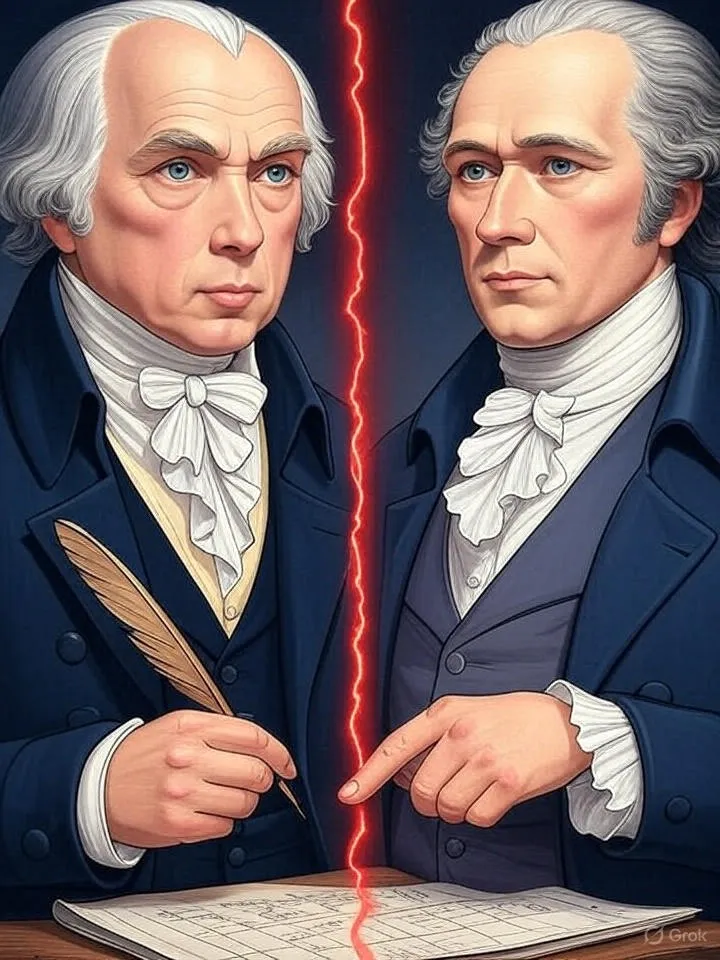
Madison’s Narrow Republic
James Madison saw the clause as a guardrail, not a grant.In Federalist No. 41 (1788), he anticipated critics who warned that “general welfare” gave Congress a blank check:
“It has been urged and echoed, that the power ‘to lay and collect taxes, duties, imposts, and excises, to pay the debts and provide for the common defence and general welfare of the United States,’ amounts to an unlimited commission… But what color can the objection have when a specification of the objects alluded to by these general terms immediately follows…?”
For Madison, the Constitution was a document of enumerated powers. The federal government could only spend in service of specific, listed functions — defense, commerce, post roads, coinage, etc. To treat “general welfare” as an open-ended invitation would make the rest of Article I meaningless.
Years later, as a Congressman, Madison opposed federal subsidies for cod fishermen (1792), warning that if the government could spend for “particular welfare” it could spend for anything. That, he said, would collapse the line between national government and states, destroying the federal balance the Constitution was meant to preserve.
Madison’s America was one where liberty depended on limited government and strict separation of spheres. The general welfare clause was not a blank check. It was a fence.
Hamilton’s Broad Nation
Hamilton, by contrast, saw the clause as the engine of national power.In Federalist No. 30, he declared:
“Money is, with propriety, considered as the vital principle of the body politic… A complete power to procure a regular and adequate supply of it, as far as the resources of the community will permit, may be regarded as an indispensable ingredient in every constitution.”
As Treasury Secretary, Hamilton argued that “general welfare” was an independent power to tax and spend for any object benefiting the nation as a whole. The only real limit was that spending must not be for purely local purposes.
Where Madison saw enumeration as a brake, Hamilton saw enumeration as examples of a broader national authority. For him, the power to tax and spend was not confined to a list. It was rooted in the principle that government must be able to adapt to new national needs.
Hamilton’s America was one where liberty depended on vigorous national action to promote prosperity and stability. The general welfare clause was not a fence. It was a key to unlock federal strength.
The Philosophical Divide
This was not a lawyer’s quibble. It was a philosophical clash:
Madison (and Jefferson): Liberty requires restraint. Government must be hemmed in to protect individual rights and state sovereignty.
Hamilton (and later the Federalists): Liberty requires strength. Government must be able to marshal resources to solve national problems.
Both claimed to be guardians of liberty — but one saw liberty as freedom from interference, the other as freedom through collective security.
Seeds of a Constitutional Time Bomb
The Constitution itself never resolved this tension. The words were vague enough that both Madison’s and Hamilton’s readings could claim legitimacy.
For most of the 19th century, Madison’s narrow view prevailed. Federal spending was limited, and the Supreme Court stayed mostly out of the fray. States remained the primary engines of welfare, education, and economic regulation.
But the Hamiltonian seed remained in the soil. When crisis struck — the Civil War, the Great Depression — presidents and Congresses reached for Hamilton’s interpretation to justify sweeping national programs.
The real constitutional revolution wouldn’t come until 1937, when the Supreme Court explicitly sided with Hamilton in Helvering v. Davis. At that moment, Madison’s restraint was abandoned, and Hamilton’s vision of a powerful spending state became constitutional law.
Why It Matters Now
If you want to understand how the United States went from a republic of limited powers to a welfare state of limitless programs, you start here. The Madison-Hamilton divide is the original fault line. Every later development — from FDR’s New Deal to LBJ’s Great Society to today’s debates over universal healthcare — grows out of this unresolved constitutional argument.
For libertarians, constitutional originalists, and anyone who values the negative liberty tradition, Madison’s warning reads like prophecy: once the federal government claimed the power to define “general welfare,” no real limits remained.
For progressives, Hamilton’s vision looks vindicated: without a flexible federal spending power, the nation could never have tackled poverty, retirement insecurity, civil rights, or public health.
The truth is that our politics today are still playing out this 18th-century dispute. The Founders never closed the question. The courts did — but only in 1937, under pressure, and in ways the Founding generation might not have accepted.
Comments