Epilogue — The Infinite Emergency: Restoring Liberty in the Age of Perpetual Governance

When the Founders wrote the Constitution, they assumed emergencies would be temporary. War, invasion, rebellion — these were storms to be weathered, not climates to be lived in. They left no explicit clause for “suspending” liberty because they believed free men would never consent to live without it.
Two centuries later, emergency has become the normal state of government. Every crisis — war, terror, finance, pandemic, climate — arrives with the same refrain: this time is different. Each one leaves behind new agencies, new powers, and new debts. The apparatus of exception has become the architecture of administration.
Even the philosophy of crisis has been codified. As community organizer and progressive tactician Saul Alinsky wrote in Rules for Radicals (1971) that effective organizers must ‘pick the target, freeze it, personalize it, and polarize it’—using conflict and controversy as catalysts for change. His tactical philosophy emphasized creating pressure through crisis, a mindset that would influence generations of activists and, eventually, administrators.¹
The ‘crisis frame’ Alinsky described in community organizing—using conflict and urgency to mobilize action—found echoes in modern governance. Though Alinsky wrote for organizers confronting institutions, the tactical use of emergency to justify rapid change became bipartisan administrative practice. What began ostensibly as a tool for the dispossessed became a reflex of the powerful.
Modern governance absorbed this ethos. The crisis frame became not just a political tactic but an administrative principle — a perpetual justification for the expansion of centralized authority in the name of adaptation. If the Founders designed a system to limit power in calm, progressives learned to grow it in chaos.
The Constitutional Drift
James Madison warned that “the accumulation of all powers, legislative, executive, and judiciary, in the same hands … may justly be pronounced the very definition of tyranny.”
Yet modern governance blends them by design. Congress delegates lawmaking to agencies; the executive enforces through regulation; the courts defer to “expertise.” The very friction the Founders engineered has been polished away by efficiency.
In the process, the republic has traded sovereignty for security — a transaction too subtle to feel like surrender. Where once power was bounded by law, it now expands by justification. Each new rationale sounds compassionate: safety, equity, sustainability. Each produces the same result: authority without consent.
The Infinite Emergency
After 9/11, the Patriot Act turned intelligence inward. After 2008, monetary rescue became permanent stimulus. After 2020, public health became public control. The pattern is mathematical: crises justify power; power sustains crisis.
Debt, too, has become a form of emergency — an existential one. Our obligations now exceed $100 trillion when including unfunded entitlements, a number no election can erase and no tax can repay. The cost of compassion has become compulsion through arithmetic.
The Founders feared kings; we have built committees. They feared despotism; we fear inconvenience. In our pursuit of perpetual safety, we have accepted perpetual rule.
The Technocratic Temptation
The new Leviathan does not roar; it calculates. It speaks in dashboards, models, and “trust frameworks.” Its face is not a dictator’s but an interface’s.
Artificial intelligence now processes what even the largest bureaucracy could never read — petabytes of private data, refined into risk scores and behavioral forecasts. What began as analytics has become authority. Where law once judged the act, algorithms now judge the potential. Governance has crossed from the prescriptive to the predictive.
Yet this evolution follows logic, not conspiracy. Every bureaucrat wants certainty; every politician wants control without blame; every citizen wants safety without cost.AI offers all three. It is the perfect tool for an imperfect species — efficient, opaque, and plausible.
But freedom cannot coexist with omniscience. To be free is to surprise, to err, to act beyond prediction. A society that optimizes everything will eventually optimize obedience.
The Technocratic Perspective
Critics of this analysis argue that genuine emergencies require rapid, centralized response—that decentralized, market-based approaches cannot coordinate pandemic response, prevent financial collapse, or address climate change at scale. They contend that administrative expansion reflects complexity, not tyranny, and that dismantling expertise would invite catastrophe.
Libertarians respond that decentralized systems—markets, federalism, civil society—coordinate through billions of voluntary decisions that out-compute any centralized model. The ‘complexity requires centralization’ argument, they contend, ignores how self-interest and local knowledge solve problems without coercion. Moreover, the real catastrophes of the 20th century—totalitarianism, genocide, economic collapse—came from centralized power claiming emergency necessity.
Restoring the Forgotten Architecture
The solution is not rebellion but re-architecture. Liberty must once again be structured — not as nostalgia but as system design. The Founders built checks and balances out of human weakness; we must now build digital ones out of code.
Decentralization as Self-Defense
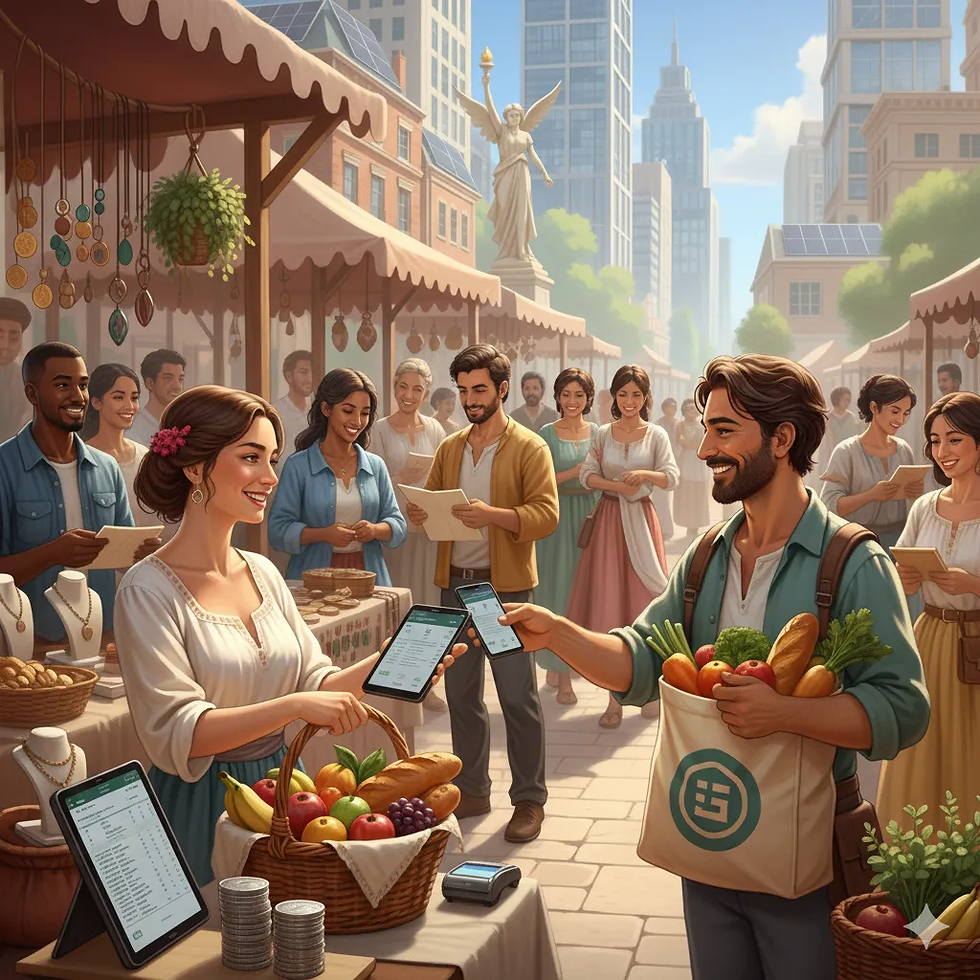
Power disperses when technology decentralizes. Open-source software, peer-to-peer networks, and voluntary digital communities are modern federalism. Where the state centralizes identity, free citizens must build alternatives that authenticate without surveillance.
Sound Money and Fiscal Honesty
The return to honest money — whether gold, Bitcoin, or competitive private currencies — is not a memento of the past but a safeguard for the future. As Murray Rothbard wrote, “Sound money is the instrument of liberty; unsound money is the instrument of tyranny.”² A currency beyond political discretion is the first firewall against the infinite emergency.
Voluntary Association and Civil Courage
The social fabric cannot be restored by law alone. It requires a moral revival of responsibility — the courage to act without permission and to respect others’ right to do the same. Freedom is not granted by documents; it is practiced in daily restraint.
Privacy as a Human Right, Not a Privilege
Privacy is the space in which conscience grows. Without it, virtue becomes compliance. Encryption, anonymity, and data minimalism are not criminal tools; they are civic ones.
The Republic of Memory
Friedrich Hayek observed in The Constitution of Liberty that each generation must learn anew the principles of freedom, which are not inherited instinctively but must be taught and practiced³
We are that generation. We have lived to see the administrative state extend its reach into biology, finance, and thought. And yet the same tools that enslave can also liberate if reclaimed for voluntary purpose.
The restoration of liberty will not come from an election cycle or a charismatic leader.It will come from the slow, stubborn refusal to outsource conscience to code. From parents who teach skepticism as civics. From entrepreneurs who build systems that make privacy practical. From citizens who remember that the Bill of Rights was not a list of permissions, but of prohibitions on power.
The Leviathan endures only by consent. Withdraw that consent, and it starves — not in revolution, but in recollection.
Freedom, once again, will depend not on revolt but on remembrance.
Final References
Saul D. Alinsky, Rules for Radicals (New York: Vintage Books, 1971), pp. 88–90.
Murray N. Rothbard, The Mystery of Banking (Auburn, AL: Ludwig von Mises Institute, 1983), p. 244.
Friedrich A. Hayek, The Constitution of Liberty (Chicago: University of Chicago Press, 1960), p. 29.
James Madison, The Federalist No. 47, 1788.
Thomas Jefferson, Letter to E. Carrington, May 27 1788, in The Papers of Thomas Jefferson, vol. 13.
Congressional Research Service, National Emergency Powers (2024 update).
U.S. Department of Health & Human Services, COVID-19 Public Health Emergency Declarations (2020–2023).
Congressional Budget Office, Federal Spending on COVID-19 Pandemic Response and Economic Relief (April 2023).


Comments