top of page
All Posts

The Dutch Republic Explained: William the Silent, Toleration, the VOC & Grotius
This is the story of how a revolt became a republic almost by accident, how toleration and commerce fed each other until a small waterlogged country surpassed a vast empire, and how the men who built it also built, on the far side of the world, a machinery of conquest and slavery that cannot be edited out of the account of it.
Jul 253 min read
John Thomas, LP Candidate for PA Lieutenant Governor — On Resistance, Romans 13 & School Choice
John Thomas is an educator, a church elder, and the Libertarian candidate for Lieutenant Governor of Pennsylvania, running alongside gubernatorial candidate Ken Krawchuk. A man who has spent his life inside both the church and the liberty movement, he is exactly the voice this week's history called for.
Jul 232 min read
Frédéric Bastiat Explained: The Top 5 Lessons
Five lessons from Bastiat, building from his most famous idea to his most profound: why the state produces nothing of its own, the satirical petition that destroyed protectionism with a joke about the sun, what happens when plunder writes itself into law, the seen and the unseen, and finally The Law — the 1850 essay that is the foundation this entire channel stands on.
Jul 222 min read
Who Actually Writes the Laws You Live Under? (It Isn't Congress)
Congress passed a statute, years or decades ago, that said something broad and pleasant, and then handed the real lawmaking to an agency the voter cannot reach. This is not a scandal in the ordinary sense. No one broke into the Capitol and stole the power to legislate. The strange and important truth at the center of this hour is that the power was given away.
Jul 213 min read


“The Dutch Experiment” — A Republic Born from Resistance
The revolt that began as a defense of provincial liberties against a foreign king had produced something its own leaders never set out to build: a durable, tolerant, prosperous republic that governed itself without a crown and became, for a century, one of the richest societies in Europe and among the most free and religiously plural of its political orders. It was the practical answer to the question the resistance theorists had left hanging — not only how to be rid of a tyr
Jul 1934 min read

The St. Bartholomew's Day Massacre and the Birth of Resistance Theory
Theodore Beza vested the right of resistance not in the private individual but in the lesser magistrates — the constituted officers who stand between the sovereign and the subject — making revolt lawful without making it universal. François Hotman built his case from history, arguing in Francogallia that absolute monarchy was a corruption of France's older, better constitution. And the Vindiciae Contra Tyrannos, published under a pseudonym in 1579, grounded the whole structur
Jul 183 min read

The #1 Big Government President Will Shock You
We ranked the five presidents who expanded the federal government further, faster, and more permanently than anyone else.
Jul 152 min read

Censorship, the Printing Press, and Free Speech: Luther's Inheritance Today
Luther set two things loose at Worms: the sovereignty of the individual conscience, and the printing press that carried it past the gatekeepers by shattering an institution's monopoly on truth. This contemporary-application companion braids three modern threads onto that one spine. First, the two censorships of the pandemic era — the overt pressure of the State on private platforms, and the quieter soft-censorship that brands a reasonable question as a mark of bad character u
Jul 143 min read


When Is Resistance Lawful? — Calvinist Resistance Theory
In the decade after 1572, and especially in the seven years that followed, the Calvinist world produced a body of political theory that would change the trajectory of Western liberty. Theodore Beza, François Hotman, the anonymous author of the most systematic treatise of them all, and the Scot George Buchanan set out to answer, with rigor and at length, the question that Luther had raised at Worms and refused to resolve.
Jul 1228 min read

Martin Luther at the Diet of Worms (1521): Conscience, the Reformation, and the Birth of Resistance
On the eighteenth of April, 1521, a thirty-seven-year-old excommunicated monk stood alone in a crowded hall at Worms and refused an order backed by the two highest powers on earth — the Pope and the Holy Roman Emperor. Posterity gave him a ringing phrase he almost certainly never said. What Martin Luther verifiably declared was quieter, and far more radical: that his conscience, captive to the Word of God, would not recant — because it is neither safe nor right to go against
Jul 113 min read
Top 5 Most Libertarian Presidents in U.S. History
We measure every president two ways — economic freedom and civil liberty — and a president has to move the country toward freedom on both to make the list. That single rule reshapes everything, and it is why the most famous "small government" names are not always where you expect.
The question underneath all of it: did this leave Americans more free, or more governed?
Jul 81 min read

Flock, Palantir & the Caribbean Boat Strikes: Due Process in 2026
What happens when the government decides to skip the courtroom and issue a death sentence via missile?
Since late 2025, over 200 people have been killed in secret U.S. military strikes on small boats. The military claims these are narco-terrorists, but admits they lack the evidence to actually hold or prosecute survivors in a court of law. It is a stark deprivation of life without due process, performed openly as state policy.
Jul 72 min read


Here I Stand — Luther, Conscience, and the Breaking of Authority
The lesson of Worms was not the lesson Luther meant to give. He meant to defend the Word of God against a corrupt Church. He taught, instead, that no earthly authority is beyond the judgment of a conscience answerable to something higher — and that lesson, once learned, could not be confined to the Church.
Jul 529 min read
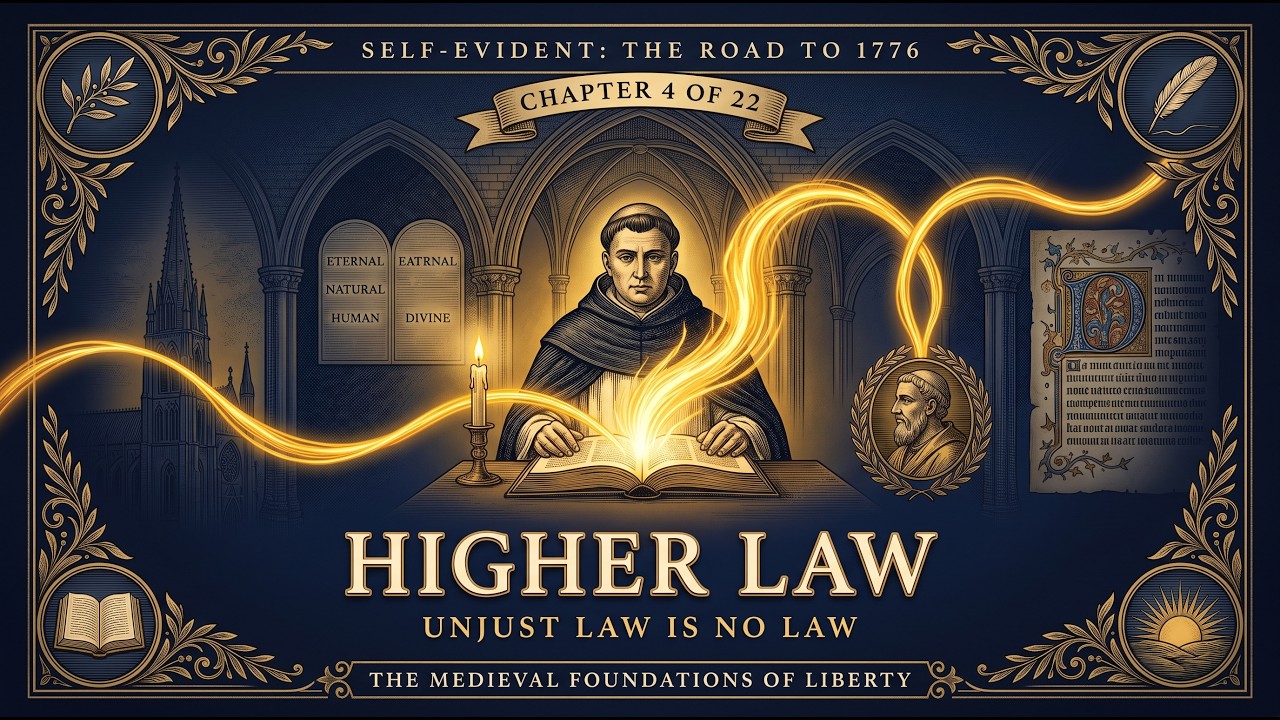
Magna Carta & Aquinas: The Medieval Roots of "The King Is Under the Law"
This is the closing episode of the series' first arc, and it does two things. It forges the medieval inheritance — Magna Carta, Bracton's "the law makes the king," Aquinas's fourfold law and his lex iniusta non est lex, the line that ran straight to Martin Luther King's Birmingham jail cell — and then it stands on the summit and looks back across the whole road: Athens, Jerusalem, Rome, and the House of Wisdom, four civilizations braided into one cord and handed to the men wh
Jul 32 min read


Two Chambers, Two Questions
Two stories crossed my desk this week, and at first they look unrelated. One is a fight over a proof-of-citizenship and voter-identification bill that the House passed and the Senate could not advance past a filibuster. The other is a long-shot resolution to repeal a constitutional amendment more than a century old. Follow them far enough, though, and they meet at the same question — the one I keep returning to. Did this leave Americans more free, or more governed?
Jul 214 min read

Ellsberg, Snowden, Assange & the Espionage Act of 1917
Who tells us what we were not supposed to know? On Saturday we met that figure in his oldest form — the Hebrew prophet who walks up to the king with no army and says "thou art the man." This episode meets him in ours: Daniel Ellsberg, Edward Snowden, Julian Assange — and the single 1917 law turned against all three, not for selling secrets to enemies, but for telling Americans what their own government was doing. Underneath runs the deeper argument of the series: the Constitu
Jun 302 min read


“Higher Law” — Medieval Foundations
The medieval centuries in which the inheritance traced in the first three installments of this series was put to immediate political and legal use. Athens had given the West reason and the idea of the mixed constitution. Jerusalem had given it the covenant and the conviction that even kings stand under a law above themselves. Rome had given it natural law and the architecture of a republic. The House of Wisdom had preserved and transmitted the Greek philosophical inheritance
Jun 2829 min read

How Baghdad Saved Aristotle for the West | House of Wisdom
The golden thread does not begin and end in Greece and Rome. This episode widens it in two directions the schoolbooks usually omit. First, to Jerusalem: the Hebrew tradition that gave the West its most radical political idea — that even the king stands under the law — expressed through the covenant at Sinai, the prophets who confronted kings to their faces, and above all Samuel’s warning in the eighth chapter of First Samuel, a catalog of royal takings that states the Liberty
Jun 262 min read

What the Classics Teach About Democracy
Saturday’s episode drew from Aristotle, Polybius, and the Founders the idea of the mixed constitution — the one, the few, and the many in balance — and insisted that the democratic element had to be genuinely popular for the whole structure to hold. This contemporary application episode asks whether our own “people’s house” still carries the voice of the people, and argues that it has been narrowed by two mechanisms: the cap of 435 members frozen in 1929, which has stretched
Jun 232 min read


“Athens, Jerusalem, and the House of Wisdom” — The Ancient Sources and the Great Transmission
This is the article in which the cross-civilizational character of the liberty tradition becomes unmistakable. The reader who insists on seeing the Founding as the product of one people, one continent, one faith, will find the historical record contradicts such insistence. The reader willing to follow the evidence will find an inheritance richer than any chauvinism could fit inside.
Jun 2130 min read
bottom of page