top of page


Why Was Operation Desert Shield Necessary?
The last American troops are leaving Iraq’s bases. The road that put them there began with a decade of war loans, a set of mixed signals from Washington, and a threat to Saudi Arabia that the satellite photographs did not show.
Sep 309 min read
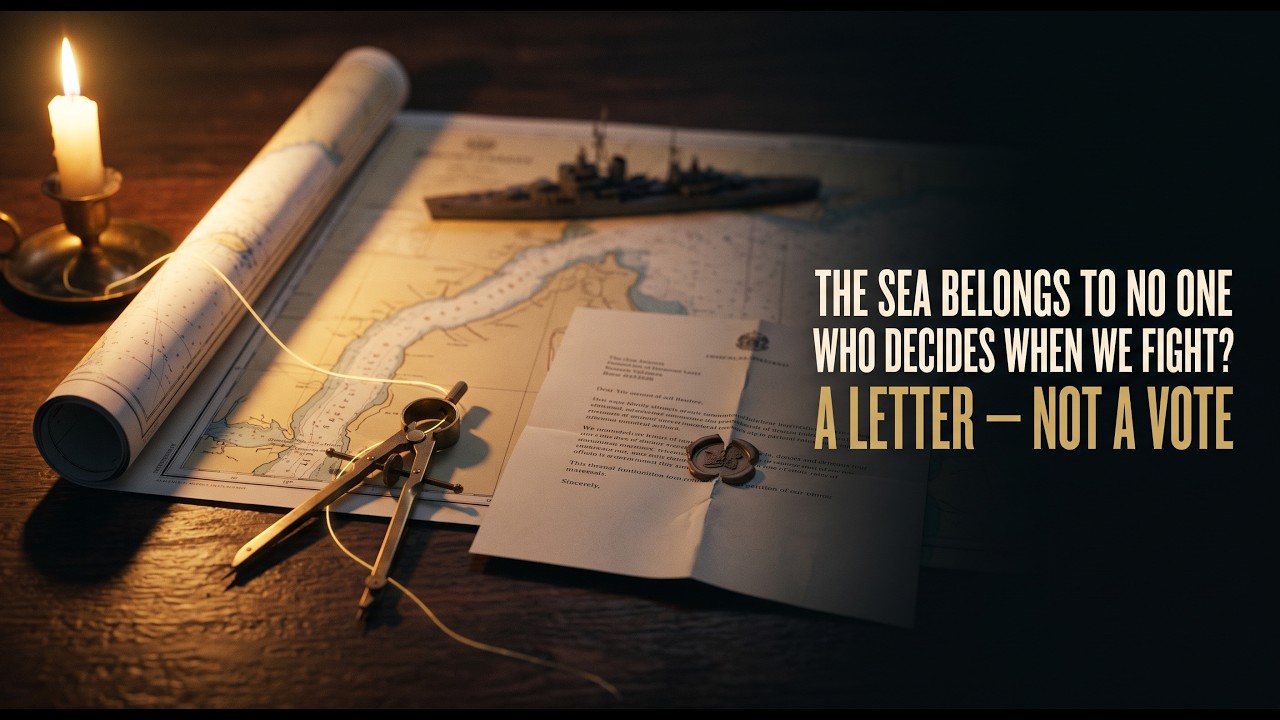
Grotius, the Free Sea & the War Powers Debate: Hormuz, Bab al-Mandab & Article I
This is the contemporary-application episode for Week 7 of Self-Evident: The Road to 1776, and it takes Grotius off the page and holds him against our own moment — then follows the free-sea question to a harder one, closer to home. When the sea is contested and America turns to military force over it, who decides that we fight? The Constitution begins with a plain answer: Article I, Section 8 gives the power to declare war to Congress, not the President. This hour measures ou
Jul 283 min read

What Are Sanctions — Do They Work, and Who Pays the Price
The covert action toolkit under fire after revelations of extra-constitutional actions during the Church committee hearings and reports of 1975-76, have been expanded to include economic instruments that are viewed as "soft" power, but cause much more widespread damage. The substitution thesis posits that regime change objectives never faded after the revelations, rather the foreign policy establishment just exchanged paramilitary activity with primary and secondary sanctions
May 122 min read
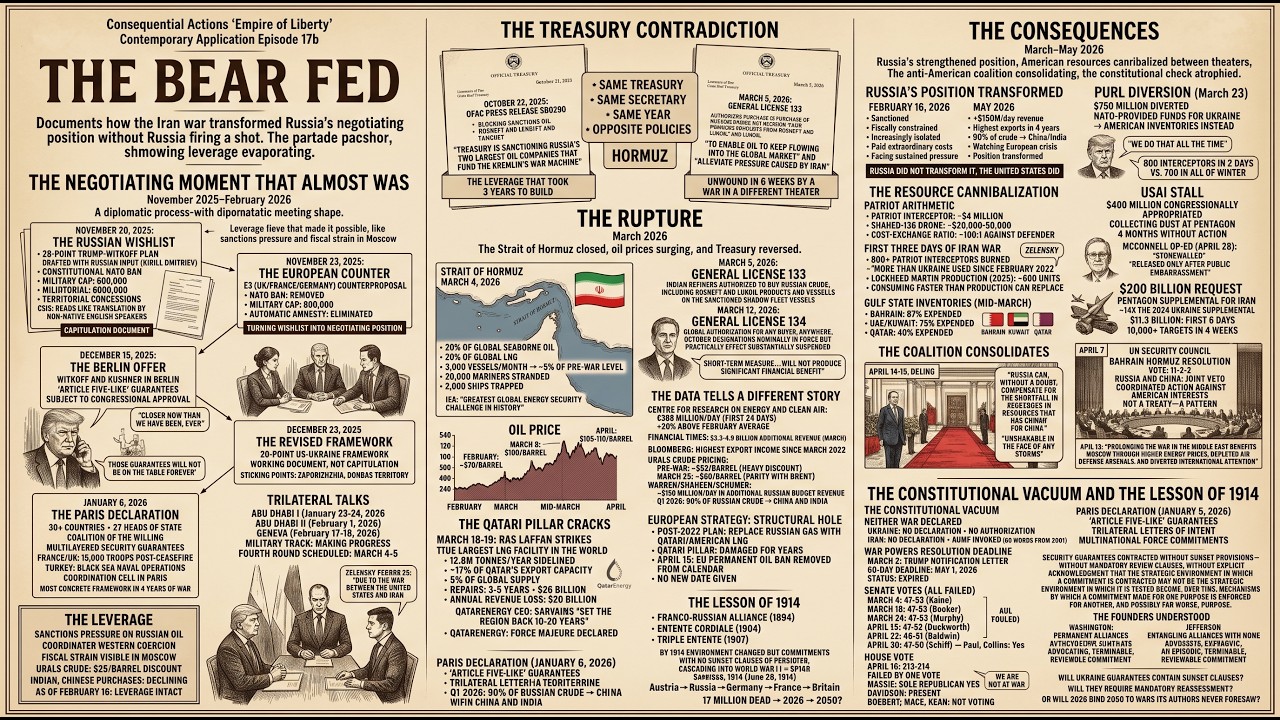
The Bear Fed — How the Iran War Handed Russia the Negotiating Position It Could Not Win on the Battlefield
This contemporary application episode examines the Russo-Ukrainian peace negotiations from the perspective of how the Iran war, launched on February twenty-eighth, 2026, materially altered the negotiating landscape in Russia’s favor.
May 52 min read

Whose Liberation, Whose Loss? — The Pattern of Intervention’s Aftermath, From Baghdad to Tehran
This contemporary application episode tests the central moral claim of American interventionism — that war can liberate populations — against the historical record of the past quarter century. Walking through Iraq, Libya, Afghanistan, and Syria in narrative form, the episode documents the consistent pattern: ancient Christian communities devastated, women’s lives constrained or destroyed, moderates eliminated, countries economically and physically wrecked.
Apr 281 min read

The Echo Chamber — Foreign Influence and the Iran War
This contemporary application episode examines reporting on foreign influence in the decisions that led to war with Iran. Drawing on the New York Times investigation by Jonathan Swan and Maggie Haberman, the resignation testimony of former National Counterterrorism Center Director Joe Kent, and the President’s own public statements, the episode applies the founders’ framework — particularly Washington’s Farewell Address warnings about “passionate attachment” to foreign nation
Apr 141 min read

Charlie Wilson's Warning—From the Mujahideen to the Kurds to the Failed State
This contemporary application episode connects the Afghan operation of the 1980s to the Iran war of 2026. The same patterns are emerging: arming fragmented proxy groups with competing agendas, the “enemy of my enemy” alliances with forces we do not control, and the absence of any plan for the day after regime collapse. Charlie Wilson’s warning echoes across four decades as analysts, members of Congress, and even the proxy forces themselves ask the question the administration
Mar 311 min read

The Lights Go Out—From Rolling Thunder to the 48-Hour Ultimatum
This contemporary application episode connects the Vietnam War’s patterns of deception and infrastructure targeting to the ongoing Iran conflict. We examine the intelligence claims that justified the war, the media mechanisms that manufacture consent, the return to overt civilian infrastructure targeting, and the constitutional failures that have allowed executive war-making to proceed unchecked.
Mar 241 min read

Why This War? — The Motivations Behind the War on Iran
This special episode examines the motivations of the principal actors behind the ongoing U.S.-Israeli war on Iran. It traces Benjamin Netanyahu's thirty-four-year campaign against Iran, documents how President Trump was persuaded to launch the war he spent a decade opposing, and identifies the congressional and institutional figures across both parties who pushed for, enabled, or laid the groundwork for this conflict. The episode presents the strongest case for those who supp
Mar 151 min read

The Approver — From Secret Coups to Open Selection
This contemporary application episode examines how American regime change evolved from covert CIA operations denied for decades to open presidential assertions of authority over foreign governments. Tracing the trajectory from Korea through Syria, we analyze how President Trump’s statement that he “must be involved” in selecting Iran’s next leader represents the culmination of seven decades of executive aggrandizement and congressional abdication. We examine the Venezuela mod
Mar 101 min read

Kermit's Game—Iran 1953 and the Template for Regime Change
This episode begins Part IV of our series—The CIA and Covert Empire—by examining the 1953 coup that overthrew Iran's democratically elected Prime Minister Mohammad Mossadegh. We trace the British oil interests that motivated the coup, the Dulles brothers' WWII background that shaped its methods, the operation itself, and the blowback that produced the 1979 hostage crisis and four decades of U.S.-Iranian hostility. We also examine the cases of Kim Philby and Aldrich Ames to il
Mar 72 min read

The Institutions Deliver—From the War on Terror to Operation Epic Fury
As American military operations in Iran continue, this contemporary application episode examines how the national security state—built for the Cold War, expanded for the War on Terror—has delivered the very outcome the Old Right warned against and Donald Trump himself promised to prevent. We trace the War on Terror framework that enables executive war-making without congressional authorization, the transformation of campaign promises into regime change, and the global applica
Mar 31 min read


"Kermit's Game"—Iran 1953 and the Template for Regime Change
This article examines the coup, its origins, its execution, and its consequences. The story is essential for understanding American covert action—its methods, its justifications, and its predictable failures. Iran 1953 established the template that would be applied in Guatemala, the Congo, Chile, and beyond: identify a target government, frame it as a communist threat, recruit local assets, create chaos, install a friendly dictator, and declare victory for freedom.
Mar 123 min read

The Template Endures—From Polk to Caracas and Tehran
This contemporary application episode applies the historical template from Article 2—the Mexican-American War’s pattern of manufactured casus belli, executive manipulation, and marginalized critics—to current events in Venezuela, Iran, and the renewed discussion of American territorial expansion. We examine how the DOJ’s “Cartel de los Soles” claim dissolved when it had to be proven in court, how American objectives toward Iran have continuously shifted, and how current annex
Jan 191 min read
bottom of page