top of page

Podcast Episodes
All Podcast Episodes from Consequential Actions

Kermit's Game—Iran 1953 and the Template for Regime Change
This episode begins Part IV of our series—The CIA and Covert Empire—by examining the 1953 coup that overthrew Iran's democratically elected Prime Minister Mohammad Mossadegh. We trace the British oil interests that motivated the coup, the Dulles brothers' WWII background that shaped its methods, the operation itself, and the blowback that produced the 1979 hostage crisis and four decades of U.S.-Iranian hostility. We also examine the cases of Kim Philby and Aldrich Ames to il
Mar 71 min read

The Institutions Deliver—From the War on Terror to Operation Epic Fury
As American military operations in Iran continue, this contemporary application episode examines how the national security state—built for the Cold War, expanded for the War on Terror—has delivered the very outcome the Old Right warned against and Donald Trump himself promised to prevent. We trace the War on Terror framework that enables executive war-making without congressional authorization, the transformation of campaign promises into regime change, and the global applica
Mar 31 min read

The National Security State—World War II's Permanent Legacy
This episode examines the institutional transformation that followed World War II—the construction of permanent agencies, alliances, and war footing that replaced the founders’ constitutional design. We trace the Truman Doctrine’s unlimited commitment, the National Security Act of 1947 that created the CIA and NSC, NATO’s entangling alliance, the Korean War’s constitutional precedent, NSC-68’s blueprint for permanent militarization, and Eisenhower’s warning about the military
Feb 281 min read

The Labels That Silence—How the Old Right's Critics Continue Their Work Today
This contemporary application episode examines how the rhetorical techniques used to silence the Old Right in 1940-1941 continue to be deployed against critics of intervention today. We analyze the function of labels like “isolationist,” “Russian asset,” “antisemite,” and “conspiracy theorist” as tools of exclusion rather than argument. We document how the Old Right’s predictions about war’s consequences for the American republic have been vindicated by eighty years of eviden
Feb 241 min read

America First—The Old Right and the Fight Against Intervention
This episode recovers the lost tradition of principled American non-interventionism that flourished between the world wars. We examine the intellectual foundations developed by thinkers like Albert Jay Nock and Garet Garrett, the political leadership of Senator Robert Taft, and the mass movement of the America First Committee. We trace how this tradition was suppressed after Pearl Harbor and systematically discredited by historians who wrote interventionism into consensus—and
Feb 211 min read

The Lines We Inherit—Gaza, the West Bank, and the Balfour Legacy
This contemporary application episode traces the direct line from the 1917 Balfour Declaration to present-day Gaza and the West Bank. We examine Balfour’s explicit calculation—his refusal to consult “the wishes of the present inhabitants”—and trace how that imperial logic persists in the current “ceasefire,” the Board of Peace reconstruction framework, and the accelerating annexation of the West Bank. We present data on ceasefire violations and casualties, analyze the Kushner
Feb 171 min read

Lines in the Sand—Sykes-Picot, Balfour, and the Creation of the Modern Middle East
This episode traces the destruction of the Ottoman Empire and the creation of the modern Middle East through three documents: the Hussein-McMahon Correspondence, the Sykes-Picot Agreement, and the Balfour Declaration. We examine the key figures who shaped these events—Enver Pasha and the Young Turks, Winston Churchill and the Gallipoli disaster, T.E. Lawrence and the Arab Revolt, the Hussein and Saud families—and explore how promises made and broken a century ago created conf
Feb 141 min read

The Perpetual Emergency
Contemporary Application to the Empire of Liberty: America's Foreign Entanglements from the Founders to the Forever War - Ep. 05
Feb 101 min read
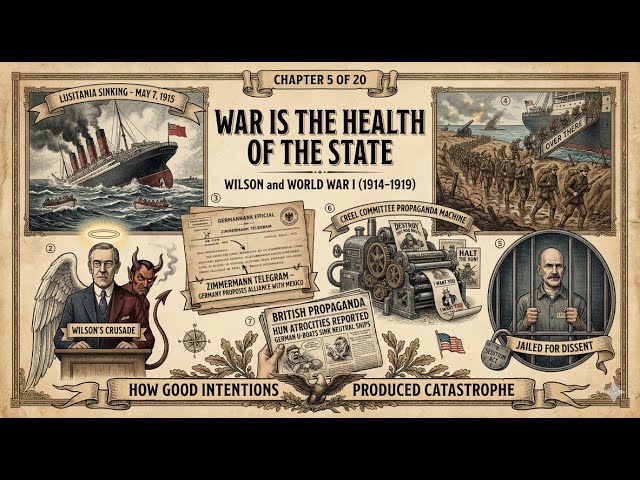
War Is the Health of the State—Wilson and World War I
America’s entry into World War I was not a response to German aggression against the United States but a choice—influenced by British propaganda, financial entanglement, Wilsonian ideology, and the interests of those who would profit from war. This episode traces how neutrality eroded through $2.3 billion in Wall Street loans, how the Lusitania and Zimmermann Telegram provided pretexts for intervention, and how the dissenters who opposed war were silenced and destroyed. We ex
Feb 71 min read

The Tripwires of Empire—NATO, Ukraine, Iran, and the Alliance Logic of 1914
This contemporary application episode connects the alliance dynamics traced in Episode 4 to current events in Ukraine and Iran. As peace talks continue in the UAE and the USS Abraham Lincoln positions off Iran’s coast, we examine how alliance commitments—NATO’s Article 5, the Russia-Iran strategic partnership, the Russia-North Korea mutual defense pact—create the same escalation dynamics that produced World War I. With 200,000 Ukrainian soldiers AWOL and President Trump threa
Feb 31 min read

Great Game and the Road to Armageddon—European Imperialism and the System That Produced World War
Before Americans can evaluate whether intervention in World War I was wise, they must understand the system they were being asked to join. This episode examines the European imperial order that produced the Great War: the British Empire at its zenith, the Crimean War and the birth of anti-Russian propaganda, the romantic brutality of the Great Game in Afghanistan, the horrors of the Scramble for Africa, and the alliance system that transformed a Balkan assassination into cont
Jan 311 min read

You Furnish the Pictures—Yellow Journalism and the Great Media Migration
This contemporary application episode connects the yellow journalism that drove America to war in 1898 with modern legacy media’s coverage of interventions from Iraq to Libya to Syria. It examines the commercial incentives that shape foreign policy coverage, the repeated pattern of uncritical amplification followed by post-hoc acknowledgment of failure, and the great migration of audiences from cable news to streaming platforms where anti-interventionist voices can reach thei
Jan 271 min read

Serving Commerce—1898 and the Birth of American Empire
1898 was the year America crossed the threshold from continental republic to overseas empire. In ten months, the United States acquired colonies spanning the Caribbean and Pacific, engaged in brutal counterinsurgency against Filipino independence fighters, and abandoned the founders’ foreign policy principles. This episode examines the manufactured justification for war (the Maine explosion, likely an internal accident), the Philippine-American War’s atrocities (reconcentrati
Jan 241 min read

The Template Endures—From Polk to Caracas and Tehran
This contemporary application episode applies the historical template from Article 2—the Mexican-American War’s pattern of manufactured casus belli, executive manipulation, and marginalized critics—to current events in Venezuela, Iran, and the renewed discussion of American territorial expansion. We examine how the DOJ’s “Cartel de los Soles” claim dissolved when it had to be proven in court, how American objectives toward Iran have continuously shifted, and how current annex
Jan 191 min read

Manifest Destiny—Continental Expansion and the Seeds of Empire
This episode examines American continental expansion—from Jefferson’s peaceful Louisiana Purchase to Polk’s manufactured Mexican-American War to Cleveland’s principled refusal to annex Hawaii. We explore the diversity of Native American nations and the varying (but consistently dispossessive) American policies toward them. We trace how the Mexican-American War established a template for imperial conflict—executive manipulation, manufactured casus belli, congressional acquiesc
Jan 171 min read

Foreign Policy Comes Home—Somalia, Refugees, and the Minneapolis Connection
This contemporary application episode examines how the founders’ key insight—that foreign policy and domestic liberty are intimately connected—plays out in a current case study. We trace the chain from America’s ongoing undeclared war in Somalia (over 100 airstrikes in 2025 alone) to the refugee crisis it has fueled to the fraud scandal now dominating headlines in Minnesota. The founders warned that entanglements abroad would have consequences at home. This is what those cons
Jan 131 min read

Entangling Alliances with None—The Founders' Vision of American Foreign Policy
This episode establishes the baseline of American foreign policy as the founders envisioned it. We examine the lessons of the Revolutionary War and the French Alliance, the classical republican tradition's warnings about standing armies, and the constitutional provisions designed to prevent military adventurism. We explore the foundational texts—Washington's Farewell Address, Jefferson's First Inaugural, and Madison's "Political Observations"—in depth and in the founders' own
Jan 101 min read

The Venezuela Question—When Empire Comes to the Western Hemisphere
On January 3, 2026, the United States launched military strikes against Venezuela and captured President Nicolás Maduro. This special episode—released alongside our series introduction—applies the founders’ framework to these events in real time. We examine the facts as currently known, compare the operation to historical precedents (Panama 1989, the Escobar manhunt), analyze the constitutional questions raised by unilateral executive military action, and ask what precedent h
Jan 61 min read

Introducing Empire of Liberty—America's Foreign Entanglements from the Founders to the Forever Wars
How did a republic founded on principles of non-intervention become an empire with military bases in eighty countries? How did a nation that once warned against “entangling alliances” come to maintain alliance commitments that span the globe? And here is the question that matters most: How have these choices abroad shaped liberty at home?
Jan 31 min read

The Infinite Emergency: Restoring Liberty in the Age of the New Leviathan
When the Founders wrote the Constitution, they assumed emergencies would be temporary. War, invasion, rebellion — these were storms to be weathered, not climates to be lived in. They left no explicit clause for “suspending” liberty because they believed free men would never consent to live without it.
Dec 31, 20251 min read
bottom of page