Why Was Operation Desert Shield Necessary?

A CONTEMPORARY CODA To the series Empire of Liberty: America’s Foreign Entanglements from the Founders to the Forever Wars
The last American troops are leaving Iraq’s bases. The road that put them there began with a decade of war loans, a set of mixed signals from Washington, and a threat to Saudi Arabia that the satellite photographs did not show.
Today the United States military completes its withdrawal from its remaining bases in Iraq, under a 2024 agreement with the Iraqi government that formally ends the anti-ISIS coalition mission begun in 2014.¹ Counted from the first deployment of American troops to Saudi Arabia in August 1990, nearly continuous American military involvement with Iraq has run thirty-six years, spanning the 1991 war, a decade of no-fly zones and blockade, the 2003 invasion and occupation, and the campaign against the Islamic State. All of it traces back to a single decision in the summer of 1990: that Iraq’s seizure of Kuwait required half a million American soldiers in the Arabian desert.
The Official Case
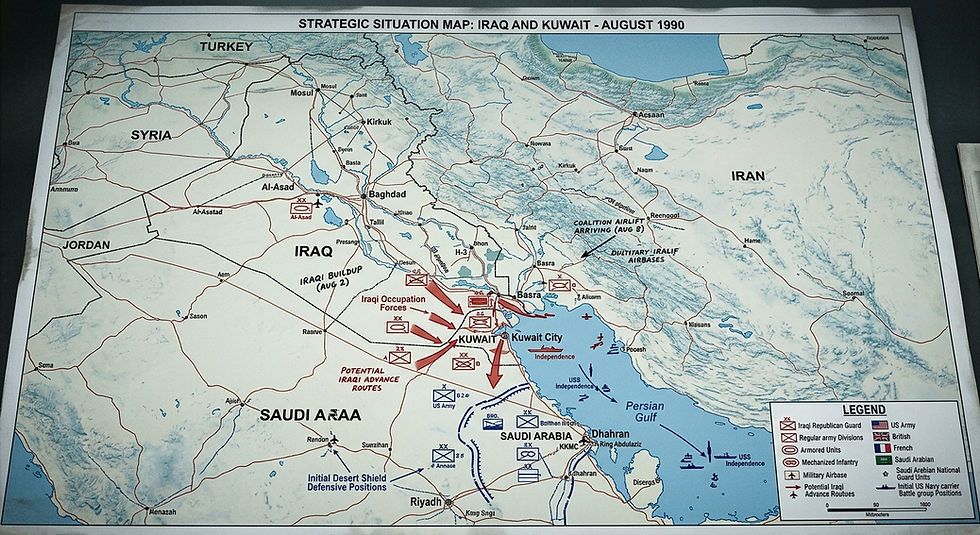
On August 2, 1990, Saddam Hussein sent his army across an internationally recognized border, and overran Kuwait in a matter of hours. Baghdad then purported to annex the country, and on August 28 declared it Iraq's nineteenth province, although the U.N. Security Council had already ruled the annexation null and void.² Iraqi forces looted Kuwait City and took foreign nationals hostage. Two days later, CIA Director William Webster told President George H.W. Bush that Iraq now controlled the second- and third-largest oil reserves in the world and was positioned to seize the largest, in Saudi Arabia, whose defenses could not have stopped eight Republican Guard divisions.³ A dictator who had already started one war of aggression against Iran, and gassed Iraqi Kurdish villagers, now sat astride a fifth of the world's oil with the fourth-largest army on Earth. On that reading, deterrence was prudence, not empire.
Nearly every element of that threat grew out of events the United States government had spent the previous decade helping to create.
Both Sides of the Iran-Iraq War
As Scott Horton documents in Enough Already, Washington's relationship with Saddam Hussein long predates 1990. After Iraq invaded revolutionary Iran in September 1980, allegations emerged that Washington had encouraged the attack. In 1981 Secretary of State Alexander Haig recorded Saudi Crown Prince Fahd's claim that President Jimmy Carter had asked him to convey a "green light" to Baghdad. Carter officials denied it, and researchers who have combed the captured Iraqi archives report finding no evidence of an American green light.⁴ What is not disputed is the course the Reagan administration took once the war was underway. In November 1983, National Security Decision Directive 114 committed the United States to do "whatever was necessary and legal" to prevent Iraq from losing the war.⁵ Washington supplied Baghdad with intelligence, including satellite-derived battlefield information, even as U.S. officials knew Iraqi forces were using, and intended to keep using, mustard gas and nerve agents against Iran. It also allowed Jordan, Saudi Arabia and Kuwait to pass American weapons to Iraq.⁶
The Department of Agriculture approved roughly $4.5 billion in export credit guarantees for Iraq between 1983 and 1989, and another $500 million in 1990, even after its own risk analysts rated Iraq a high-risk borrower.⁷ Separately, the Atlanta branch of Italy's Banca Nazionale del Lavoro extended Iraq some $4 billion in loans concealed from the bank's own headquarters and from federal regulators. About $1.9 billion of that financed American agricultural purchases under U.S. government guarantees. The rest became the center of the "Iraq-gate" scandal.⁸
At the same time, the Reagan administration sold missiles to Iran in the arms-for-hostages operation later exposed as Iran-Contra. Horton describes the pattern plainly: Washington increased support for Iraq when Iran appeared to be winning, then authorized increased Israeli support for Iran when Iraq seemed to gain the upper hand, and each side's new equipment necessitated the next round of intervention for the other.⁹ Vice President Bush later said of the policy, "There was a lot of support at the time for Iraq as a balance to a much more aggressive Iran under Khomeini. ... I was very proud to support that."¹⁰
The war lasted eight years and killed hundreds of thousands of people.¹¹ Iraq paid for its side largely on credit, and the largest creditors were its Gulf neighbors. By 1990 Iraq owed some $37 billion to Gulf lenders alone, chiefly Saudi Arabia and Kuwait.¹² Washington did not write those checks, and American policy was not responsible for all eight years of fighting. But Washington's effort to prevent an Iraqi defeat helped sustain a war that Baghdad was financing with borrowed Gulf money.
The Debt Crisis of 1990
When the fighting stopped in 1988, the bills came due. Saddam argued that Iraq had fought Iran on behalf of the Gulf monarchies and asked Kuwait and the United Arab Emirates to forgive the loans. They refused.¹² At the same time, Kuwait was pumping well above its OPEC quota, which drove down the price of oil, Iraq’s only significant export. Baghdad also accused Kuwait of drawing oil from the Rumaila field, which straddles the border. On July 25, 1990, Saddam summoned the American ambassador, April Glaspie, and told her Iraq was $40 billion in debt and going bankrupt from the cost of the war with Iran.¹³
What Washington Told Baghdad
Glaspie's reply has become famous. In the transcript Baghdad released and the New York Times published, she told Saddam: "We have no opinion on the Arab-Arab conflicts, like your border disagreement with Kuwait."¹⁵ Her own cable back to Washington records the same message in the embassy's words: "we took no position on these Arab affairs."¹⁶ The day before, State Department spokeswoman Margaret Tutwiler had told reporters that the United States had "no defense treaties with Kuwait, and there are no special defense or security commitments to Kuwait."¹⁷ On July 31, two days before the invasion, Assistant Secretary of State John Kelly told a House subcommittee, "We don't have any defense treaty with the Gulf States. That's clear."¹⁸
Glaspie's defenders argue that she delivered standing American policy accurately and pressed Saddam to settle the dispute peacefully, which she also did.¹⁹ Washington wanted a peaceful settlement and had interests of its own in the Gulf. What it would not say, three times in a single week, was whether it would fight for Kuwait. A man with an army massed on the Kuwaiti border was left to guess where the American red line lay.
The civilian diplomats were not the only voices. In Horton's account, the Defense Intelligence Agency warned that Saddam was "not bluffing." Defense Secretary Dick Cheney and Undersecretary Paul Wolfowitz issued a public warning that the United States was obligated to defend Kuwait, which Pentagon spokesman Pete Williams then walked back. Horton also reports that the CIA and the military's Central Command decided to encourage the Kuwaitis to keep refusing Iraq's demands for new negotiations.²⁰ A DIA estimate held that Iraq would take a single oil field, and senior officials told reporters the administration had expected a "limited invasion" it "could live with."²¹ Glaspie herself later said, "Obviously, I didn't think — and nobody else did — that the Iraqis were going to take all of Kuwait."²²
Horton weighs the possibility that Washington deliberately set a trap and concludes that the simpler explanation is a massive failure of coordination between departments. He adds that if the administration had set out to snare Saddam, events would probably not have looked much different, and he quotes a prominent Kuwaiti businessman: "I think that if the Americans had not pushed, the royal family would never have taken the steps that it did to provoke Saddam."²³ Whatever Saddam inferred from those signals, Washington had left substantial uncertainty about where its military red line lay. That ambiguity was part of the environment in which Baghdad made its catastrophic calculation.
Selling the Deployment
The first public response in Washington was restrained. Bush said on August 2 that he was "not contemplating" military action, and Colin Powell suggested drawing the line at Saudi Arabia.²⁴ Five days later, with King Fahd's consent, Bush ordered Operation Desert Shield, and American troops began arriving in the kingdom.²⁵
Then came the sales campaign. Powell recalled Webster reporting that Iraqi forces were "within eight tenths of a mile of the Saudi border."²⁶ By September the administration was telling the public that some 250,000 Iraqi troops and 1,500 tanks were massed in Kuwait, poised to move south toward Riyadh. When the St. Petersburg Times bought Soviet commercial satellite photographs of the area taken in mid-September, the imaging specialists it hired could not find forces on anything like that scale.²⁷ The photographs did not prove that no threat existed in early August, when the deployment decision was made, but they did challenge the size of the force the administration was describing. The Associated Press, Scripps-Howard and CNN all declined the story.²⁸ The public relations firm Hill and Knowlton, run by Bush's former chief of staff Craig Fuller, prepared and coached a fifteen-year-old girl, introduced only as "Nayirah," who told a congressional caucus she had seen Iraqi soldiers pull infants from hospital incubators. She was later revealed to be the daughter of Kuwait's ambassador to Washington, a relationship never disclosed to her audience, and human rights investigators could not substantiate her account as she presented it.²⁹
Through the fall, Iraqi officials and intermediaries floated several possible withdrawal packages involving access to the uninhabited islands of Bubiyan and Warbah and talks over the disputed Rumaila border. Washington rejected territorial concessions or linkage as conditions for withdrawal.³⁰ Jim Webb, Reagan's former secretary of the Navy, judged that the stated willingness to negotiate "was little more than veneer, a way to spin up the public's emotions and prepare the nation for a war the administration had already decided to fight."³¹
Thirty-Six Years Later
Desert Shield became necessary against a danger that earlier American policy had helped create. Washington tilted toward Iraq during its war with Iran while selling missiles to Tehran, extended billions in government-backed credit to Baghdad, and then sent Saddam Hussein ambiguous signals about whether it would defend Kuwait. After the invasion, the Bush administration presented Saudi Arabia as the next target, a danger it had real intelligence reasons to weigh, though commercial satellite imagery later raised hard questions about the scale of the buildup it described to the public. The greatly expanded American military posture in the Gulf after 1990, including the bases closing in Iraq this week, grew from that deployment. So did the grievance Osama bin Laden cited in his 1996 declaration of war against the United States: American soldiers stationed in the land of the two holy places.³²
The pattern did not start in 1990. American foreign policy has repeatedly created the crises it later answered with force, from the founding era to the forever wars. Empire of Liberty: America's Foreign Entanglements from the Founders to the Forever Wars traces that history in a twenty-part series of in-depth articles and podcast episodes. To read and hear the full series, and to get new work as it is published, visit ConsequentialActions.com/Subscribe.
As the last transports lift off from Iraq, one question remains: did thirty-six years of intervention leave Americans more free, or more governed?
Endnotes
Sangar Akrayi, "CENTCOM Completes Departure From Erbil Air Base, Hands Iraq's Security To Iraqi Forces," Kurdistan24, September 30, 2026; Dave DeCamp, "US Completing Its Withdrawal From Remaining Military Bases in Iraq," Antiwar.com, September 29, 2026.
U.N. Security Council Resolution 662, August 9, 1990; Institute for Palestine Studies, Chronology of the Gulf Crisis, entry for August 28, 1990.
Bruce Riedel, "Remembering George H.W. Bush, a Wise Foreign Policy Leader," Brookings Institution, December 3, 2018.
Horton, Enough Already, 18, on the Haig record of Fahd's claim; "Re-Writing History: The Iran-Iraq War 30 Years Later," Al Majalla, on Kevin Woods's review of captured Iraqi records.
Horton, Enough Already, 20.
Shane Harris and Matthew M. Aid, "Exclusive: CIA Files Prove America Helped Saddam as He Gassed Iran," Foreign Policy, August 26, 2013; Horton, Enough Already, 19–20.
U.S. General Accounting Office, International Trade: Iraq's Participation in U.S. Agricultural Export Programs, GAO/NSIAD-91-76 (1990).
Multinational Monitor, March 1991, on the roughly $4 billion in BNL Atlanta loans and the $1.9 billion guaranteed through the Commodity Credit Corporation; U.S. Department of Justice press release on the BNL settlement, February 1995.
Horton, Enough Already, 20.
Horton, Enough Already, 21, quoting George H.W. Bush in the Los Angeles Times.
Horton, Enough Already, 21.
Office of the Historian, U.S. Department of State, "The Gulf War, 1991," Milestones: 1989–1992.
Office of the Historian, "The Gulf War, 1991."
Horton, Enough Already, 21.
"Excerpts From Iraqi Document on Meeting With U.S. Envoy," New York Times, September 23, 1990.
U.S. Embassy Baghdad cable 90BAGHDAD4237, "Saddam's Message of Friendship to President Bush," July 25, 1990; quoted in Horton, Enough Already, 23.
"Washington Watch," Middle East Report (MERIP), January–February 1991.
Horton, Enough Already, 23.
Association for Diplomatic Studies and Training, "A Bum Rap for April Glaspie? Saddam and the Start of the Iraq War," February 2016.
Horton, Enough Already, 22.
Horton, Enough Already, 23.
Horton, Enough Already, 23, quoting Glaspie to the New York Times.
Horton, Enough Already, 22.
Horton, Enough Already, 24.
"Bush Orders Operation Desert Shield," HISTORY.com, This Day in History, August 7; Riedel, "Remembering Colin Powell and a Pivotal Moment Before the Gulf War."
Bruce Riedel, "Remembering Colin Powell and a Pivotal Moment Before the Gulf War," Brookings Institution, October 18, 2021.
Jean Heller, "Photos Don't Show Buildup," St. Petersburg Times, January 6, 1991; "Experts Look Again at Wartime Satellite Photos," St. Petersburg Times, September 15, 1991; Horton, Enough Already, 25.
Horton, Enough Already, 25.
John R. MacArthur, "Remember Nayirah, Witness for Kuwait?" New York Times, January 6, 1992; "What About the Incubators?" Middle East Report (MERIP), June 2000; Horton, Enough Already, 24–25.
Horton, Enough Already, 26–27.
Horton, Enough Already, 27, quoting Jim Webb.
Osama bin Laden, "Declaration of War Against the Americans Occupying the Land of the Two Holy Places," Al-Quds al-Arabi, August 23, 1996; Horton, Enough Already, 5–6.


Comments