The Federalist-Liberty Model, Part I: Methodology

Thomas Jefferson wrote to James Madison in 1789 with an observation that would haunt American politics: “The natural progress of things is for liberty to yield and government to gain ground.”¹ Jefferson understood that power, once granted, rarely returns voluntarily to the people. Crises justify expansions. Emergencies require extraordinary measures. Temporary authorities become permanent. The trajectory matters more than the intention.
Two centuries later, we face the same question Jefferson posed: Are we more free, or more governed? And crucially: How do we measure this?
We can’t rely on party labels—Article 2 showed that parties are coalitions that shift positions based on electoral advantage. We can’t rely solely on ideology—Article 3 showed that the same ideology can justify opposite policies. We can’t rely on economic system alone—Article 4 showed capitalism and socialism can be defended from multiple ideological premises. We can’t rely on populist rhetoric—Article 5 showed “people versus elite” framing reveals nothing about actual governance.
We need a framework that measures what politicians actually do with power, not what they claim to believe or which team they represent. We need to answer Jefferson’s question with evidence rather than assertion: Did this leader’s policies leave Americans more free, or more governed?
The Federalist-Liberty Model provides that framework. It plots political figures on two independent axes:
Economic Axis (X): The degree of economic freedom—whether markets operate with minimal interference or are subject to extensive regulation, planning, and redistribution. Left (−200) represents maximum collective control; right (+200) represents maximum market freedom.

Liberty Axis (Y): The extent of civil liberty—the balance between constitutional restraint and executive/governmental coercion. Bottom (−200) represents maximum authoritarianism; top (+200) represents maximum protection of individual rights and limits on government power.

This isn’t a partisan exercise. It’s a constitutional one. The model measures the same things Madison and Jefferson debated: How much power should government hold? What happens when it exceeds its bounds? Are rights secured or violated? Is power concentrated or dispersed? Does government expand or contract?
Before we plot historical figures (Article 7), we must establish the methodology. How do we measure economic freedom and civil liberty? How do we account for lasting versus temporary changes? How do we handle the inevitable controversies about scoring? And crucially: How has the “center” itself shifted over time, making yesterday’s moderates today’s extremists (or vice versa)?
Why Two Axes? The Inadequacy of Left-Right
The traditional left-right political spectrum emerged from the French Revolution, when legislators supporting the monarchy sat on the right, and those supporting revolution sat on the left. This single-axis model persists, conflating multiple distinct dimensions:
What “Left” supposedly means
Economic redistribution
Social progressivism
Government intervention
Equality emphasis
Change and reform
What “Right” supposedly means
Free markets
Social traditionalism
Limited government
Liberty emphasis
Stability and order
But this collapses incompatible dimensions. Consider:
Libertarians favor free markets (right) and social liberalism (left). Where do they fall?
National conservatives favor economic intervention (left) and social traditionalism (right). Where do they fall?
Civil libertarian progressives favor economic redistribution (left) and civil liberties (libertarian). Where do they fall?
The single axis forces these into incoherent positions or pretends they don’t exist.
Other Two-Axis Models
We’re not the first to recognize this problem. David Nolan’s Nolan Chart (1969) placed economic freedom on one axis and personal freedom on another, creating a diamond with libertarian at top, authoritarian at bottom, left and right on sides.² The Political Compass (2001) uses economic left-right on X-axis and authoritarian-libertarian on Y-axis.³
Our model draws on these insights but centers explicitly on the founding question: liberty versus authority. The axes measure:
Economic Axis: Not just “left vs. right” but degree of market freedom versus collective control. This captures whether resources are allocated through voluntary exchange or government direction, whether property rights are protected or overridden, whether economic decisions are decentralized or centralized.
Liberty Axis: Not just “liberal vs. conservative” but degree of constitutional constraint versus executive authority. This captures whether rights are protected or violated, whether power is limited or concentrated, whether due process operates or is suspended, whether government acts within enumerated powers or beyond them.
This framework reveals patterns invisible on single-axis models:
FDR and Hoover both expanded federal authority during Depression, but FDR went much further on both economic intervention and executive power
Reagan and Nixon both called themselves conservatives, but Reagan deregulated while Nixon imposed wage-price controls; Reagan reduced some federal authority while Nixon expanded surveillance
Sanders and Trump both deployed populist rhetoric, but Sanders wants economic redistribution while Trump wanted immigration restriction and protectionism
Jefferson and Hamilton both served in Washington’s cabinet, but Hamilton wanted energetic federal government while Jefferson wanted minimal government strictly constrained by enumeration

Think about your own instincts: When you hear “conservative,” do you think economic freedom or traditional values? When you hear “liberal,” do you think individual liberty or collective provision? The confusion reveals why single-axis models fail—they force us to conflate distinct questions.
The Economic Axis: Measuring Market Freedom vs. Collective Control
The Economic Axis measures the degree to which economic decisions are made through markets (decentralized, voluntary exchange) versus government direction (centralized, coercive allocation).
What This Axis Measures
Market Freedom Direction (+):
Minimal taxation and regulation
Strong property rights protection
Free trade with few restrictions
Sound money and fiscal discipline
Decentralized economic decision-making
Market prices guiding resource allocation
Limited government spending as percentage of GDP
Private ownership of productive resources
Collective Control Direction (−):
Progressive taxation and wealth redistribution
Extensive economic regulation
Protectionism and trade restrictions
Monetary manipulation through central banking
Government planning and industrial policy
Price controls and rationing
High government spending as percentage of GDP
Public/collective ownership of productive resources
What This Axis Does NOT Measure
This is not a measure of economic outcomes (prosperity, equality, growth). It measures economic organization—who makes decisions and through what mechanisms. A highly regulated economy might be prosperous or poor. A free-market economy might be equal or unequal. The axis measures structure, not results.
Nor is this simply “size of government.” Government can be large but decentralized (strong state/local authority) or small but concentrated (minimal government with absolute executive control). The economic axis specifically measures economic freedom—how much government controls or constrains economic activity.
Dimensional Structure
The Economic Axis comprises four dimensions that sum to the total score:
Taxation & Fiscal Policy (−50 to +50): Tax rates, tax structure, fiscal restraint
Government Spending & Entitlements (−60 to +60): Federal spending levels, social insurance programs
Economic Regulation (−50 to +50): Regulatory frameworks, agency creation/elimination
Trade & Market Intervention (−40 to +40): Trade policy, protectionism, industrial policy
Historical Examples Illustrating the Economic Axis
Grover Cleveland (1885-1889, 1893-1897): Cleveland vetoed over 600 bills including pension expansions, opposed tariffs, rejected federal intervention in economy, maintained gold standard, and limited government spending. His famous veto message: “though the people support the Government, the Government should not support the people.”⁴ Cleveland’s economic policies placed him far right (+141) on economic axis—the most free-market president in American history.
Calvin Coolidge (1923-1929): Coolidge reduced taxes dramatically (top rate from 73% to 25%), paid down national debt, deregulated, opposed farm subsidies, maintained sound money, and famously declared “the chief business of the American people is business.”⁵ His economic philosophy—maximum market freedom, minimal government—places him at +105 on economic axis, second only to Cleveland.
Franklin Roosevelt (1933-1945): FDR created Social Security, implemented progressive taxation, established SEC and extensive financial regulation, created agricultural price supports, attempted court-packing to enable economic intervention, and imposed wartime controls. His New Deal fundamentally restructured American capitalism, placing him far left (−168) on economic axis—the most interventionist president in peacetime American history.
Ronald Reagan (1981-1989): Reagan cut top tax rates from 70% to 28%, deregulated airlines and telecommunications, reduced regulation generally, and promoted free trade. However, he maintained Social Security and Medicare, increased military spending dramatically, ran substantial deficits, and didn’t reverse New Deal fundamentals. His economic policy moved rightward (+42) but not as far as rhetoric suggested—he reformed the mixed economy rather than dismantling it.
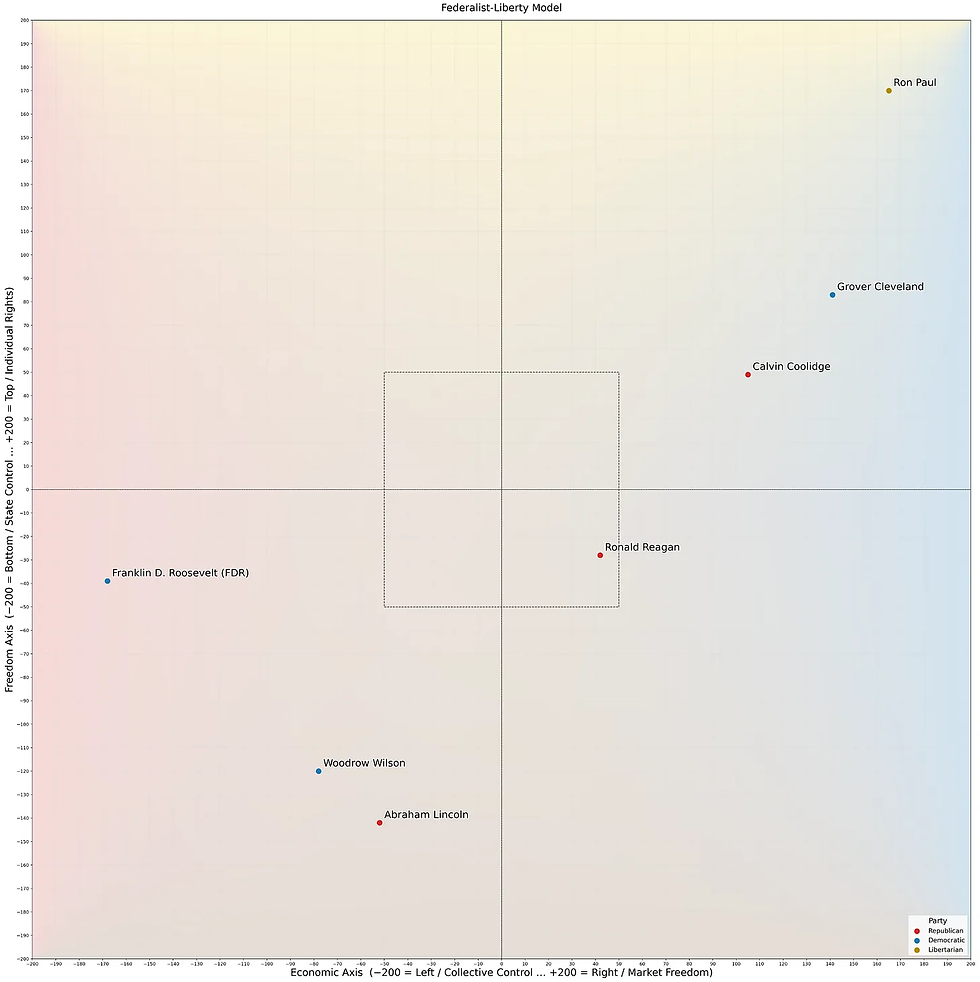
These placements reveal patterns invisible in party labels:
Cleveland (Democrat) and Coolidge (Republican) occupy similar space despite different parties and eras
FDR (Democrat) moved dramatically further left than any president before or since
Nixon (Republican) actually moved left economically (wage-price controls, EPA creation, expanded spending)
The “center” shifted dramatically leftward between Cleveland’s era (1890s baseline around +100) and Reagan’s era (1980s baseline around −20)
Consider where you’d place yourself
Do you think most economic decisions should be made through markets with minimal government intervention (rightward position)?
Or through democratic/governmental direction with extensive regulation and redistribution (leftward position)? Or somewhere between?
Your answer reveals your economic axis position.
The Liberty Axis: Measuring Constitutional Restraint vs. Executive Authority
The Liberty Axis measures the degree to which government respects constitutional limits, protects civil liberties, and constrains its own power versus expanding authority through emergency powers, surveillance, mandates, and violations of due process.
What This Axis Measures
Libertarian Direction (+):
Strong protection of civil liberties and due process
Constitutional constraints on executive/federal power
Respect for enumerated powers doctrine
Limited surveillance and police power
Non-interventionist foreign policy (avoiding entangling wars)
Protection of minority rights against majoritarian overreach
Transparency and accountability
Decentralized authority (federalism, separation of powers)
Authoritarian Direction (−):
Suspension or erosion of civil liberties
Executive aggrandizement and emergency powers
Broad interpretation of implied powers
Expanded surveillance and security state
Military intervention and undeclared wars
Majoritarian overrides of minority rights
Secrecy and concentration of power
Centralization in federal executive
What This Axis Does NOT Measure
This is not a measure of whether government is “good” or “bad,” wise or foolish. Authoritarian measures might be well-intentioned (wartime security) or malicious (political persecution). Libertarian restraint might enable private oppression or protect valuable freedom. The axis measures governmental authority and constraint, not motives or outcomes.
Nor is this simply “small vs. big government.” A government can be large but constrained by constitutional limits (extensive welfare state operating within democratic norms). Or it can be small but highly authoritarian (minimal government with absolute executive control, no civil liberties). The liberty axis specifically measures whether government respects constraints on its power.
Dimensional Structure
The Liberty Axis comprises six dimensions that sum to the total score:
War & Foreign Policy (−60 to +60): Military interventions, war declarations, foreign policy
Due Process & Criminal Justice (−40 to +40): Incarceration, habeas corpus, mandatory minimums
Surveillance & Privacy (−30 to +30): Warrantless surveillance, privacy protections
Civil Liberties (−30 to +30): First Amendment, censorship, whistleblower protections
Personal Autonomy (−30 to +30): Drug war, conscription, vaccine mandates, bodily autonomy
Equal Rights & Discrimination (−10 to +10): Civil rights expansions, discriminatory policies
Historical Examples Illustrating the Liberty Axis
Abraham Lincoln (1861-1865): Lincoln suspended habeas corpus, imprisoned newspaper editors, censored telegraph lines, instituted the draft, and wielded executive authority more aggressively than any previous president.⁶ The president who freed 4 million slaves also imprisoned 13,000 without trial, established the imperial presidency, and demonstrated that emergencies justify suspending constitutional government. His greatest achievement (ending slavery) required—or he believed required—methods that permanently damaged constitutional constraints on power. These measures, taken during existential crisis of Civil War, substantially moved him down the liberty axis (−142) despite preserving the Union and ending slavery. We’ll explore this complexity in Article 7, but methodology requires acknowledging that even necessary emergency powers represent authoritarianism.
Grover Cleveland (1885-1889, 1893-1897): Cleveland avoided foreign wars (refusing to annex Hawaii), respected congressional authority, maintained limited federal police power, and generally governed with constitutional restraint. However, he deployed federal troops against the Pullman Strike (−20 penalty), showing authoritarian instincts when labor threatened order. Overall liberty score: +83—strongly libertarian but not perfect.
Woodrow Wilson (1913-1921): Wilson’s administration passed Espionage Act (1917) and Sedition Act (1918) criminalizing dissent, imprisoned socialist leader Eugene Debs for anti-war speech, conducted Palmer Raids arresting thousands without due process, censored anti-war publications, and entered WWI.⁶ Combined with extensive wartime controls, Wilson moved far down liberty axis (−120)—among the most authoritarian presidents in American history.
Calvin Coolidge (1923-1929): Coolidge pardoned Eugene Debs and others imprisoned under Wilson’s Sedition Act (+25), ended Palmer Raids, restored civil liberties, pursued non-interventionist foreign policy (+18), and reduced federal authority. However, he signed the restrictive Immigration Act of 1924 (−18), limiting freedom of movement. His overall liberty score (+49) represents substantial recovery from Wilson’s authoritarianism while falling short of Cleveland’s record.
Franklin Roosevelt (1933-1945): FDR’s liberty record is more complex than his economic interventionism. He interned 120,000 Japanese Americans without trial (−45), attempted court-packing (−30), and wielded unprecedented executive authority. However, his wartime measures were largely temporary (reduced permanence multipliers), and he avoided the systematic peacetime repression of Wilson’s era. Liberty score: −31—moderately authoritarian, primarily through wartime actions rather than peacetime civil liberties violations.
Ronald Reagan (1981-1989): Reagan escalated drug war dramatically (−15), expanded mandatory minimums, increased incarceration rates, supported civil asset forfeiture, maintained extensive military operations (Grenada, Libya, support for Contras), and continued Cold War security apparatus. While rhetoric emphasized freedom, actual policies moved down liberty axis (−28) through criminal justice expansion and military interventionism—a pattern showing that “conservative” doesn’t predict liberty axis position.
Ron Paul (2008-2012 campaigns): Paul advocated ending drug war, abolishing Patriot Act, bringing troops home from overseas, eliminating surveillance programs, and restoring constitutional limits.¹⁰ His consistent opposition to government coercion in civil liberties and foreign policy places him far up liberty axis (+170), though he never held executive power to implement these proposals.

These placements reveal crucial patterns:
Presidents who governed during major wars (Wilson, FDR) consistently moved down liberty axis
Peacetime presidents (Coolidge, Cleveland) generally remained higher on liberty axis
Rhetoric about freedom doesn’t predict position (Reagan talked liberty but expanded drug war)
The “center” has shifted substantially downward—what was authoritarian in Cleveland’s era (federal troops against strikes) is now considered moderate compared to post-9/11 security state
Consider where you’d place yourself
Do you think government should have broad emergency powers to address crises (authoritarian direction)?
Or should constitutional constraints apply even in emergencies (libertarian direction)? Do you prioritize security and order (down) or civil liberties and restraint (up)?
Your answer reveals your liberty axis position.
The Four Quadrants: Patterns of Governance
The two-axis framework creates four distinct quadrants, each representing coherent approach to governance:
Upper Right: Liberty-Market (Libertarian/Classical Liberal)

Characteristics
Maximum individual freedom, minimum government coercion
Market allocation of resources with minimal regulation
Strong property rights and contract enforcement
Non-interventionist foreign policy
Constitutional constraints strictly observed
Enumerated powers doctrine
Federalism and decentralized authority
Historical Examples
Grover Cleveland (+141, +83): Vetoed pensions and federal aid, opposed tariffs, limited government spending, avoided foreign wars, maintained constitutional restraint
Calvin Coolidge (+105, +49): Minimal government, maximum market freedom, pardoned Wilson’s political prisoners, non-interventionism
Martin Van Buren (+88, +45): Refused Panic of 1837 stimulus, maintained hard money, limited federal authority
Ron Paul: (+165, +170) Consistent advocacy for ending drug war, bringing troops home, eliminating Fed, restoring constitutional limits
Ideological Foundation: Classical liberalism and libertarianism (Article 3)—belief that individual liberty is highest political good, markets coordinate better than planning, government is necessary evil requiring strict constraint.
System Preference: Free-market capitalism with minimal government intervention (Article 4)—though some figures in this quadrant (Jefferson) were skeptical of industrial capitalism and preferred agrarian economy.
Upper Left: Liberty-Collectivist (Democratic Socialist/Civil Libertarian Progressive)

Characteristics
Strong civil liberties protection and due process
Non-interventionist foreign policy
Economic redistribution and collective provision
Democratic control of economic life
Constitutional constraints on authoritarianism but not on economic intervention
Protection of minority rights
Historical Examples
Eugene Debs (as advocate, not president): Socialist leader who opposed WWI (imprisoned under Sedition Act), advocated for labor rights, opposed imperialism, supported economic democracy
Bernie Sanders (legislator, not president): Medicare for All advocacy, opposition to Iraq War and military intervention, support for civil liberties, economic redistribution
This quadrant is rare among American presidents—the upper-left combination of economic intervention with libertarian civil liberties hasn’t characterized executive governance. This reveals an important pattern: economic interventionists typically also expand government authority generally (moving into lower-left quadrant).
Ideological Foundation: Democratic socialism and progressive liberalism (Article 3)—belief that economic equality is necessary for genuine freedom, markets produce unjust outcomes requiring correction, government should provide for basic needs while respecting civil liberties.
System Preference: Social democracy or democratic socialism (Article 4)—extensive government provision and redistribution within democratic framework, respecting pluralism and rights.
Lower Left: Authoritarian-Collectivist (Progressive Nationalist/Socialist Authoritarian)

Characteristics
Economic intervention and redistribution
Strong executive authority and centralized power
Emergency powers and crisis governance
War mobilization and security state
Collective provision combined with authority
Majoritarian override of constraints
Historical Examples
Abraham Lincoln: (-52, -142) Ended slavery (credit) but suspended habeas corpus, imprisoned dissidents, instituted draft, centralized authority during Civil War
Woodrow Wilson (−78, −120): Created Federal Reserve and income tax (permanent leftward institutions), but primarily scores low on liberty axis through WWI intervention, Sedition Act, Palmer Raids, systematic repression of dissent
Franklin Roosevelt (−168, −39): New Deal expansion represents furthest leftward economic movement, but liberty score reflects primarily wartime measures (Japanese internment, wartime controls) rather than systematic peacetime authoritarianism
Lyndon Johnson (−145, −87): Great Society programs moved substantially left economically, Vietnam escalation and domestic surveillance moved down on liberty, but less extreme than Wilson or wartime presidents
Richard Nixon: (-60, -118) Some free-market economic policies but oversaw significant economic centralization (imposed wage-price controls, instituted fiat currency), also known for Watergate abuses, expansion of drug war, secret bombing of Cambodia, enemies list, surveillance
Barack Obama (−118, −42): Modest leftward movement economically (ACA, stimulus), but significant downward movement on liberty through continuing post-9/11 security state, surveillance expansion, drone warfare
Ideological Foundation: Progressive nationalism or crisis-justified expansion (Article 3)—belief that emergencies require concentrated authority, that experts can manage society effectively, that collective welfare justifies individual constraints.
System Preference: Managed capitalism or socialist planning with strong state (Article 4)—extensive government control of economy combined with centralized political authority.
This quadrant contains the most controversial placements. Many of these presidents are celebrated for accomplishments (Lincoln preserved Union and ended slavery, FDR addressed Depression and defeated fascism, LBJ passed Civil Rights Act). The model acknowledges these achievements while noting that their methods concentrated power and violated constitutional constraints. We measure trajectory on liberty and economic freedom, not moral worth or historical necessity.
Lower Right: Authoritarian-Market (National Conservative/Authoritarian Capitalist)

Characteristics
Market economy with limited redistribution
Strong executive authority and security state
Law and order emphasis
Military intervention and empire
Traditional values sometimes enforced through state power
Property rights protected but civil liberties constrained
Historical Examples
Rudy Giuliani: (45, -35): Rudy Giuliani represents law-and-order conservatism at its most aggressive—combining pro-business economic policies with highly authoritarian policing and national security positions.
Ronald Reagan: (42, -28): Tax cuts and deregulation (rightward economically), but heavy policies for the domestic drug war as well as foreign interventionism in central and south America.
John F. Kennedy: (28, -22): Major tax cut proposal (passed posthumously 1964), but Cold War policies and actions (Bay of Pigs, Vietnam escalation)
Ideological Foundation: National conservatism or authoritarian capitalism (Article 3)—belief that free markets produce prosperity but strong state authority is necessary for order, that traditional values should be enforced, that national security justifies civil liberties constraints.
System Preference: Market capitalism but with protectionism, nationalism, and state enforcement of cultural norms (Article 4).
This quadrant is least populated in American history—pure authoritarian capitalism is rare. Most American right-authoritarians also embrace some economic intervention (protectionism, industrial policy). The model captures this by showing figures who move right on economics but down on liberty, though rarely to extreme positions on both simultaneously.
This quadrant also shows that “pro-business” or “economically conservative” doesn’t predict libertarianism. Leaders can support market economics while expanding government authority through war, surveillance, and criminal justice.

Reflection Question
Looking at these four quadrants, which feels most aligned with your values?
Do you prioritize both liberty and markets (upper right)?
Do you prioritize liberty but prefer economic redistribution (upper left)?
Do you accept authority if it delivers economic security and collective welfare (lower left)?
Do you accept authority if it preserves market freedom and traditional order (lower right)?
Most people don’t fit perfectly in one quadrant—you might be near center, or on a boundary between quadrants. But noticing which quadrant you gravitate toward reveals your fundamental priorities about liberty, authority, markets, and collective provision.
The Permanence Multiplier: Why Lasting Changes Matter More
Not all policies have equal impact on the Federalist-Liberty Model. Some are temporary—wartime controls end when war ends, emergency measures expire when crisis passes. Others create lasting institutions, legal precedents, or cultural shifts that permanently alter the relationship between citizens and state.
The Permanence Multiplier accounts for this temporal dimension: Durable institutions that concentrate authority or expand government economic control have amplified effect on scores. Temporary measures that quickly reverse have minimal long-term impact.
Why This Matters:
Imagine two presidents:
President A suspends habeas corpus during rebellion but restores it immediately after crisis ends. Creates temporary wartime agencies that dissolve when war concludes. Expansions of authority are crisis-specific and time-limited.
President B creates permanent administrative agencies that continue indefinitely. Establishes legal precedents that future presidents cite to justify expansion. Builds institutions that become self-perpetuating.
Both expanded government authority, but President B’s impact on the liberty-authority balance is far greater because the expansions don’t reverse. The Permanence Multiplier captures this difference.
How It Works
Policies receive base scores according to dimensional rubrics (detailed in appendix). Then we apply multiplier based on durability:

The 0.85× multiplier for policies struck down by courts addresses your specific concern: Even failed attempts reveal ideological intent and deserve partial scoring. A president who attempts court-packing but is blocked still demonstrated authoritarian impulses. A president who implements unconstitutional surveillance that courts later strike down still violated rights temporarily. The attempt itself is scoreable, though weighted less than permanent success.
Historical Examples
Woodrow Wilson’s Federal Reserve (1913): The Fed represents permanent expansion of government control over money supply. It doesn’t expire. It can’t be easily eliminated. It enables government to finance itself through inflation rather than direct taxation. Future presidents couldn’t reverse it without congressional action that never came.
Base score for creating central bank: −20 (moderate leftward economic shift)Permanence multiplier: 1.5× (permanent institution fundamentally altering monetary system)Final impact: −30
This is why Wilson’s score moves substantially left economically despite the Fed being “independent.” It permanently expanded government’s economic reach.
Franklin Roosevelt’s Social Security (1935): Created permanent entitlement program requiring permanent taxation. Once in place, it became politically untouchable—the “third rail” of American politics. It committed future generations to specific fiscal arrangements they didn’t vote for.
Base score: −25 (major leftward economic shift through redistribution and taxation)Permanence multiplier: 1.5× (permanent program that grows over time)Final impact: −37.5
This is why FDR moves so far left economically—not just because he expanded government, but because expansions proved permanent and irreversible.
FDR’s Court-Packing Attempt (1937): Roosevelt attempted to add justices to Supreme Court to overcome constitutional obstacles to New Deal. Congress rejected the plan, but the attempt itself demonstrated willingness to undermine judicial independence.
Base score: −30 (major authoritarian action attacking institutional independence)Permanence multiplier: 0.85× (serious attempt that failed but revealed authoritarian intent)Final impact: −25.5
The 0.85× multiplier recognizes that failed attempts matter less than successful permanent changes, but still count because they reveal the leader’s willingness to cross constitutional lines.
Abraham Lincoln’s Suspension of Habeas Corpus (1861-1865): Lincoln suspended habeas corpus during Civil War emergency. This was restored after war, and while it set concerning precedent, subsequent presidents haven’t routinely suspended habeas corpus in lesser crises.
Base score: −40 (major authoritarian shift suspending fundamental right)Permanence multiplier: 0.9× (temporary wartime measure that was reversed, though precedent remains)Final impact: −36
Lincoln still moves down liberty axis substantially, but less than if suspension had become permanent or routine. The Permanence Multiplier recognizes that crisis measures limited to genuine crises do less lasting damage than permanent authority expansions.
Ronald Reagan’s Tax Reform (1986): Reagan’s tax cuts and simplification reduced top rates from 70% to 28%, broadened base, eliminated deductions. While some provisions were later modified, it represented lasting shift in tax policy and philosophy about confiscatory rates.
Base score: +25 (major rightward economic shift reducing government revenue and intervention)Permanence multiplier: 1.2× (lasting reform that shifted baseline, though not irreversible like constitutional amendment)Final impact: +30
Reagan moves right economically not just because he cut taxes, but because the cuts proved relatively durable (top rate never returned to 70%) and shifted debate about acceptable tax rates.
George W. Bush’s Patriot Act (2001): Expanded surveillance authority, reduced judicial oversight, normalized security state. Many provisions made permanent or repeatedly renewed. Created infrastructure that can’t easily be dismantled.
Base score: −30 (major authoritarian shift in surveillance and due process)Permanence multiplier: 1.2× (provisions made permanent, surveillance infrastructure endures)Final impact: −36
Bush moves substantially down liberty axis because post-9/11 expansions proved largely permanent. The security state he built remains in place two decades later, repeatedly renewed by successors.
Biden OSHA Vaccine Mandate (2021): Biden administration attempted to require vaccination or testing for all employers with 100+ employees. Supreme Court struck down the mandate before full implementation.
Base score: −20 (significant authoritarian action mandating medical treatment) Permanence multiplier: 0.7× (serious attempt blocked by courts before implementation) Final impact: −14
The 0.7× multiplier (lower than the 0.85× for implemented-then-struck-down policies) reflects that the mandate never took full effect. But it still scores because the attempt revealed willingness to use OSHA for broad public health mandates beyond workplace safety.
The Pattern
Presidents who build permanent institutions move farther on axes than presidents who make temporary changes. Crisis presidents (Lincoln, Wilson, FDR) often make temporary expansions, but those that become permanent (Fed, Social Security, income tax, surveillance state) have amplified impact through the multiplier system.
This is why Jefferson’s warning proves prescient: “The natural progress of things is for liberty to yield and government to gain ground.” Expansions tend to be permanent (1.2×-1.5× multipliers); contractions tend to be temporary (0.9×-1.0× multipliers). Each crisis ratchets authority upward through permanent institutional changes. The trajectory rarely reverses.
Consider this for contemporary policies: When government expands authority to address current crisis (pandemic, terrorism, recession), ask: Will this expansion reverse when crisis ends, or will it become permanent? The answer determines whether current policies represent temporary adjustment or lasting shift in government-citizen relationship.
The Overton Window: How “Center” Has Shifted Over Time
The Federalist-Liberty Model reveals something profound: what counts as “moderate” or “centrist” has moved dramatically over time. Figures considered moderate in their era appear extreme by modern standards—or vice versa. This isn’t because they changed; it’s because the frame of reference shifted.
The “Overton Window” concept (named for Joseph P. Overton of Mackinac Center) describes the range of policies politically acceptable at given moment.⁷ Policies inside the window are debatable; policies outside are unthinkable. The window can shift through political advocacy, cultural change, media influence, education, and crisis.
Applying This to the Federalist-Liberty Model
On our two-axis chart, the Overton Window isn’t just about policy acceptability—it’s about where “center” sits. And that center has moved substantially over American history, particularly on the Economic Axis.
The Founding Era Center (1790-1820)
Economic Position: Very far right by modern standards (+120 to +140)Liberty Position: Moderate to high (+40 to +60), with significant asterisk for slavery and women’s exclusion
What was “moderate” in 1800:
No income tax (any income tax would be radical left proposal)
Minimal federal spending (2-3% of GDP)
No central bank (Hamilton’s was controversial and expired in 1811)
No regulation beyond interstate commerce basics
Gold/silver standard assumed
Property requirements for voting in many states
Jefferson vs. Hamilton debate seemed like wide gulf, but both operated far right of modern center economically. Hamilton’s “energetic government” would be considered radically libertarian today. Jefferson’s minimal government would be considered anarchistic.
The Gilded Age Center (1870-1900)
Economic Position: Far right (+100 to +120)Liberty Position: Mixed (−20 to +40, depending on issue—high for white men, low for others)
What was “moderate” in 1890:
No income tax (declared unconstitutional in 1895)
Minimal federal regulation (Interstate Commerce Act 1887 was innovation)
Gold standard nearly universal assumption
Low tariffs vs. high tariffs main debate (both would be considered protectionist today)
Federal spending still 3-4% of GDP
Grover Cleveland’s vetoes of federal aid considered proper constitutional restraint
The “center” had moved slightly leftward from founding (more accepting of tariffs, some regulation), but remained far right of modern standards. The Populist Party’s demands—progressive income tax, nationalization of railroads, direct election of senators—were considered radical left.
The Great Depression Era Center (1930s-1940s)
Economic Position: Sharp leftward shift (−20 to −60)Liberty Position: Down due to wartime (−40 to −20)
The Depression and WWII fundamentally shifted what was considered “moderate”:
Before Depression (1928 center: approximately +80, +20):
Hoover was considered moderate, even progressive (supported some regulation)
Coolidge’s minimal government was mainstream Republican position
Any social insurance program was socialist proposal
After Depression (1940 center: approximately −30, −40):
FDR’s New Deal became new baseline
Social Security, unemployment insurance, financial regulation now “moderate”
Opposition to New Deal basics (Landon 1936, Willkie 1940) failed electorally
Conservatives accepted Social Security while opposing further expansion
Pure laissez-faire became politically unviable
Wartime emergency powers normalized
This represents the most dramatic center shift in American economic history. What was moderate in 1928 (Hoover’s limited intervention) became unthinkably right-wing by 1940. What was radical in 1928 (comprehensive social insurance) became moderate by 1940.
The Post-War Consensus Center (1950s-1970s)
Economic Position: Center-left (−40 to −60)Liberty Position: Variable (−30 to +10, depending on Cold War security vs. civil rights progress)
The “liberal consensus” of postwar era:
Both parties accepted Social Security, Medicare (after 1965), significant federal role
Debate was over degree of intervention, not legitimacy of intervention
Top tax rates remained very high (70-91%)
Regulation extensive across sectors
Military-industrial complex permanent feature
Civil rights progress (upward on liberty axis) but also Cold War security state (downward on liberty axis)
Dwight Eisenhower, considered moderate/centrist Republican in his era (approximately −35, −10), would be center-left by modern standards. His warning about military-industrial complex and acceptance of New Deal basics place him left of many contemporary Democrats economically.
The Reagan Revolution Center Shift (1980s-2000s)
Economic Position: Rightward shift but not back to pre-Depression (+10 to +40)Liberty Position: Mostly down (−40 to −20) due to drug war and post-9/11 security state
Reagan’s presidency attempted to shift center rightward:
Lower taxes became consensus (top rates fell from 70% to 28-40% range)
Deregulation across industries
Free trade consensus (NAFTA passed under Clinton with Republican support)
Welfare reform (1996)
“End of big government” rhetoric (Clinton: “era of big government is over”)
But Reagan didn’t reverse New Deal basics:
Social Security and Medicare remained untouchable
Federal spending as percentage of GDP remained higher than pre-Depression
Regulatory state remained extensive despite some deregulation
Federal Reserve role expanded rather than contracted
The center moved right economically (from approximately −50 in 1970s to +20 in 2000) but remained far left of pre-Depression baseline. And on liberty axis, drug war expansion, increased incarceration, and post-9/11 security state moved center downward (from approximately −20 in 1970s to −40 in 2000s).
The Contemporary Center (2010s-2020s)
Economic Position: Contested/unstable (−30 to +10)Liberty Position: Down (−50 to −30) with COVID emergency powers and continued security state
Current politics show contested, unstable center:
Leftward pressures:
Sanders/Warren pushing Medicare for All, wealth taxes, Green New Deal
Student debt relief
Expanded child tax credits
Climate interventions
Housing as right rhetoric
Industrial policy revival (CHIPS Act, IRA)
Rightward pressures:
Tax cut persistence
Deregulation in some sectors
Continued welfare reform opposition
Inflation concerns limiting spending appetite
Cryptocurrency and tech libertarianism
On liberty axis, mostly downward:
Patriot Act provisions permanent
Surveillance state normalized (NSA bulk collection continues)
COVID emergency powers (lockdowns, mandates, business closures)
Continued military interventions despite rhetoric
Social media censorship debates
Polarization enabling each side to justify authority when they hold it
The contemporary center is unstable—neither left nor right has achieved new consensus comparable to New Deal or Reagan Revolution. The economic center fluctuates between approximately −30 (Biden policies) and +10 (Trump tax cuts), without clear directional trend. The liberty center has settled around −40, substantially below historical baseline.
What This Reveals
1. “Moderate” is relative to era: Grover Cleveland was moderate Democrat in 1890s (+141, +83) but would be considered extreme libertarian today. Eisenhower was moderate Republican in 1950s (−35, −10) but would be center-left Democrat today. Labels mean nothing without historical context.
2. The center has moved dramatically leftward economically: What was unthinkable in 1900 (income tax) became moderate by 1950 (progressive income tax funding extensive government). What was moderate in 1900 (no social insurance) became unthinkable by 1950 (eliminating Social Security). The baseline economic position shifted from approximately +130 (founding era) to 0 (current)—a 130-point leftward movement.
3. The center has moved downward on liberty axis: From founding era’s relatively high liberty for those included (+50), through Civil War restrictions (−30), to WWI authoritarianism (−50), to New Deal expansion (−30), to Cold War security state (−20), to War on Drugs (−30), to post-9/11 surveillance (−40), to COVID emergency powers (−45)—the trajectory is toward more authority, not less. Temporary emergency powers tend to become permanent (high permanence multipliers).
4. Major shifts occur during crises: Depression shifted economic center left (from +80 to −30). WWII shifted liberty center down (from +20 to −40). Cold War maintained downward pressure. 9/11 shifted down further (from −20 to −40). COVID shifted down again (from −40 to −45). Each crisis ratchets up authority through permanent institutional changes that rarely fully reverse.
5. The founding center was far right and moderately libertarian: The baseline of 1790 (+130, +50) reveals that the founders’ “mixed” views (Jefferson vs. Hamilton) were all far right economically by modern standards. Their “limited government” consensus would be anarcho-capitalism today. The 130-point economic shift and 90-point liberty shift show how dramatically the American system has transformed.
Why This Matters for the Model
When we plot historical figures, we must remember they operated in different Overton Windows. Grover Cleveland wasn’t trying to be extreme—he was being a moderate Democrat by 1890s standards (+100 economic baseline, +40 liberty baseline). That those standards place him at +141 economically reveals how much the frame shifted, not that Cleveland was radical.
But the model doesn’t grade on curve. It measures actual policies’ effect on economic freedom and civil liberty relative to objective baselines (maximum freedom = +200, current mixed economy = 0, maximum collectivism = −200), not whether policies were considered moderate at the time.
This allows us to see that:
The “moderate center” can itself be authoritarian (1940s center at −40 liberty included Japanese internment as acceptable)
What’s politically achievable shifts, but the principles (freedom vs. authority) remain constant
Figures who resisted their era’s center shift (Coolidge opposing Progressive Era growth, Cleveland refusing to expand federal role) were outliers in their time but consistent with founding principles
The trajectory Jefferson warned about—”liberty to yield and government to gain ground”—is empirically measurable through center shift over 235 years
Consider: If the center has moved from (+130, +50) in 1790 to (−10, −40) in 2024, does that mean Americans are less free economically and less protected from government authority than at founding? The model invites this inquiry. You might approve of the shifts (believing modern social insurance and regulation are progress, that security measures are necessary). Or you might lament them (believing we’ve strayed from founding principles of limited government). But the measurement itself is objective: government’s economic role and coercive authority have expanded dramatically since founding, shifting the “moderate” baseline 140 points left economically and 90 points down on liberty.
Where do you place yourself relative to different era centers? Would you have been moderate in 1900 (far right today)? Moderate in 1950 (center-left today)? Moderate today (far left by 1900 standards)? Or do you maintain consistent principles regardless of era’s Overton Window, placing you as outlier in some periods but aligned with founding vision?
Integration: Framework Established, Application Ahead
We’ve now established the Federalist-Liberty Model’s methodological foundation:
Two Independent Axes:
Economic: Collectivism (−200) ← → Free Market (+200)
Liberty: Authoritarian (−200) ← → Libertarian (+200)
Four Quadrants:
Upper Right: Liberty-Market (Cleveland +141/+83, Coolidge +105/+49)
Upper Left: Liberty-Collectivist (rare among presidents)
Lower Left: Authoritarian-Collectivist (Wilson −140/−150, FDR −160/−31)
Lower Right: Authoritarian-Market (Bush 43 −16/−164, Clinton +62/−62)
Dimensional Structure:
Economic Axis: 4 dimensions (taxation, spending, regulation, trade)
Liberty Axis: 6 dimensions (war, due process, surveillance, civil liberties, autonomy, equal rights)
Permanence Multiplier System:
Permanent institutional changes: 1.2×-1.5×
Standard implemented policies: 1.0×
Failed attempts (struck down): 0.85× (still reveals intent)
Blocked attempts: 0.6×-0.7×
Campaign rhetoric only: 0.3×
Overton Window Shifts:
Founding center: (+130, +50)
Gilded Age center: (+100, +30)
Post-Depression center: (−30, −40)
Post-War center: (−50, −25)
Reagan era center: (+20, −35)
Current center: (−10, −40)
Total shift: 140 points left economically, 90 points down on liberty
This framework connects everything from previous articles:
From Article 2 (Parties): Party labels don’t tell you where figures plot. Cleveland (Democrat) and Coolidge (Republican) occupy similar space. FDR and LBJ (both Democrats) occupy different positions. The model transcends party.
From Article 3 (Ideologies): Ideology predicts general quadrant but not specific position. Classical liberals cluster upper right, but some more extremely than others. Progressives cluster left, but some higher (civil libertarian) and some lower (authoritarian) on liberty axis.
From Article 4 (Systems): Defending capitalism doesn’t place you on axes—depends whether you want minimal government capitalism (Coolidge +105) or managed capitalism (FDR −160). Socialism could theoretically be libertarian (market socialism, voluntary communes) or authoritarian (Soviet model).
From Article 5 (Populism): Populist rhetoric masks actual trajectory. William Jennings Bryan’s populism moved left economically, moderately libertarian on foreign policy. Trump’s populism moved mixed economically (tax cuts right, tariffs left), substantially down on liberty (norm-breaking, authoritarian rhetoric). Sanders’ populism moves left economically, up on liberty (anti-war, civil liberties). Same populist style, different directions.
Article 7 will apply this framework to comprehensive analysis of American political figures from founders through present, revealing patterns invisible in conventional analysis:
The founding generation operated far right economically by modern standards (+120 to +140 baseline)
Every major war shifted downward on liberty axis, with varying degrees of post-war recovery
The New Deal fundamentally realigned the economic axis center (from +80 to −30)
Post-9/11 security state represents continuing downward trajectory on liberty (from −20 to −40)
Contemporary populists push in opposite directions despite similar rhetoric
Article 8 will synthesize everything, providing:
Comprehensive self-assessment survey placing you on the model
Tools for evaluating any politician based on trajectory rather than rhetoric
Framework for analyzing policy proposals’ likely effects on freedom
Jefferson’s question answered with evidence: “Are we more free, or more governed?”
But the methodology is now established. We’ve defined the axes, explained the scoring system including the permanence multiplier, addressed how to handle failed attempts (0.85× for revealing intent), shown how center shifts over time make historical comparison complex. We’ve established that detailed dimensional scoring rubrics exist in the appendix for presidents, legislators, governors, and advocates.
Now we can plot. Article 7 will show where major American leaders actually fall—and what those placements reveal about the trajectory Jefferson warned us about.
Bibliography
¹ Jefferson, Thomas. Letter to Edward Carrington, May 27, 1788. Founders Online, National Archives. https://founders.archives.gov/documents/Jefferson/01-13-02-0124
² Nolan, David. “Classifying and Analyzing Politico-Economic Systems.” The Individualist (January 1971). For chart development see: Nolan, David. “The Nolan Chart Explained.” Available at: https://www.theadvocates.org/about/nolan-chart/
³ The Political Compass. “Analysis and Test.” Available at: https://www.politicalcompass.org/analysis2
⁴ Cleveland, Grover. Veto of the Texas Seed Bill, February 16, 1887. Available at: https://millercenter.org/the-presidency/presidential-speeches/february-16-1887-veto-texas-seed-bill
⁵ Coolidge, Calvin. Speech to the American Society of Newspaper Editors, Washington, D.C., January 17, 1925.
⁶ For analysis of Wilson’s suppression of dissent, see: Stone, Geoffrey R. Perilous Times: Free Speech in Wartime from the Sedition Act of 1798 to the War on Terrorism. W.W. Norton, 2004.
⁷ Lehman, Joseph M. “A Brief Explanation of the Overton Window.” Mackinac Center for Public Policy. Available at: https://www.mackinac.org/OvertonWindow
[Additional citations from Articles 1-5 available in previous bibliographies]



Comments