The Crown and the Kingdom — A Series Companion to Self-Evident (Articles 8-15)

Self-Evident: The Road to 1776 — Reference Companion
Articles 8 through 15 follow arguments. They follow a lawyer insisting that the common law bounds the King, a regiment debating the franchise in a Putney church, a philosopher justifying revolution, and a generation of Scots and Frenchmen asking what a free society requires. What those articles do not do, because they cannot do it without losing their subjects, is keep a running account of who held the throne while the arguments were made, and what that person was doing.
This companion supplies that account. It is a reference document rather than an argument. It runs from the accession of Henry VIII in 1509 to the Declaration of Independence in 1776, with a short coda to 1783. Readers may consult it section by section alongside the articles or read it straight through as a single narrative.
The Monarchs at a Glance

Two features of this table deserve notice before the narrative begins. The first is how many of these reigns ended irregularly. Between 1603 and 1714, one monarch was executed, one fled and was deemed to have abdicated, one was invited in by conspirators, and one was seated by act of Parliament over the claims of more than fifty persons with better hereditary title. The English Crown of this period was not a stable institution that occasionally suffered a crisis. It was an institution whose terms were renegotiated roughly every generation.
The second is the religion column itself. From 1534 onward, the question of what a monarch believed was not private. Through the period this companion covers it determined who could hold office, who could worship lawfully, who could inherit, and whether armed resistance was thought justified — and the religious tests on office outlasted the period by well over a century. The reader who wonders why Articles 5 through 11 keep returning to conscience will find the answer in that column.
Which Monarch Sits Behind Which Article

Articles 12 through 15 leave England for Scotland and the Continent. They are placed here anyway, because the British political order those thinkers observed — and in Montesquieu’s case, admired and misdescribed — is the order this companion traces.
Before the Stuarts: The Reformation Century
Henry VIII, 1509 to 1547
The English Reformation was accomplished by statute. That fact matters more for this series than any question of doctrine.
Between 1529 and 1536, the assembly later called the Reformation Parliament passed a body of legislation that severed the English church from Rome. The Act in Restraint of Appeals in 1533 declared that the realm of England was an empire, governed by one supreme head, and that appeals in spiritual causes could no longer run outside the kingdom.² The Act of Supremacy in 1534 made the King the supreme head on earth of the Church of England. The dissolutions that followed transferred monastic property on a scale that reshaped the English gentry, many of whom acquired land they would have no interest in returning.
Henry himself remained doctrinally conservative. He died holding to transubstantiation and clerical celibacy, and he burned Protestants as readily as he executed Catholics who denied the supremacy. To call him a Protestant is to misstate what happened. What happened was jurisdictional.

Two consequences run forward into the articles. The first is that Parliament had now demonstrated that statute could reach anything — the church, the succession, property held for centuries, and the definition of treason. The second is that the Crown had acquired authority over conscience that no English monarch had previously claimed. Article 8 is largely the record of Sir Edward Coke attempting to bound the first claim. Articles 5 through 7 are the record of Europeans working out what to do about the second.
Edward VI, 1547 to 1553
Edward came to the throne at nine and died at fifteen. His reign moved England toward genuine Protestant doctrine through the prayer books of 1549 and 1552 and a series of injunctions issued in his name.
The reign’s significance here is structural rather than theological. England was governed for six years by councils acting in the name of a child. The machinery ran. Whatever divine right was later claimed for the person of the monarch, the realm had already shown that it could be administered without an adult one.
Mary I, 1553 to 1558
Mary restored the papal supremacy and prosecuted heresy with severity. Something near three hundred people were burned, and several hundred more fled to the Continent.
Those who fled produced the material that matters most for this series. In Strasbourg in 1556, John Ponet published A Shorte Treatise of Politike Power, which argued that political authority derives from the people, that rulers are subject to law, and that a tyrant may lawfully be deposed and even killed.³ In Geneva in 1558, Christopher Goodman published How Superior Powers Oght to be Obeyd, which held that the ordinary subject bears a duty to resist an idolatrous ruler when the magistrates who should have protected the realm have failed.⁴
This is English resistance theory, written in English, by Englishmen, two generations before the Stuarts arrived. Article 6 treats the Continental development of these arguments among Calvinist writers. The preamble’s contribution is to establish that England had its own branch of that tradition, and that the branch did not wither. Ponet’s treatise was reprinted in England in 1642, with an earlier edition recorded before 1640 — precisely when the quarrel with Charles I made the question live a second time.⁵
Elizabeth I, 1558 to 1603
The Settlement of 1559 restored royal authority over the church with a change of title that was more than cosmetic. Elizabeth became Supreme Governor rather than Supreme Head, a formula that conceded something to those who held that no layperson, and no woman, could head a church.
Two conflicts of the reign anticipate the Stuart crisis directly.
The first concerned free speech in the Commons. Peter Wentworth and his brother Paul pressed the claim that members must be able to debate any matter, including the succession and the church, without royal interference. Elizabeth disagreed, and Peter Wentworth spent time in the Tower for pressing the point. The privilege was asserted, denied, and left unresolved.
The second concerned monopolies. Elizabeth granted exclusive patents over ordinary commodities — salt, starch, playing cards — to courtiers, who collected the resulting rents. Parliamentary anger in 1601 was sharp enough that the Queen retreated, promising redress in what became known as the Golden Speech.
The associated litigation requires care. Darcy v. Allen, better known as the Case of Monopolies, was argued in 1602 with judgment reported for 1602 or 1603 depending on the citation. The patent over playing cards was held invalid. But the conventional account, in which Coke curbs the prerogative, inverts the record: Coke appeared in the case as Attorney-General arguing on behalf of the patent.⁶ He was the Crown’s advocate, and he lost.

The case entered constitutional memory through Coke’s own report of it, published years later. Recent scholarship holds that Coke shaped that report around the arguments made by the defense, producing a precedent well suited to the prerogative battles he would fight in the 1610s, and that there is little evidence the decision carried much weight until he popularized his version of it.⁷ Coke himself acknowledged that the case sat oddly in the chronology of the volume where he placed it. The dispute among historians is live, and this companion does not resolve it. It records the caution: some of the common law tradition’s authority over the Stuart Crown was authority Coke wrote for it afterward.
Elizabeth died in 1603 having never named a successor in any formal act, and the deathbed designation of James rests on a single later account. What passed to her successor was a Crown claiming supremacy over conscience, a Parliament with a memory of extraordinary statutory power, an unsettled quarrel over prerogative revenue, an unresolved claim to free debate, and a body of English resistance writing already in print.
The man who inherited all of this had published a theory of divine right before he ever crossed the border.
The Stuart Ascendancy and Its Collapse
James I, 1603 to 1625
James VI of Scotland became James I of England, uniting the crowns in his person while the kingdoms remained separate. He arrived with a settled and published theory. The Trew Law of Free Monarchies, printed in 1598, held that kings were made by God, that they preceded parliaments and the law itself, and that subjects owed obedience even to a wicked king, whose punishment belonged to God alone.⁸ Basilikon Doron offered similar instruction to his son.
The theory met English practice at the point where it usually did, which was revenue. Under the ordinary constitutional understanding, extraordinary taxation required parliamentary consent. The Crown’s ordinary income did not cover the Crown’s ordinary expenses, and every Stuart monarch of this century sought ways around that arithmetic.
Bate’s Case in 1606 tested one route. John Bate, a merchant, refused to pay an imposition on currants that had not been granted by Parliament. The Court of Exchequer found for the Crown, reasoning that the King’s absolute prerogative over foreign trade permitted duties imposed for reasons of state. The judgment opened a revenue stream that required no Commons.
Coke’s collision with James came from a different direction. Appointed Chief Justice of the Common Pleas and later of the King’s Bench, Coke maintained that the King could not decide cases in person, that the common law bounded the prerogative, and — in the passage from Dr. Bonham’s Case that Article 8 examines — that the common law would control acts of Parliament and adjudge them void when they ran against common right and reason. James dismissed him in 1616.
Coke returned as a parliamentarian, which is where the confrontation matured.
Charles I, 1625 to 1649
Charles inherited his father’s theory without his father’s flexibility.
Denied adequate supply by Parliament, he raised a forced loan in 1626 and imprisoned refusers without stating a cause. Five knights sued for habeas corpus in 1627 and lost, the court accepting that a commitment by special command of the King required no further justification. The Commons responded with the Petition of Right in 1628, drafted with Coke’s hand in it, which asserted four limits: no taxation without parliamentary consent, no imprisonment without cause shown, no billeting of soldiers on civilians, and no martial law over civilians in peacetime. Charles assented, then governed as though he had not.
From 1629 to 1640 he called no Parliament at all. This was the Personal Rule, and it was funded by reviving obsolete prerogative revenues. Ship money — a levy traditionally raised from coastal towns for naval defense in emergency — was extended inland and collected annually in peacetime. John Hampden refused to pay and lost in 1637, though narrowly, and the narrowness was itself instructive: a substantial minority of the judges held against the Crown⁹.
Religion supplied the accelerant. Archbishop William Laud pressed ceremonial uniformity through the Court of High Commission and the Star Chamber, punishing critics by mutilation as well as imprisonment. When the prayer book the Scots called Laud’s was imposed on Scotland in 1637, the Scots covenanted, raised an army, faced down the King’s forces in 1639, and defeated them at Newburn in 1640. Charles needed money on a scale only Parliament could supply.
The Long Parliament, seated in 1640, abolished Star Chamber and High Commission, executed Laud’s ally Strafford by attainder, declared ship money illegal, and passed an act preventing its own dissolution without its consent. In 1641 it presented the Grand Remonstrance, a comprehensive indictment of the reign. In January 1642 Charles entered the Commons with armed men to arrest five members. They had gone. Within months the country was at war.
The wars ran from 1642 to 1651. Parliament won, largely through the New Model Army. In January 1649 Charles was tried by a court whose jurisdiction he refused to acknowledge, convicted of treason against the kingdom, and beheaded.
The claim embedded in that proceeding is the one Articles 9 and 10 pursue. A king had been tried by his subjects for offenses against a people from whom his authority was said to derive. Whatever the legal irregularities — and they were considerable — the theory required to justify the act was the theory of Ponet and Goodman, now enforced by an army.
The Kingless Years
England was without a monarch from 1649 to 1660. The period is essential to this companion precisely because it is the one stretch when the alternative was tried.
The Rump Parliament abolished the monarchy and the House of Lords and declared a Commonwealth. Executive authority sat with a Council of State. Real power sat with the army.
The Levellers pressed hardest during these years, and Article 9 treats their program in full: a written constitution in the successive versions of the Agreement of the People, an extended franchise, religious liberty, equality before the law, and limits placed beyond the reach of any parliament. The Putney Debates of 1647 recorded the argument inside the army itself over how far the franchise should reach. The movement was broken by force. Leveller mutineers were shot at Burford in May 1649, less than four months after the King’s execution, by the same army that had made the execution possible.
That sequence deserves to be stated plainly rather than softened. The most radical constitutionalists of the English Revolution were suppressed by the revolution’s own military authority within a single year of its greatest victory.
Government by written constitution arrived anyway, in a form the Levellers would not have chosen. The Instrument of Government of 1653 was England’s first written national constitution, and one of only two the country has ever had. It installed Oliver Cromwell as Lord Protector for life. Cromwell dissolved parliaments that displeased him. In 1655 he divided England into districts under major-generals exercising military and moral supervision, an experiment sufficiently detested that it was abandoned within two years.
In 1657 Parliament offered him the crown. He refused it after weeks of deliberation, accepting instead a revised settlement under the Humble Petition and Advice that restored an upper house and allowed him to name his successor. He named his son. Richard Cromwell lasted some eight months. The army removed him, the recalled Rump failed to govern, and General George Monck marched south from Scotland to arrange elections that produced a Convention Parliament, which invited Charles II to return.
For a series concerned with delegated authority, the Interregnum offers a case that resists easy use. The men who executed a king for making war on his own people proceeded to govern without the consent they had fought for. The army that fought for the liberties of the subject shot the subjects who took those liberties most seriously. And the office that replaced the monarchy acquired, in Cromwell’s hands, a discretionary reach the Stuarts had claimed but never achieved.
Restoration and the Second Stuart Crisis
Charles II, 1660 to 1685
Charles returned in 1660 on terms he had set out in the Declaration of Breda, which promised a general pardon, arrears of army pay, and liberty to tender consciences, each subject to parliamentary confirmation. The last promise did not survive contact with the Cavalier Parliament.
Between 1661 and 1665 that Parliament passed the statutes known collectively as the Clarendon Code, which required the use of the Book of Common Prayer, drove some two thousand ministers from their livings¹⁰, restricted nonconformist assembly, and barred dissenting ministers from approaching corporate towns. The Test Act of 1673 required officeholders to take Anglican communion and to declare against transubstantiation; that of 1678 reached members of both Houses and required a declaration against transubstantiation, the invocation of saints, and the sacrifice of the Mass, with a proviso exempting the Duke of York. Restoration Anglicanism was, in its legal architecture, considerably less tolerant of Protestant dissent than the regime it replaced, which had been considerably less tolerant of Anglicans.
Charles pursued religious relief by prerogative instead, issuing a Declaration of Indulgence in 1672 that suspended the penal laws. Parliament forced its withdrawal by making supply conditional. In 1670 he had concluded the secret Treaty of Dover with Louis XIV, receiving French subsidies against a private undertaking to declare himself Catholic when circumstances allowed — an arrangement that, had it been known, would have confirmed the darkest suspicions of the King’s critics.
Those suspicions erupted in 1678, when Titus Oates fabricated a Popish Plot to murder the King. The perjury cost at least twenty-two innocent men their lives before it collapsed, and more if the priests executed in the persecution that followed are counted.¹¹ Out of the ensuing attempt to exclude the King’s Catholic brother James from the succession came the two parties whose names organize the next century of English politics: Whigs, who supported exclusion, and Tories, who opposed it as an attack on hereditary right.
Charles won that fight. He dissolved three parliaments over exclusion and, after 1681, called none at all, sustained by French money. He then went further, using writs of quo warranto to force the surrender of borough charters and reissue them on terms that gave the Crown control of municipal corporations — and therefore of the men who returned members to Parliament and empanelled juries.
The Rye House Plot of 1683 supplied the occasion for the reckoning Article 10 examines. Algernon Sidney was convicted of treason on the testimony of one witness supplemented by the manuscript of his unpublished Discourses Concerning Government, on the theory that writing was an overt act. He was executed in December 1683. Locke, whose associations were similar, left for the Dutch Republic.
The lesson colonists later drew from this reign was not primarily about Catholicism. It was that a king with an independent revenue does not need a parliament, and that charters could be revoked by legal process — a lesson Massachusetts learned directly when its own charter was vacated in 1684.
James II, 1685 to 1688
James succeeded peacefully and lost the throne in under four years.
He defeated Monmouth’s rebellion in 1685 and permitted the Bloody Assizes that followed, in which several hundred were executed and many more transported¹². He kept a standing army in peacetime near London. When Parliament objected, he prorogued it and never met it again.
His central instrument was the dispensing power — the claim that the King could exempt named individuals from statutes. Godden v. Hales in 1686 tested it in a case arranged for the purpose: Sir Edward Hales, a Catholic convert holding military command without the required oaths, was sued by his own footman for the informer’s reward, and the King’s Bench found for Hales.¹³ James had removed six of the twelve judges before the trial.
Fairness requires two observations here. The court was packed, but the legal question was not frivolous. Modern historians generally hold that the decision was a defensible reading of the precedents on the dispensing power, even though contemporaries regarded it as plainly wrong. The historian who has surveyed that literature most closely concludes, against the trend he reports, that the contemporaries had the better of it.¹⁴ The objection that carried was less that James had misread the law than that the law, so read, left no statute secure.
Armed with the ruling, James suspended the penal laws entirely by proclamation in 1687 and admitted Catholics to office, the universities, and the army. A second Declaration of Indulgence followed in April 1688, which he ordered read from every pulpit. Seven bishops petitioned against the order and were prosecuted for seditious libel. Their acquittal in June 1688 was greeted with public celebration.
That same month James’s wife bore a son, displacing his Protestant daughters and converting a temporary difficulty into a Catholic dynasty. Within days of that acquittal, seven men invited William of Orange to intervene. William landed in November with a substantial fleet and army. James’s support dissolved, and he fled to France.
The Revolution Settlement
William III and Mary II, 1689 to 1702
The Convention Parliament that met in 1689 faced a problem it solved by evasion. Tories could not accept that subjects might depose a king. Whigs would not accept that James remained one. The formula adopted held that James had broken the original contract, violated the fundamental laws, and withdrawn himself, thereby abdicating and leaving the throne vacant.
The Declaration of Right, later enacted as the Bill of Rights, condemned specific abuses and secured specific remedies: no suspending of laws without parliamentary consent, no dispensing power as recently assumed, no standing army in peacetime without consent, no taxation by prerogative, free elections, freedom of debate in Parliament, no excessive bail or fines, no cruel and unusual punishments, and the right of Protestant subjects to have arms for their defense suitable to their conditions and as allowed by law.¹⁵ Article 11 examines both what this document secured and what it declined to say.
The Toleration Act of 1689 permitted Protestant dissenters to worship, subject to registration and oaths. It did not extend to Catholics or to those denying the Trinity, and it left the Test Acts intact. Toleration meant relief from prosecution, not equality of civil status.
Two structural changes did more to bind the Crown than any declaration of rights. The first was fiscal. William’s wars required borrowing on a scale that produced the Bank of England in 1694 and a funded national debt serviced by taxes Parliament voted. A Crown financed by debt that Parliament must service cannot govern without Parliament. The second was procedural: the Mutiny Act made the maintenance of military discipline depend on renewed parliamentary authority, and the Triennial Act of 1694 required parliaments to meet at least every three years and to be dissolved within three years.
The Act of Settlement in 1701 secured the Protestant succession in the House of Hanover and added restraints beyond it. Judges were to hold office during good behavior with salaries established, removable only on the address of both Houses — ending, from the Hanoverian succession onward, the Stuart practice of dismissing judges who ruled inconveniently.¹⁶ No royal pardon could be pleaded against impeachment by the Commons. Several of the act’s other provisions were amended or repealed before they took effect, including a restriction on the monarch leaving the realm, which George I had removed in 1716.¹⁷
Anne, 1702 to 1714
Anne’s reign completed the settlement in two respects.
The Acts of Union in 1707 merged the English and Scottish parliaments into a Parliament of Great Britain, achieved through commercial inducement, the exclusionary pressure of the Alien Act, and disbursements from the Equivalent whose character — compensation or inducement — historians still dispute.¹⁸
And on 11 March 1708 Anne withheld royal assent from the Scottish Militia Bill, on the advice of ministers who feared that a Scottish militia might prove disloyal with a Franco-Jacobite invasion fleet at sea.¹⁹ No British monarch has refused assent to legislation since.
The veto did not die everywhere. Denial of assent, exercised through royal instructions to colonial governors, continued in the colonies for another seventy years — and appears in the Declaration of Independence as the charge that the King refused assent to laws necessary for the public good and forbade his governors to pass laws of pressing importance.²⁰ The prerogative that had become a dead letter in Britain remained live in America. That asymmetry is among the most direct constitutional grievances of 1776, and it is invisible unless the two histories are read together.
The Hanoverian Regime and the Rise of the Ministry
George I and George II, 1714 to 1760
George I arrived from Hanover in 1714 under statutory title, with more than fifty persons of superior hereditary claim passed over for being Catholic. A Jacobite rising followed in 1715 and failed. A more dangerous one in 1745 reached Derby before turning back, and ended at Culloden — though the Fifteen was the larger mobilization of the two, and the Jacobites never again drew so many men.²¹
The constitutional development of these reigns was not a matter of formal law. It was the growth of ministerial government.
The Septennial Act of 1716 extended the maximum life of a parliament from three years to seven. It was passed by a Whig majority anxious about its prospects, and it applied to the sitting Parliament, which thereby extended its own term. Elections became rarer; the value of a seat rose.
Robert Walpole dominated government from 1721 to 1742, emerging from the wreckage of the South Sea Bubble and managing the Commons through patronage. Places, pensions, sinecures, and contracts were distributed to members and their relations, and the Civil List supplied a fund for the purpose. Critics called the system Robinocracy. Walpole did not deny the practice so much as treat it as the ordinary means of making government work — and there is a defense available, which the Country writers never fully answered: a monarch who could not manage a Commons, and a Commons that could not sustain a ministry, had produced the instability of the previous century. Patronage bought a stability that formal constitutional machinery had not delivered.
Alongside it grew the cabinet. George I attended council irregularly and, as the reign proceeded, less often, and business settled increasingly on ministers who could transact it without him. Business settled on a group of ministers meeting without the King and coordinated by one of them. No statute created the office of Prime Minister. It emerged from the arrangement.
Two statutes indicate the temper of the regime toward disorder. The Riot Act, in force from 1715, made it a capital felony for twelve or more persons to remain assembled an hour after a magistrate read the prescribed proclamation. The Black Act of 1723 created a large number of new capital offenses concerning poaching, going armed and disguised, and damage to property.
The result by 1760 was a system genuinely constrained in the ways the Bill of Rights specified and genuinely unaccountable in ways it had not anticipated. The Crown could not tax without Parliament or keep an army without consent. It could, through the ministry, manage a legislature elected on a franchise covering a small fraction of adult men, in constituencies many of which had few voters and some of which had almost none. The electorate of 1715 has been estimated at something like a fifth to a quarter of adult males, and it fell as a proportion thereafter.²²
The Country Opposition and Its Colonial Readers
No article in this arc treats the following writers directly, which is why this section exists. They are the channel through which seventeenth-century English constitutional argument reached eighteenth-century America.
The division that mattered in Hanoverian politics ran between Court and Country rather than only between Whig and Tory. The Court interest held office and distributed patronage. The Country interest, drawn from both parties, held that placemen and pensioners in the Commons corrupted the constitution at its root, that standing armies were the instrument of tyranny, that public debt created a monied interest with a stake in war, and that septennial parliaments had severed representatives from those they represented.
The writing this produced was extensive. Robert Molesworth’s Account of Denmark in 1694 offered a study in how a free people had lost its liberties within living memory. Between 1720 and 1723, John Trenchard and Thomas Gordon published Cato’s Letters in the London press, arguing for freedom of speech as the bulwark of all other rights, warning that power encroaches wherever it is not resisted, and treating corruption as the ordinary mechanism by which free constitutions die.²³ Bolingbroke’s Craftsman attacked Walpole from 1726. James Burgh’s Political Disquisitions, published from 1774, catalogued the abuses at length and was read attentively in the colonies.
These arguments lost in Britain. Walpole governed for two decades; the Septennial Act stood; the debt grew; the placemen kept their seats.
They did not lose in America. Colonial printers reprinted Cato’s Letters heavily, and on Bailyn’s reading colonial writers drew on them more freely than on Locke — a judgment that later citation counts have qualified without overturning.²⁴ The reason is not obscure. A colonist looking at a royal governor with an independent salary, a Parliament in which he had no member, and a garrison he had not consented to house found the Country diagnosis fitted his circumstances exactly, while the Court answer — that patronage was the price of stable government — offered him nothing, since he received none of the patronage and none of the representation.
The general warrant cases sharpened the point. When John Wilkes attacked the ministry in issue 45 of The North Briton in 1763, the Secretary of State issued a warrant naming no one, under which some four dozen people were arrested. Wilkes sued and won in Wilkes v. Wood. In Entick v. Carrington in 1765 — a case about the seizure of a named man’s papers rather than about general warrants — Lord Camden held²⁵ that the executive possessed no power to break into a subject’s house and seize his papers absent authority in law, and that silence in the law books on such a power was itself decisive against it. Colonists followed these cases closely, and the principle appears in the Fourth Amendment.
Americans in 1770 sounded like Englishmen of 1720 because they were reading Englishmen of 1720. Article 18 will find the Revolutionary argument already assembled. It was assembled here.
George III and the Imperial Crisis
George III came to the throne in 1760 at twenty-two, the first of his line born in England, a point he made in his first address to Parliament.
The Declaration of Independence indicts him personally, in a long train of charges laid against him by name and in the third person, one after another, with no other defendant in view. Read as constitutional description, that indictment is misleading, and understanding why is necessary to reading Articles 18 through 21 correctly.
George III did not govern as an autocrat. He could not tax, could not maintain an army in peacetime, and could not suspend statutes. What he did was insist on choosing ministers he trusted and on supporting them with the patronage the system supplied — a prerogative the Revolution Settlement had left untouched. The first decade of the reign produced ministerial instability as he searched for a combination that could both command his confidence and manage the Commons: Bute, Grenville, Rockingham, Chatham, Grafton, and from 1770, North, who lasted twelve years.
The measures that provoked America were parliamentary. The Sugar Act, the Stamp Act, the Townshend duties, the Tea Act, and the Coercive Acts were statutes. When the Stamp Act was repealed in 1766, Parliament simultaneously passed the Declaratory Act, asserting authority to bind the colonies in all cases whatsoever.
That phrase is the actual constitutional dispute of the imperial crisis, and it is the same dispute this companion opened with. Between 1533 and 1539, Parliament had asserted that its statute could reach the church, the succession, and property held for centuries. In 1766, it asserted that its statute could reach the colonies without limit. The Americans were denying, against Parliament, what Coke had attempted to deny against the Stuarts: that any body possesses authority bounded by nothing but its own will.
This explains the shape of the Declaration. Having concluded that Parliament had no authority over them at all, the colonists could not frame their grievances against Parliament without conceding the jurisdiction they denied. Their remaining constitutional connection to Britain ran through the King, and so the indictment had to be addressed to him. The Declaration names the King because the colonists’ theory left them nowhere else to direct it.
Some of the charges fit him squarely. The refusal of assent through royal instructions to governors was genuinely a prerogative act. Others attribute to George III measures adopted by a Parliament he supported but did not control.
Whether that made him a tyrant depends on a question the Declaration answers and this companion does not. What can be said as a matter of record is that the king-in-parliament that Americans confronted in 1776 was a stronger institution than the personal monarchy of Charles I, because it had absorbed the very constraints that had been imposed to weaken it. A Crown that could not tax alone had become a Crown-in-Parliament that could tax without limit. That is the outcome Article 11 flags as the warning inside the triumph of 1688, and it is the condition under which the American argument had to be made.
Coda: To 1783
The war ran from 1775 to 1783. North’s ministry fell in 1782 after Yorktown, on the loss of Commons support rather than on the King’s decision — an event that did more to establish ministerial responsibility to Parliament than any statute of the century. George III drafted an abdication message and did not send it. The Treaty of Paris was concluded in 1783.
The constitutional question the colonists raised against unlimited parliamentary authority did not disappear with their departure. It reappeared in Philadelphia in 1787, in the form of a written instrument enumerating powers, and again in 1791, in the form of amendments placing certain matters beyond legislative reach. Articles 19 through 21 take up that attempt.
Constitutional Milestone Timeline
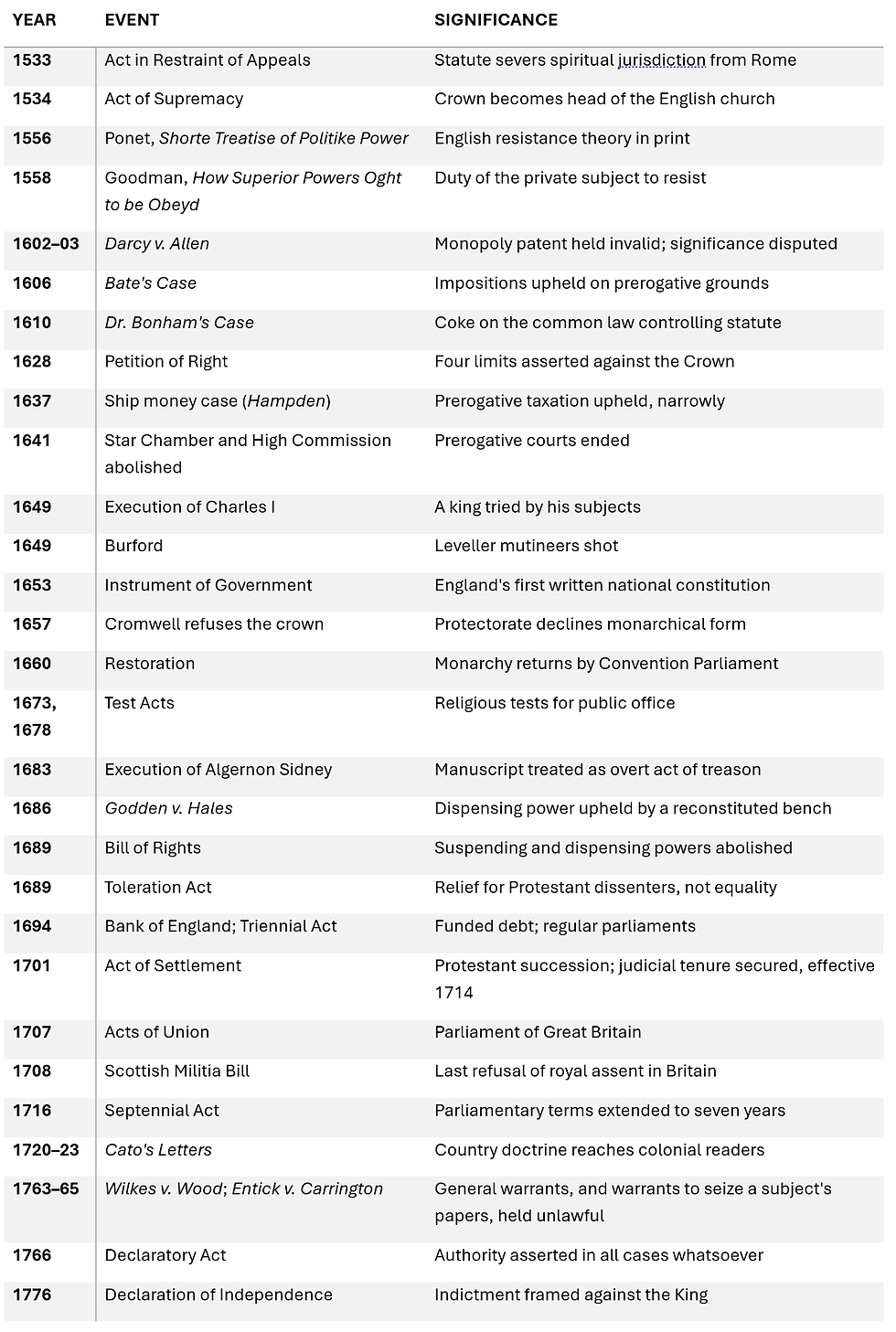
Endnotes
Charles II’s reign is dated here from the Restoration in 1660. Legally it ran from 30 January 1649, which is why Restoration statutes are cited as 12 Car. II and following. Readers consulting the statutory citations should not take them for misnumbering.
Act in Restraint of Appeals, 24 Hen. VIII c. 12 (1533). The preamble’s declaration that the realm is an empire is the operative constitutional claim.
John Ponet, A Shorte Treatise of Politike Power, and of the True Obedience which Subiectes Owe to Kynges and Other Ciuile Gouernours (Strasbourg, 1556). On its argument for deposition and tyrannicide, see the entry on Ponet in the Encyclopedia of Renaissance Philosophy (Springer).
Christopher Goodman, How Superior Powers Oght to be Obeyd of Their Subjects: And Wherin They May Lawfully by Gods Worde be Disobeyed and Resisted (Geneva, 1558).
The 1642 English reprint of Ponet is documented in the Folger and Thomason records. The Short Title Catalogue records a further edition before 1640, omitting the exhortation; the frequently cited year of 1639 is consistent with that record but was not confirmed in any catalogue entry examined, and is therefore not asserted here.
Darcy v. Allein (1602–03), 11 Co. Rep. 84b, 77 Eng. Rep. 1260. On Coke’s appearance for the plaintiff as Attorney-General, see Fisher, “The Case that Launched a Thousand Writs” (UCL).
The argument that Coke’s report — published in 1615, well after the judgment — reshaped the case for later constitutional use is developed by Corré, by Fisher in the study cited above, and by Anton Howes. This companion presents the dispute rather than resolving it.
James VI and I, The Trew Law of Free Monarchies (Edinburgh, 1598); Basilikon Doron (1599).
Case of Ship-Money (1637), 3 State Tr. 825. The division among the judges is conventionally given as seven to five for the Crown; the figure is not restated in the body text pending independent verification.
The figure of approximately two thousand ministers ejected under the Act of Uniformity of 1662 is the standard estimate and is offered as such rather than as an exact count.
Counts vary with the boundary drawn. The Catholic Encyclopedia gives sixteen executed in direct connection with the plot and eight more brought to the scaffold as priests in the ensuing persecution. The common modern figure is at least twenty-two; some accounts, including Victor Stater’s, put the number above thirty.
Estimates for the Bloody Assizes of 1685 vary; several hundred executions and a larger number of transportations is the standard range rather than a settled figure.
Godden v. Hales (1686), 11 St. Tr. 1165. Arthur Godden was Hales’s servant, described in some accounts as his coachman. The collusive character of the action, brought for the statutory informer’s reward, is undisputed.
Dennis Dixon, “Godden v Hales Revisited — James II and the Dispensing Power,” Journal of Legal History 27, no. 2 (2006): 129–152, surveying Carolyn Edie and subsequent scholarship. Dixon reports that most modern historians regard the decision as correct or at least defensible on the precedents, while contemporaries regarded it as wholly wrong. Dixon himself concludes against that trend, holding that the decision was wrong and that the charges laid against James in the Declaration of Right were justified. Edie’s own treatment is a separate study, “Revolution and the Rule of Law: The End of the Dispensing Power, 1689,” Eighteenth-Century Studies 10 (1977).
Bill of Rights, 1 Will. & Mar. sess. 2 c. 2 (1689).
Act of Settlement, 12 & 13 Will. III c. 2 (1701), art. 7, providing that judges’ commissions be made quamdiu se bene gesserint with salaries ascertained, removable upon the address of both Houses. The clause operated only from the Hanoverian succession: Anne removed two judges after her accession, and George I removed three in 1714.
On the repeal in 1716 of the provision restricting the monarch’s departure from the realm, sought by George I as Elector of Hanover, see the legislative history of the Act of Settlement.
The thesis that the Union was secured by bribery is associated with P. W. J. Riley and is contested by Christopher Whatley and others, who treat the Equivalent principally as compensation for Darien losses and arrears of Scottish public salaries.
Scottish Militia Bill 1708; assent withheld 11 March 1708. See UK Parliament, “Key Dates 1689–1714.”
Declaration of Independence (1776), charges concerning assent to laws and instructions to governors. On the continuation of colonial denial of assent after 1708, see the discussion accompanying the Scottish Militia Bill.
The Jacobite army of 1745 reached a peak strength estimated at nine to fourteen thousand, with roughly 5,500 invading England. Mar’s mobilization in 1715 was larger, and is generally treated as the widest support the Jacobite cause ever attracted.
Estimates of the English electorate in 1715 run to roughly a fifth to a quarter of adult males, declining as a proportion across the century as population grew and franchise qualifications did not.
John Trenchard and Thomas Gordon, Cato’s Letters, 4 vols. (London, 1720–23), especially Letter 15 on freedom of speech.
The claim originates with Clinton Rossiter and Bernard Bailyn. It is qualified by Donald Lutz’s 1984 study of 916 American political writings from 1760 to 1805, which ranks Montesquieu, Blackstone, Locke, and Hume above Trenchard and Gordon among individually cited authors. Bailyn’s reading holds up best when narrowed to the pamphlet literature of the 1760s and early 1770s.
Entick v. Carrington (1765), 19 Howell’s State Trials 1029. The Halifax warrant named Entick. Howell’s notes that every issue argued in the preceding Wilkes case was argued again in Entick except the question of general warrants, which belongs to Wilkes v. Wood, Huckle v. Money, and Money v. Leach.
Companion to Self-Evident: The Road to 1776. Consequential Actions.



Comments